mirror of
https://github.com/huggingface/lerobot.git
synced 2026-05-11 14:49:43 +00:00
 Pepijn
919184d6f8
Pepijn
919184d6f8
* docs(benchmarks): add benchmark integration guide and standardize benchmark docs

Add a comprehensive guide for adding new benchmarks to LeRobot, and
refactor the existing LIBERO and Meta-World docs to follow the new
standardized template.

Made-with: Cursor

* refactor(envs): move dispatch logic from factory into EnvConfig subclasses

Replace hardcoded if/elif chains in factory.py with create_envs() and
get_env_processors() methods on EnvConfig. New benchmarks now only need
to register a config subclass — no factory.py edits required.

Net -23 lines: factory.py shrinks from ~200 to ~70 lines of logic.

Made-with: Cursor

* docs(benchmarks): clean up adding-benchmarks guide for clarity

Rewrite for simpler language, better structure, and easier navigation.
Move quick-reference table to the top, fold eval explanation into
architecture section, condense the doc template to a bulleted outline.

Made-with: Cursor

* fix link

* fix task count

* fix: enable SmolVLA eval on LIBERO with custom camera mappings

- Thread camera_name_mapping from LiberoEnv config through to gym envs
- Sync features_map with camera_name_mapping in LiberoEnv.__post_init__
- Fix render() to use first available camera instead of hardcoded "image"
- Handle non-dict final_info in rollout by falling back to info["is_success"]
- Add use_peft legacy field to SmolVLAConfig for checkpoint compat
- Add defaults to GR00TN15Config init=False fields for transformers 5.3

Made-with: Cursor

* fix: use direct AutoresetMode import for gymnasium compat

Made-with: Cursor

* fix: handle gymnasium < 1.0 without AutoresetMode

Made-with: Cursor

* refactor: revert policy changes, keep env-only camera mapping fixes

- Revert GR00T N1.5 default_factory/default changes (transformers compat)
- Revert SmolVLA use_peft legacy field
- Apply ruff formatting fixes
- camera_name_mapping stays entirely in env/eval layer (no policy changes)

Made-with: Cursor

* Update docs/source/env_processor.mdx

Co-authored-by: Khalil Meftah <khalil.meftah@huggingface.co>
Signed-off-by: Pepijn <138571049+pkooij@users.noreply.github.com>

* feat(envs): lazy env init + AsyncVectorEnv as default for n_envs > 1

LiberoEnv and MetaworldEnv previously allocated GPU resources (EGL context,
OpenGL framebuffer) in __init__, before AsyncVectorEnv's fork(). Worker
processes inherited stale GPU handles, causing EGL_BAD_CONTEXT crashes on
first render.

Fix: defer OffScreenRenderEnv / MT1 construction to _ensure_env(), called on
first reset() or step() inside the worker subprocess. Each worker creates its
own clean context after fork().

Also fixes lerobot_eval.py:170 (add_envs_task TODO): replace with
env.call("task") which works with both SyncVectorEnv and AsyncVectorEnv.

AsyncVectorEnv is now the default for n_envs > 1; auto-downgraded to
SyncVectorEnv when n_envs=1 (no benefit, less overhead).

Expected speedup: ~15-20x for LIBERO Spatial with batch_size=50.

Co-Authored-By: Claude Sonnet 4.6 <noreply@anthropic.com>

* fix: close envs between tasks to prevent worker process accumulation

eval_policy_all never closed environments after each task completed,
causing AsyncVectorEnv worker processes to accumulate (N_tasks × n_envs).
This led to OOM, BrokenPipeError and EOFError on multi-task benchmarks.

Also fixes:
- AsyncVectorEnv compat in envs/utils.py (use get_attr/call instead of .envs)
- Tuple task handling in tokenizer_processor and lerobot_eval
- _LazyAsyncVectorEnv for deferred worker spawning in LIBERO

Made-with: Cursor

* fix(eval): use task_description instead of task for language conditioning

env.call("task") returns the LIBERO task name with underscores
(e.g. "pick_up_the_black_bowl_...") instead of the natural language
description ("pick up the black bowl ..."). The VLM tokenizes these
completely differently, causing 0.0 reward across all episodes.

Made-with: Cursor

* docs: update adding_benchmarks for async env changes

- Replace add_envs_task reference with env.call("task_description")
- Update use_async_envs default to True
- Add note about lazy GPU init for AsyncVectorEnv compatibility

Made-with: Cursor

* feat(eval): batch_size=auto + faster env loading

- batch_size=0 (default) auto-tunes based on CPU cores, capped by
  n_episodes and 64. Removes the need for users to guess the right
  value. The old batch_size > n_episodes error is replaced by silently
  clamping to n_episodes.
- _LazyAsyncVectorEnv accepts pre-computed spaces so only one temp env
  is created per suite (not per task). For libero_spatial (10 tasks)
  this avoids 9 redundant LiberoEnv instantiations during env setup.

Made-with: Cursor

* docs: add evaluation guide and update benchmarks doc

- New docs/source/evaluation.mdx covering lerobot-eval usage, batch_size
  auto-tuning, AsyncVectorEnv performance, tuning tips, output format,
  multi-task evaluation, and programmatic usage.
- Add evaluation page to _toctree.yml under Benchmarks section.
- Update adding_benchmarks.mdx to reference batch_size auto default and
  link to the evaluation guide.

Made-with: Cursor

* docs(evaluation): remove benchmark table, rename section header

Made-with: Cursor

* perf(eval): shared memory, observation passthrough, task prefetch

- AsyncVectorEnv now uses shared_memory=True for zero-copy observation transfer
- LiberoEnvConfig.gym_kwargs passes observation_height/width to the env
- eval_policy_all prefetches next task's workers while current task runs

Made-with: Cursor

* style: ruff format

Made-with: Cursor

* chore: revert env_processor.mdx changes (not part of this PR)

Made-with: Cursor

* ci(benchmarks): add isolated integration tests for libero and metaworld

Each benchmark gets its own Docker image (lerobot[libero] / lerobot[metaworld]
only) so incompatible dep trees cannot collide. A 1-episode smoke eval runs
per benchmark on GPU runners.

Co-Authored-By: Claude Sonnet 4.6 <noreply@anthropic.com>

* ci(benchmarks): pin action hashes and use uv sync --locked

Co-Authored-By: Claude Sonnet 4.6 <noreply@anthropic.com>

* ci(benchmarks): trigger only on envs/ or lerobot_eval.py changes

Co-Authored-By: Claude Sonnet 4.6 <noreply@anthropic.com>

* fix(ci): set LIBERO_DATA_FOLDER to bypass interactive stdin prompt

libero/__init__.py calls input() to ask about a custom dataset path,
which raises EOFError when stdin is closed inside Docker. Setting
LIBERO_DATA_FOLDER skips the prompt entirely.

Co-Authored-By: Claude Sonnet 4.6 <noreply@anthropic.com>

* docs(benchmarks): add CI smoke test step to adding_benchmarks guide

Co-Authored-By: Claude Sonnet 4.6 <noreply@anthropic.com>

* fix(ci): pre-create libero config in Dockerfile to bypass stdin prompt

libero/__init__.py calls input() when ~/.libero/config.yaml is missing.
We write the config at image build time (without importing libero) so
the prompt never fires at runtime. Also trigger CI on pyproject.toml changes.

Co-Authored-By: Claude Sonnet 4.6 <noreply@anthropic.com>

* fix(ci): use shell to create libero config instead of multiline python -c

The multiline RUN python -c "..." was being parsed as Dockerfile
instructions. Use printf to write ~/.libero/config.yaml directly.

Co-Authored-By: Claude Sonnet 4.6 <noreply@anthropic.com>

* fix(ci): point libero config to bundled package init_files

The config was pointing to /tmp/libero_init which doesn't exist.
Use importlib.util.find_spec to locate the hf-libero package directory
and write paths to the actual bundled bddl_files/init_files/assets.

Co-Authored-By: Claude Sonnet 4.6 <noreply@anthropic.com>

* fix(ci): add smolvla extra to benchmark Dockerfiles

num2words (required by SmolVLM processor) is declared in lerobot[smolvla],
not lerobot[libero/metaworld]. Install both extras together.

Co-Authored-By: Claude Sonnet 4.6 <noreply@anthropic.com>

* fix(eval): render_frame covers _LazyAsyncVectorEnv

isinstance(env, AsyncVectorEnv) silently skipped _LazyAsyncVectorEnv,
causing video rendering to produce no frames on the default async path.
Switch to hasattr(env, "call") so any async-compatible env (including
_LazyAsyncVectorEnv) hits the call("render") branch.

Co-Authored-By: Claude Sonnet 4.6 <noreply@anthropic.com>

* refactor(envs): remove unused _get_sub_env_attr helper

_get_sub_env_attr was defined but never called anywhere in the codebase.
_sub_env_has_attr (its sibling) is kept — it is actively used in utils.py.

Co-Authored-By: Claude Sonnet 4.6 <noreply@anthropic.com>

* chore: apply prettier formatting to docs

Co-Authored-By: Claude Sonnet 4.6 <noreply@anthropic.com>

* docs(env_processor): remove deprecated add_envs_task from pipeline example

add_envs_task is replaced by env.call("task_description") in this PR.
Remove it from the pipeline walkthrough and renumber the steps (8→7).

Co-Authored-By: Claude Sonnet 4.6 <noreply@anthropic.com>

* refactor(envs): remove __del__ from _LazyAsyncVectorEnv

__del__ is unreliable as a cleanup mechanism. close() is already called
explicitly in the eval loop's finally block, so the finalizer is redundant.

Co-Authored-By: Claude Sonnet 4.6 <noreply@anthropic.com>

* fix(eval): prefetch next task's workers after close to avoid GPU memory overlap

Previously, next task's AsyncVectorEnv workers were spawned while the
current task was still running, causing both tasks' GPU contexts to coexist.
Moving the prefetch start into the finally block (after env.close()) ensures
workers for task N+1 only spin up once task N has released GPU memory.

Co-Authored-By: Claude Sonnet 4.6 <noreply@anthropic.com>

* refactor(envs): move _LazyAsyncVectorEnv to utils and apply to metaworld

_LazyAsyncVectorEnv lived in libero.py but metaworld had the same OOM
problem: all tasks' AsyncVectorEnv workers were spawned eagerly, wasting
GPU memory for tasks not yet running.

Move the class to envs/utils.py so both environments share it, then apply
the same is_async + lazy wrapping pattern in create_metaworld_envs.

Co-Authored-By: Claude Sonnet 4.6 <noreply@anthropic.com>

* chore: remove out-of-scope benchmark/CI/docs files from PR

Benchmark CI workflow, Dockerfiles, benchmark docs, evaluation smoke-test
doc, and dispatch tests belong in a separate PR. Scope this PR to the
async env init changes only.

Co-Authored-By: Claude Sonnet 4.6 <noreply@anthropic.com>

* chore: restore adding_benchmarks + test_dispatch, drop env_processor changes

- Restore docs/source/adding_benchmarks.mdx (belongs in this PR)
- Restore tests/envs/test_dispatch.py (belongs in this PR)
- Revert docs/source/env_processor.mdx to main (out of scope for this PR)

Co-Authored-By: Claude Sonnet 4.6 <noreply@anthropic.com>

* docs(adding_benchmarks): remove CI smoke test step (coming in separate PR)

Step 7 (Dockerfile + benchmark_tests.yml CI job) and its table rows are
out of scope for this PR. The CI infrastructure will be added on top in a
follow-up PR.

Co-Authored-By: Claude Sonnet 4.6 <noreply@anthropic.com>

* refactor(envs): remove unused add_envs_task

Replaced by env.call("task_description") in lerobot_eval.py. No callers
remain in the codebase.

Co-Authored-By: Claude Sonnet 4.6 <noreply@anthropic.com>

* style: fix prettier formatting in env_processor.mdx

Co-Authored-By: Claude Sonnet 4.6 <noreply@anthropic.com>

* fix(eval): catch AttributeError and NotImplementedError explicitly for task description

Co-Authored-By: Claude Sonnet 4.6 <noreply@anthropic.com>

* fix(envs): use forkserver context and close envs in test to prevent deadlock

AsyncVectorEnv with default fork context leaks worker processes between
test_policy parametrized cases; subsequent env creation deadlocks because
new forked workers inherit stale pipe FDs from previous test's leaked workers.

- configs.py: pass context="forkserver" to AsyncVectorEnv (matches _LazyAsyncVectorEnv)
- test_policies.py: call close_envs(envs) at end of test_policy to clean up workers

Co-Authored-By: Claude Sonnet 4.6 <noreply@anthropic.com>

* fix(envs): default use_async_envs=False in create_envs and make_env

Tests that call make_env(n_envs=2) without passing use_async_envs were
getting AsyncVectorEnv, whose forked workers can't resolve gym namespaces
registered at runtime. Default to False (sync) so existing tests pass.

lerobot_eval.py explicitly passes cfg.eval.use_async_envs, so the CLI
async behaviour (controlled by EvalConfig.use_async_envs) is unchanged.

Co-Authored-By: Claude Sonnet 4.6 <noreply@anthropic.com>

---------

Signed-off-by: Pepijn <138571049+pkooij@users.noreply.github.com>
Co-authored-by: Khalil Meftah <khalil.meftah@huggingface.co>
Co-authored-by: Claude Sonnet 4.6 <noreply@anthropic.com>
131 lines
4.9 KiB
Plaintext
131 lines
4.9 KiB
Plaintext
# Meta-World
|
|
|
|
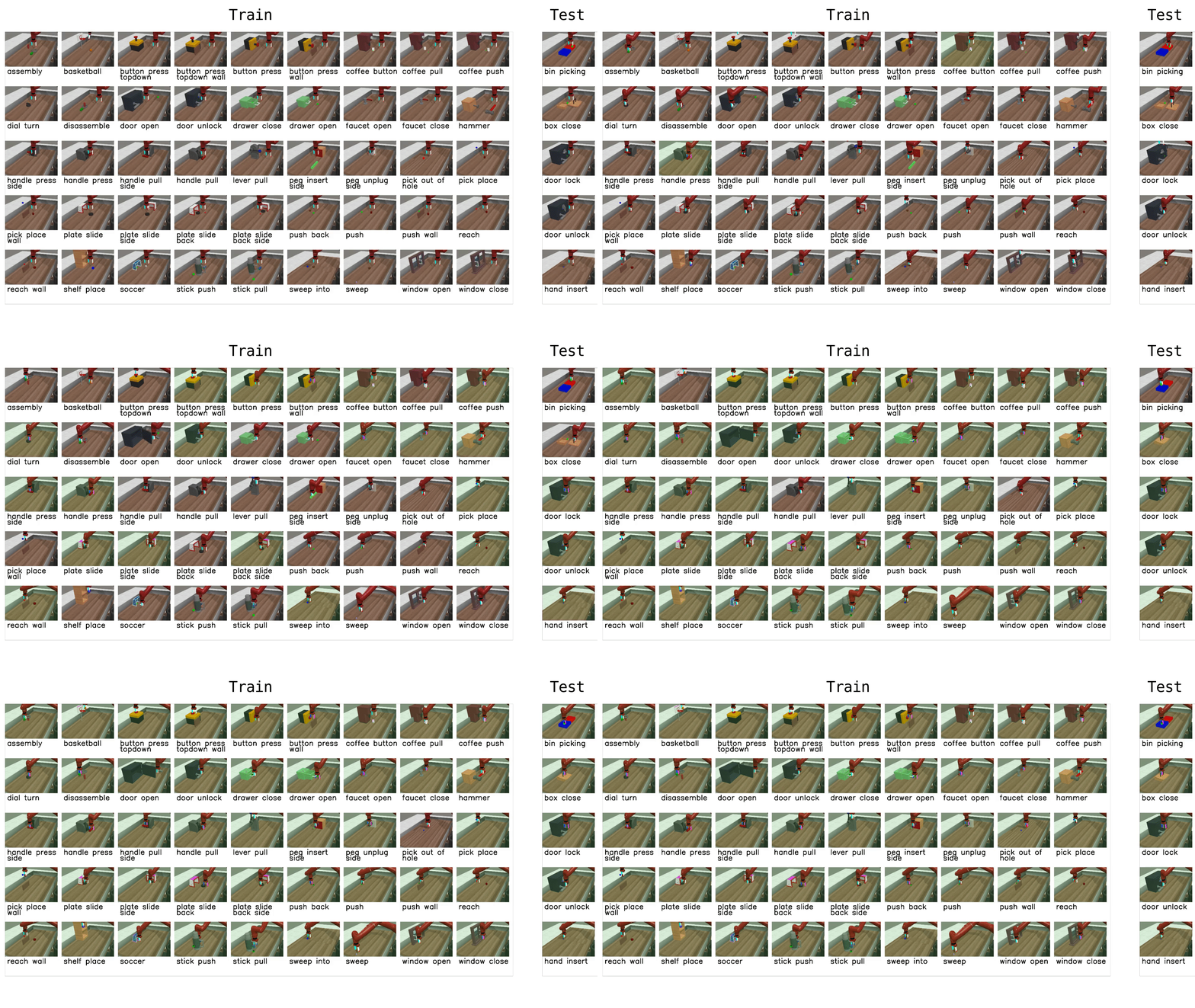
Meta-World is an open-source simulation benchmark for **multi-task and meta reinforcement learning** in continuous-control robotic manipulation. It bundles 50 diverse manipulation tasks using everyday objects and a common tabletop Sawyer arm, providing a standardized playground to test whether algorithms can learn many different tasks and generalize quickly to new ones.
|
|
|
|
- Paper: [Meta-World: A Benchmark and Evaluation for Multi-Task and Meta Reinforcement Learning paper](https://arxiv.org/abs/1910.10897)
|
|
- GitHub: [Farama-Foundation/Metaworld](https://github.com/Farama-Foundation/Metaworld)
|
|
- Project website: [metaworld.farama.org](https://metaworld.farama.org)
|
|
|
|
|
|
|
|
## Available tasks
|
|
|
|
Meta-World provides 50 tasks organized into difficulty groups. In LeRobot, you can evaluate on individual tasks, difficulty groups, or the full MT50 suite:
|
|
|
|
| Group | CLI name | Tasks | Description |
|
|
| ---------- | -------------------- | ----- | ------------------------------------------------------ |
|
|
| Easy | `easy` | 28 | Tasks with simple dynamics and single-step goals |
|
|
| Medium | `medium` | 11 | Tasks requiring multi-step reasoning |
|
|
| Hard | `hard` | 6 | Tasks with complex contacts and precise manipulation |
|
|
| Very Hard | `very_hard` | 5 | The most challenging tasks in the suite |
|
|
| MT50 (all) | Comma-separated list | 50 | All 50 tasks — the most challenging multi-task setting |
|
|
|
|
You can also pass individual task names directly (e.g., `assembly-v3`, `dial-turn-v3`).
|
|
|
|
We provide a LeRobot-ready dataset for Meta-World MT50 on the HF Hub: [lerobot/metaworld_mt50](https://huggingface.co/datasets/lerobot/metaworld_mt50). This dataset is formatted for the MT50 evaluation that uses all 50 tasks with fixed object/goal positions and one-hot task vectors for consistency.
|
|
|
|
## Installation
|
|
|
|
After following the LeRobot installation instructions:
|
|
|
|
```bash
|
|
pip install -e ".[metaworld]"
|
|
```
|
|
|
|
<Tip warning={true}>
|
|
If you encounter an `AssertionError: ['human', 'rgb_array', 'depth_array']` when running Meta-World environments, this is a mismatch between Meta-World and your Gymnasium version. Fix it with:
|
|
|
|
```bash
|
|
pip install "gymnasium==1.1.0"
|
|
```
|
|
|
|
</Tip>
|
|
|
|
## Evaluation
|
|
|
|
### Default evaluation (recommended)
|
|
|
|
Evaluate on the medium difficulty split (a good balance of coverage and compute):
|
|
|
|
```bash
|
|
lerobot-eval \
|
|
--policy.path="your-policy-id" \
|
|
--env.type=metaworld \
|
|
--env.task=medium \
|
|
--eval.batch_size=1 \
|
|
--eval.n_episodes=10
|
|
```
|
|
|
|
### Single-task evaluation
|
|
|
|
Evaluate on a specific task:
|
|
|
|
```bash
|
|
lerobot-eval \
|
|
--policy.path="your-policy-id" \
|
|
--env.type=metaworld \
|
|
--env.task=assembly-v3 \
|
|
--eval.batch_size=1 \
|
|
--eval.n_episodes=10
|
|
```
|
|
|
|
### Multi-task evaluation
|
|
|
|
Evaluate across multiple tasks or difficulty groups:
|
|
|
|
```bash
|
|
lerobot-eval \
|
|
--policy.path="your-policy-id" \
|
|
--env.type=metaworld \
|
|
--env.task=assembly-v3,dial-turn-v3,handle-press-side-v3 \
|
|
--eval.batch_size=1 \
|
|
--eval.n_episodes=10
|
|
```
|
|
|
|
- `--env.task` accepts explicit task lists (comma-separated) or difficulty groups (e.g., `easy`, `medium`, `hard`, `very_hard`).
|
|
- `--eval.batch_size` controls how many environments run in parallel.
|
|
- `--eval.n_episodes` sets how many episodes to run per task.
|
|
|
|
### Policy inputs and outputs
|
|
|
|
**Observations:**
|
|
|
|
- `observation.image` — single camera view (`corner2`), 480x480 HWC uint8
|
|
- `observation.state` — 4-dim proprioceptive state (end-effector position + gripper)
|
|
|
|
**Actions:**
|
|
|
|
- Continuous control in `Box(-1, 1, shape=(4,))` — 3D end-effector delta + 1D gripper
|
|
|
|
### Recommended evaluation episodes
|
|
|
|
For reproducible benchmarking, use **10 episodes per task**. For the full MT50 suite this gives 500 total episodes. If you care about generalization, run on the full MT50 — it is intentionally challenging and reveals strengths/weaknesses better than a few narrow tasks.
|
|
|
|
## Training
|
|
|
|
### Example training command
|
|
|
|
Train a SmolVLA policy on a subset of Meta-World tasks:
|
|
|
|
```bash
|
|
lerobot-train \
|
|
--policy.type=smolvla \
|
|
--policy.repo_id=${HF_USER}/metaworld-test \
|
|
--policy.load_vlm_weights=true \
|
|
--dataset.repo_id=lerobot/metaworld_mt50 \
|
|
--env.type=metaworld \
|
|
--env.task=assembly-v3,dial-turn-v3,handle-press-side-v3 \
|
|
--output_dir=./outputs/ \
|
|
--steps=100000 \
|
|
--batch_size=4 \
|
|
--eval.batch_size=1 \
|
|
--eval.n_episodes=1 \
|
|
--eval_freq=1000
|
|
```
|
|
|
|
## Practical tips
|
|
|
|
- Use the one-hot task conditioning for multi-task training (MT10/MT50 conventions) so policies have explicit task context.
|
|
- Inspect the dataset task descriptions and the `info["is_success"]` keys when writing post-processing or logging so your success metrics line up with the benchmark.
|
|
- Adjust `batch_size`, `steps`, and `eval_freq` to match your compute budget.
|