mirror of
https://github.com/huggingface/lerobot.git
synced 2026-07-29 12:39:41 +00:00
Compare commits
161 Commits
| Author | SHA1 | Date | |
|---|---|---|---|
 Pepijn Pepijn
|
7788db7838 | ||
|
Pepijn
|
d883c78a94 | ||
|
Pepijn
|
de42da8225 | ||
|
Pepijn
|
d0d714be47 | ||
|
Pepijn
|
7d9b469eee | ||
|
Pepijn
|
6db39cad58 | ||
|
Pepijn
|
af0676f99e | ||
|
Pepijn
|
b9df1a4ac5 | ||
|
Pepijn
|
5361346bec | ||
|
Pepijn
|
f0b969ae48 | ||
|
Pepijn
|
a9d54cbddb | ||
|
Pepijn
|
c5a029a28a | ||
|
Pepijn
|
c8163662ad | ||
|
Pepijn
|
376cc772ff | ||
|
Pepijn
|
d1eefd4e97 | ||
|
Pepijn
|
7a03223693 | ||
|
Pepijn
|
f840d2e006 | ||
|
Pepijn
|
e94844fa59 | ||
|
Pepijn
|
990f8e9cc9 | ||
|
Pepijn
|
6ce2a00135 | ||
|
Pepijn
|
bf90efa7e1 | ||
|
Pepijn
|
5b4ac3068e | ||
|
Pepijn
|
dbe3406a69 | ||
|
Pepijn
|
1785767e61 | ||
|
Pepijn
|
afd833f49e | ||
|
Pepijn
|
2234b851c0 | ||
|
Pepijn
|
e4a214d890 | ||
|
Pepijn
|
e8438aac59 | ||
|
pre-commit-ci[bot]
|
8fe977118b | ||
|
Jade Choghari
|
d09b2a28af | ||
|
pre-commit-ci[bot]
|
f2530570e0 | ||
|
Jade Choghari
|
8567ab60d8 | ||
|
pre-commit-ci[bot]
|
9784123463 | ||
|
Jade Choghari
|
4c2add41d7 | ||
|
pre-commit-ci[bot]
|
a19d7fb6bf | ||
|
Jade Choghari
|
565c992589 | ||
|
Jade Choghari
|
96cc634a66 | ||
|
Pepijn
|
b044f3104b | ||
|
Pepijn
|
384ec52ec7 | ||
|
Pepijn
|
8d1434c069 | ||
|
Pepijn
|
f613a37cd2 | ||
|
Pepijn
|
494aa576b2 | ||
|
Pepijn
|
514625a7f6 | ||
|
Pepijn
|
9f7bfeb419 | ||
|
Jade Choghari
|
aa40c8c813 | ||
|
Pepijn
|
d36bdac114 | ||
|
Pepijn
|
ff1666b216 | ||
|
Pepijn
|
c57d3a9688 | ||
|
Pepijn
|
9ae11a087d | ||
|
Pepijn
|
21e63b505f | ||
|
Pepijn
|
e9e7eb827a | ||
|
Pepijn
|
ac323b0113 | ||
|
Pepijn
|
b028907d21 | ||
|
Pepijn
|
2eafcc7ca1 | ||
|
Pepijn
|
b3b57a8288 | ||
|
Pepijn
|
eaaf1c1766 | ||
|
Pepijn
|
3bc3bf0391 | ||
|
Pepijn
|
8c5fe10d6c | ||
|
Pepijn
|
8178a06b90 | ||
|
Pepijn
|
9ea8bd029c | ||
|
Pepijn
|
bd5c264c49 | ||
|
Jade Choghari
|
5c628f1700 | ||
|
Steven Palma
|
d602e8169c | ||
|
Steven Gong
|
49baccdccb | ||
|
Jade Choghari
|
9beafe0c19 | ||
|
Jade Choghari
|
27c9db60a6 | ||
|
Jade Choghari
|
fda5fb5e94 | ||
|
Jade Choghari
|
5f5438d6fa | ||
|
pre-commit-ci[bot]
|
2b779cd6c6 | ||
|
Jade Choghari
|
3886af42a5 | ||
|
pre-commit-ci[bot]
|
38f7229078 | ||
|
Jade
|
504421949c | ||
|
pre-commit-ci[bot]
|
28b9efc04f | ||
|
Jade Choghari
|
abba423e28 | ||
|
Jade Choghari
|
47a81c4150 | ||
|
Gaëlle Lannuzel
|
6a3d57031a | ||
|
Justin Huang
|
d74494d92b | ||
|
Jade Choghari
|
1ba896598e | ||
|
Jade Choghari
|
61e55830da | ||
|
Jade Choghari
|
b7522da85d | ||
|
pre-commit-ci[bot]
|
98dc053e6d | ||
|
Jade Choghari
|
bbff93d20d | ||
|
Jade Choghari
|
32c1649085 | ||
|
Jade Choghari
|
eb564f8ddb | ||
|
Jade Choghari
|
a2958a8e0c | ||
|
Jade Choghari
|
8f1679f309 | ||
|
pre-commit-ci[bot]
|
b1473f11c8 | ||
|
Jade Choghari
|
7b556079d8 | ||
|
pre-commit-ci[bot]
|
e91a773b93 | ||
|
Jade Choghari
|
a9bd67eae9 | ||
|
Jade Choghari
|
4a4ac759ec | ||
|
pre-commit-ci[bot]
|
7dd8e015f8 | ||
|
Jade Choghari
|
af2960c33e | ||
|
Jade Choghari
|
a36e4619ad | ||
|
pre-commit-ci[bot]
|
b397a757bb | ||
|
Jade Choghari (jchoghar)
|
92adf2218f | ||
|
Jade Choghari
|
f3614dd812 | ||
|
Jade Choghari
|
b23b7a5bd7 | ||
|
Pepijn
|
882c80d446 | ||
|
Jade Choghari
|
6ff5f318b2 | ||
|
pre-commit-ci[bot]
|
2eae751977 | ||
|
Jade Choghari
|
894878039d | ||
|
Jade Choghari
|
ab72471dda | ||
|
pre-commit-ci[bot]
|
23849e0cb8 | ||
|
Jade Choghari
|
cb18fc07ef | ||
|
Jade Choghari
|
440e22c184 | ||
|
Jade Choghari
|
28b69bf8ba | ||
|
Jade Choghari
|
b997fdde96 | ||
|
Jade Choghari
|
6f975cf576 | ||
|
Jade Choghari
|
2688731064 | ||
|
Pepijn
|
61b0eeae4b | ||
|
Jade Choghari (jchoghar)
|
fe20437b62 | ||
|
Jade Choghari (jchoghar)
|
ff861ba869 | ||
|
mgiac-hexagon
|
577cd10974 | ||
|
pre-commit-ci[bot]
|
4be3942cbc | ||
|
Jade Choghari
|
fd5afdfbf0 | ||
|
Jade Choghari (jchoghar)
|
8d2c66abd2 | ||
|
lxk
|
b0923ab74b | ||
|
Jack Vial
|
7f70b78f32 | ||
|
Jade Choghari
|
afad90ffaa | ||
|
pre-commit-ci[bot]
|
f5091448a8 | ||
|
Jade Choghari (jchoghar)
|
cc46497f4c | ||
|
pre-commit-ci[bot]
|
5d25f5bd40 | ||
|
Jade Choghari (jchoghar)
|
ce83752f16 | ||
|
pre-commit-ci[bot]
|
4ed6cf159d | ||
|
Jade Choghari (jchoghar)
|
7626d26e6a | ||
|
pre-commit-ci[bot]
|
14a59f576b | ||
|
Jade Choghari (jchoghar)
|
eb3649292b | ||
|
Jade Choghari (jchoghar)
|
ac0993c2e3 | ||
|
Steven Palma
|
55198de096 | ||
|
pre-commit-ci[bot]
|
c20bf75ba0 | ||
|
Jade Choghari
|
a25480d363 | ||
|
Jade Choghari
|
4c19a71d7c | ||
|
Steven Palma
|
0878c6880f | ||
|
Jade Choghari
|
d2684d41cd | ||
|
Jade Choghari
|
4e76c1f88c | ||
|
Caroline Pascal
|
11e6bd762a | ||
|
Steven Palma
|
ce3b9f627e | ||
|
Steven Palma
|
c66cd40176 | ||
|
Steven Palma
|
b883328e6c | ||
|
Steven Palma
|
49ecbeb33f | ||
|
Adil Zouitine
|
88f7bf01c1 | ||
|
Steven Palma
|
6daa579ce1 | ||
|
pre-commit-ci[bot]
|
3bf0c19be7 | ||
|
Jade Choghari
|
ad4f510262 | ||
|
pre-commit-ci[bot]
|
9124b36b0a | ||
|
Jade Choghari
|
4bc356b7f3 | ||
|
Jade Choghari
|
21a961ecbb | ||
|
Caroline Pascal
|
06bebd97b3 | ||
|
HUANG TZU-CHUN
|
e0096feb6a | ||
|
Francesco Capuano
|
90d3a99aa1 | ||
|
Steven Palma
|
8c577525c1 | ||
|
Steven Palma
|
f771e3eaf1 | ||
|
Steven Palma
|
240a3892ae | ||
|
Steven Palma
|
3e24ecaf54 | ||
|
Steven Palma
|
60dc8e3a5d | ||
|
Steven Palma
|
dcb305ffb2 | ||
|
Steven Palma
|
11525cedeb | ||
|
Simon Alibert
|
2f8d98b05e | ||
|
Steven Palma
|
1baaa77a86 | ||
|
Steven Palma
|
91ed6097bc |
@@ -30,7 +30,7 @@ pytest -sx tests/test_stuff.py::test_something
|
||||
```
|
||||
|
||||
```bash
|
||||
python -m lerobot.scripts.train --some.option=true
|
||||
lerobot-train --some.option=true
|
||||
```
|
||||
|
||||
## SECTION TO REMOVE BEFORE SUBMITTING YOUR PR
|
||||
|
||||
@@ -29,8 +29,8 @@ on:
|
||||
env:
|
||||
UV_VERSION: "0.8.0"
|
||||
PYTHON_VERSION: "3.10"
|
||||
DOCKER_IMAGE_NAME_CPU: huggingface/lerobot-gpu:latest
|
||||
DOCKER_IMAGE_NAME_GPU: huggingface/lerobot-cpu:latest
|
||||
DOCKER_IMAGE_NAME_CPU: huggingface/lerobot-cpu:latest
|
||||
DOCKER_IMAGE_NAME_GPU: huggingface/lerobot-gpu:latest
|
||||
|
||||
# Ensures that only the latest commit is built, canceling older runs.
|
||||
concurrency:
|
||||
|
||||
@@ -19,6 +19,11 @@ on:
|
||||
tags:
|
||||
- 'v*.*.*' # Trigger on tags like v0.1.0, v1.0.0
|
||||
|
||||
# Sets up the environment variables
|
||||
env:
|
||||
UV_VERSION: "0.8.0"
|
||||
PYTHON_VERSION: "3.10"
|
||||
|
||||
jobs:
|
||||
# This job builds the Python package and publishes it to PyPI
|
||||
build-and-publish:
|
||||
@@ -50,6 +55,7 @@ jobs:
|
||||
VERSION_NUMBER=${VERSION#v}
|
||||
echo "tag_version=$VERSION_NUMBER" >> $GITHUB_OUTPUT
|
||||
- name: Check if version matches pyproject.toml
|
||||
if: startsWith(github.ref, 'refs/tags/v') && !contains(github.ref, '-')
|
||||
# zizmor: ignore[template-injection]
|
||||
run: |
|
||||
TAG_VERSION=${{ steps.extract_info.outputs.tag_version }}
|
||||
@@ -86,13 +92,29 @@ jobs:
|
||||
env:
|
||||
GITHUB_TOKEN: ${{ secrets.GITHUB_TOKEN }}
|
||||
# zizmor: ignore[template-injection]
|
||||
run: gh release create ${{ github.ref_name }} --release-name "Release ${{ github.ref_name }}" --generate-notes ./dist/*
|
||||
run: |
|
||||
gh release create ${{ github.ref_name }} \
|
||||
--title "Release ${{ github.ref_name }}" \
|
||||
--generate-notes \
|
||||
--draft=$([[ "${{ github.ref_name }}" == *-* ]] && echo true || echo false) \
|
||||
--prerelease=$([[ "${{ github.ref_name }}" == *-* ]] && echo true || echo false) \
|
||||
./dist/*
|
||||
|
||||
- name: Publish to PyPI
|
||||
if: startsWith(github.ref, 'refs/tags/v')
|
||||
- name: Publish to TestPyPI for pre-releases
|
||||
# True for tags like 'v0.2.0-rc1'
|
||||
if: startsWith(github.ref, 'refs/tags/v') && contains(github.ref, '-')
|
||||
uses: pypa/gh-action-pypi-publish@v1.12.4 # zizmor: ignore[unpinned-uses, use-trusted-publishing]
|
||||
with:
|
||||
password: ${{ secrets.PYPI_API_TOKEN }}
|
||||
repository-url: https://test.pypi.org/legacy/
|
||||
verbose: true
|
||||
print-hash: true
|
||||
|
||||
- name: Publish to PyPI
|
||||
if: startsWith(github.ref, 'refs/tags/v') && !contains(github.ref, '-')
|
||||
uses: pypa/gh-action-pypi-publish@v1.12.4 # zizmor: ignore[unpinned-uses, use-trusted-publishing]
|
||||
with:
|
||||
verbose: true
|
||||
print-hash: true
|
||||
|
||||
# This job runs end-to-end tests on the release
|
||||
test-release:
|
||||
@@ -119,15 +141,31 @@ jobs:
|
||||
enable-cache: true
|
||||
version: ${{ env.UV_VERSION }}
|
||||
python-version: ${{ env.PYTHON_VERSION }}
|
||||
- name: Create uv virtual environment
|
||||
run: uv venv
|
||||
- name: Install lerobot release
|
||||
run: uv run pip install lerobot==${{ needs.build-and-publish.outputs.version }} # zizmor: ignore[template-injection]
|
||||
|
||||
# zizmor: ignore[template-injection]
|
||||
run: |
|
||||
VERSION="${{ needs.build-and-publish.outputs.version }}"
|
||||
if [[ "$VERSION" == *-* ]]; then
|
||||
BASE_VERSION="${VERSION%%-*}"
|
||||
echo "Installing pre-release version $BASE_VERSION from TestPyPI..."
|
||||
uv pip install \
|
||||
--index-url https://test.pypi.org/simple/ \
|
||||
--extra-index-url https://pypi.org/simple \
|
||||
--index-strategy unsafe-best-match \
|
||||
"lerobot[all]==$BASE_VERSION"
|
||||
else
|
||||
echo "Installing release version $VERSION from PyPI..."
|
||||
uv pip install "lerobot[all]==$VERSION"
|
||||
fi
|
||||
- name: Check lerobot version
|
||||
run: uv run lerobot --version
|
||||
run: uv run python -c "import lerobot; print(lerobot.__version__)"
|
||||
|
||||
- name: Run end-to-end tests
|
||||
run: uv run make test-end-to-end
|
||||
|
||||
|
||||
# TODO(Steven): Publish draft/pre-release and to test pypi
|
||||
# TODO(Steven): Publish draft/pre-release and to test pypi weekly
|
||||
# TODO(Steven): Separate build and publish job
|
||||
# TODO(Steven): Tag documentation with the same version as the package
|
||||
|
||||
@@ -44,7 +44,7 @@ test-end-to-end:
|
||||
${MAKE} DEVICE=$(DEVICE) test-smolvla-ete-eval
|
||||
|
||||
test-act-ete-train:
|
||||
python -m lerobot.scripts.train \
|
||||
lerobot-train \
|
||||
--policy.type=act \
|
||||
--policy.dim_model=64 \
|
||||
--policy.n_action_steps=20 \
|
||||
@@ -68,12 +68,12 @@ test-act-ete-train:
|
||||
--output_dir=tests/outputs/act/
|
||||
|
||||
test-act-ete-train-resume:
|
||||
python -m lerobot.scripts.train \
|
||||
lerobot-train \
|
||||
--config_path=tests/outputs/act/checkpoints/000002/pretrained_model/train_config.json \
|
||||
--resume=true
|
||||
|
||||
test-act-ete-eval:
|
||||
python -m lerobot.scripts.eval \
|
||||
lerobot-eval \
|
||||
--policy.path=tests/outputs/act/checkpoints/000004/pretrained_model \
|
||||
--policy.device=$(DEVICE) \
|
||||
--env.type=aloha \
|
||||
@@ -82,7 +82,7 @@ test-act-ete-eval:
|
||||
--eval.batch_size=1
|
||||
|
||||
test-diffusion-ete-train:
|
||||
python -m lerobot.scripts.train \
|
||||
lerobot-train \
|
||||
--policy.type=diffusion \
|
||||
--policy.down_dims='[64,128,256]' \
|
||||
--policy.diffusion_step_embed_dim=32 \
|
||||
@@ -106,7 +106,7 @@ test-diffusion-ete-train:
|
||||
--output_dir=tests/outputs/diffusion/
|
||||
|
||||
test-diffusion-ete-eval:
|
||||
python -m lerobot.scripts.eval \
|
||||
lerobot-eval \
|
||||
--policy.path=tests/outputs/diffusion/checkpoints/000002/pretrained_model \
|
||||
--policy.device=$(DEVICE) \
|
||||
--env.type=pusht \
|
||||
@@ -115,7 +115,7 @@ test-diffusion-ete-eval:
|
||||
--eval.batch_size=1
|
||||
|
||||
test-tdmpc-ete-train:
|
||||
python -m lerobot.scripts.train \
|
||||
lerobot-train \
|
||||
--policy.type=tdmpc \
|
||||
--policy.device=$(DEVICE) \
|
||||
--policy.push_to_hub=false \
|
||||
@@ -137,7 +137,7 @@ test-tdmpc-ete-train:
|
||||
--output_dir=tests/outputs/tdmpc/
|
||||
|
||||
test-tdmpc-ete-eval:
|
||||
python -m lerobot.scripts.eval \
|
||||
lerobot-eval \
|
||||
--policy.path=tests/outputs/tdmpc/checkpoints/000002/pretrained_model \
|
||||
--policy.device=$(DEVICE) \
|
||||
--env.type=xarm \
|
||||
@@ -148,7 +148,7 @@ test-tdmpc-ete-eval:
|
||||
|
||||
|
||||
test-smolvla-ete-train:
|
||||
python -m lerobot.scripts.train \
|
||||
lerobot-train \
|
||||
--policy.type=smolvla \
|
||||
--policy.n_action_steps=20 \
|
||||
--policy.chunk_size=20 \
|
||||
@@ -171,7 +171,7 @@ test-smolvla-ete-train:
|
||||
--output_dir=tests/outputs/smolvla/
|
||||
|
||||
test-smolvla-ete-eval:
|
||||
python -m lerobot.scripts.eval \
|
||||
lerobot-eval \
|
||||
--policy.path=tests/outputs/smolvla/checkpoints/000004/pretrained_model \
|
||||
--policy.device=$(DEVICE) \
|
||||
--env.type=aloha \
|
||||
|
||||
@@ -1,25 +1,21 @@
|
||||
<p align="center">
|
||||
<picture>
|
||||
<source media="(prefers-color-scheme: dark)" srcset="media/lerobot-logo-thumbnail.png">
|
||||
<source media="(prefers-color-scheme: light)" srcset="media/lerobot-logo-thumbnail.png">
|
||||
<img alt="LeRobot, Hugging Face Robotics Library" src="media/lerobot-logo-thumbnail.png" style="max-width: 100%;">
|
||||
</picture>
|
||||
<img alt="LeRobot, Hugging Face Robotics Library" src="https://raw.githubusercontent.com/huggingface/lerobot/main/media/lerobot-logo-thumbnail.png" width="100%">
|
||||
<br/>
|
||||
<br/>
|
||||
</p>
|
||||
|
||||
<div align="center">
|
||||
|
||||
[](https://github.com/huggingface/lerobot/actions/workflows/nightly-tests.yml?query=branch%3Amain)
|
||||
[](https://codecov.io/gh/huggingface/lerobot)
|
||||
[](https://github.com/huggingface/lerobot/actions/workflows/nightly.yml?query=branch%3Amain)
|
||||
[](https://www.python.org/downloads/)
|
||||
[](https://github.com/huggingface/lerobot/blob/main/LICENSE)
|
||||
[](https://pypi.org/project/lerobot/)
|
||||
[](https://pypi.org/project/lerobot/)
|
||||
[](https://github.com/huggingface/lerobot/tree/main/examples)
|
||||
[](https://github.com/huggingface/lerobot/blob/main/CODE_OF_CONDUCT.md)
|
||||
[](https://github.com/huggingface/lerobot/blob/main/CODE_OF_CONDUCT.md)
|
||||
[](https://discord.gg/s3KuuzsPFb)
|
||||
|
||||
<!-- [](https://codecov.io/gh/huggingface/lerobot) -->
|
||||
|
||||
</div>
|
||||
|
||||
<h2 align="center">
|
||||
@@ -29,10 +25,10 @@
|
||||
|
||||
<div align="center">
|
||||
<img
|
||||
src="media/hope_jr/hopejr.png?raw=true"
|
||||
src="https://raw.githubusercontent.com/huggingface/lerobot/main/media/hope_jr/hopejr.png"
|
||||
alt="HopeJR robot"
|
||||
title="HopeJR robot"
|
||||
style="width: 60%;"
|
||||
width="60%"
|
||||
/>
|
||||
|
||||
<p><strong>Meet HopeJR – A humanoid robot arm and hand for dexterous manipulation!</strong></p>
|
||||
@@ -51,20 +47,12 @@
|
||||
</h2>
|
||||
|
||||
<div align="center">
|
||||
<div style="display: flex; gap: 1rem; justify-content: center; align-items: center;" >
|
||||
<img
|
||||
src="media/so101/so101.webp?raw=true"
|
||||
alt="SO-101 follower arm"
|
||||
title="SO-101 follower arm"
|
||||
style="width: 40%;"
|
||||
/>
|
||||
<img
|
||||
src="media/so101/so101-leader.webp?raw=true"
|
||||
alt="SO-101 leader arm"
|
||||
title="SO-101 leader arm"
|
||||
style="width: 40%;"
|
||||
/>
|
||||
</div>
|
||||
<table>
|
||||
<tr>
|
||||
<td align="center"><img src="https://raw.githubusercontent.com/huggingface/lerobot/main/media/so101/so101.webp" alt="SO-101 follower arm" title="SO-101 follower arm" width="90%"/></td>
|
||||
<td align="center"><img src="https://raw.githubusercontent.com/huggingface/lerobot/main/media/so101/so101-leader.webp" alt="SO-101 leader arm" title="SO-101 leader arm" width="90%"/></td>
|
||||
</tr>
|
||||
</table>
|
||||
|
||||
<p><strong>Meet the updated SO100, the SO-101 – Just €114 per arm!</strong></p>
|
||||
<p>Train it in minutes with a few simple moves on your laptop.</p>
|
||||
@@ -76,7 +64,7 @@
|
||||
<p>Want to take it to the next level? Make your SO-101 mobile by building LeKiwi!</p>
|
||||
<p>Check out the <a href="https://huggingface.co/docs/lerobot/lekiwi">LeKiwi tutorial</a> and bring your robot to life on wheels.</p>
|
||||
|
||||
<img src="media/lekiwi/kiwi.webp?raw=true" alt="LeKiwi mobile robot" title="LeKiwi mobile robot" width="50%">
|
||||
<img src="https://raw.githubusercontent.com/huggingface/lerobot/main/media/lekiwi/kiwi.webp" alt="LeKiwi mobile robot" title="LeKiwi mobile robot" width="50%">
|
||||
</div>
|
||||
|
||||
<br/>
|
||||
@@ -99,9 +87,9 @@
|
||||
|
||||
<table>
|
||||
<tr>
|
||||
<td><img src="media/gym/aloha_act.gif" width="100%" alt="ACT policy on ALOHA env"/></td>
|
||||
<td><img src="media/gym/simxarm_tdmpc.gif" width="100%" alt="TDMPC policy on SimXArm env"/></td>
|
||||
<td><img src="media/gym/pusht_diffusion.gif" width="100%" alt="Diffusion policy on PushT env"/></td>
|
||||
<td><img src="https://raw.githubusercontent.com/huggingface/lerobot/main/media/gym/aloha_act.gif" width="100%" alt="ACT policy on ALOHA env"/></td>
|
||||
<td><img src="https://raw.githubusercontent.com/huggingface/lerobot/main/media/gym/simxarm_tdmpc.gif" width="100%" alt="TDMPC policy on SimXArm env"/></td>
|
||||
<td><img src="https://raw.githubusercontent.com/huggingface/lerobot/main/media/gym/pusht_diffusion.gif" width="100%" alt="Diffusion policy on PushT env"/></td>
|
||||
</tr>
|
||||
<tr>
|
||||
<td align="center">ACT policy on ALOHA env</td>
|
||||
@@ -110,23 +98,11 @@
|
||||
</tr>
|
||||
</table>
|
||||
|
||||
### Acknowledgment
|
||||
|
||||
- The LeRobot team 🤗 for building SmolVLA [Paper](https://arxiv.org/abs/2506.01844), [Blog](https://huggingface.co/blog/smolvla).
|
||||
- Thanks to Tony Zhao, Zipeng Fu and colleagues for open sourcing ACT policy, ALOHA environments and datasets. Ours are adapted from [ALOHA](https://tonyzhaozh.github.io/aloha) and [Mobile ALOHA](https://mobile-aloha.github.io).
|
||||
- Thanks to Cheng Chi, Zhenjia Xu and colleagues for open sourcing Diffusion policy, Pusht environment and datasets, as well as UMI datasets. Ours are adapted from [Diffusion Policy](https://diffusion-policy.cs.columbia.edu) and [UMI Gripper](https://umi-gripper.github.io).
|
||||
- Thanks to Nicklas Hansen, Yunhai Feng and colleagues for open sourcing TDMPC policy, Simxarm environments and datasets. Ours are adapted from [TDMPC](https://github.com/nicklashansen/tdmpc) and [FOWM](https://www.yunhaifeng.com/FOWM).
|
||||
- Thanks to Antonio Loquercio and Ashish Kumar for their early support.
|
||||
- Thanks to [Seungjae (Jay) Lee](https://sjlee.cc/), [Mahi Shafiullah](https://mahis.life/) and colleagues for open sourcing [VQ-BeT](https://sjlee.cc/vq-bet/) policy and helping us adapt the codebase to our repository. The policy is adapted from [VQ-BeT repo](https://github.com/jayLEE0301/vq_bet_official).
|
||||
|
||||
## Installation
|
||||
|
||||
Download our source code:
|
||||
LeRobot works with Python 3.10+ and PyTorch 2.2+.
|
||||
|
||||
```bash
|
||||
git clone https://github.com/huggingface/lerobot.git
|
||||
cd lerobot
|
||||
```
|
||||
### Environment Setup
|
||||
|
||||
Create a virtual environment with Python 3.10 and activate it, e.g. with [`miniconda`](https://docs.anaconda.com/free/miniconda/index.html):
|
||||
|
||||
@@ -151,7 +127,18 @@ conda install ffmpeg -c conda-forge
|
||||
>
|
||||
> - _[On Linux only]_ Install [ffmpeg build dependencies](https://trac.ffmpeg.org/wiki/CompilationGuide/Ubuntu#GettheDependencies) and [compile ffmpeg from source with libsvtav1](https://trac.ffmpeg.org/wiki/CompilationGuide/Ubuntu#libsvtav1), and make sure you use the corresponding ffmpeg binary to your install with `which ffmpeg`.
|
||||
|
||||
Install 🤗 LeRobot:
|
||||
### Install LeRobot 🤗
|
||||
|
||||
#### From Source
|
||||
|
||||
First, clone the repository and navigate into the directory:
|
||||
|
||||
```bash
|
||||
git clone https://github.com/huggingface/lerobot.git
|
||||
cd lerobot
|
||||
```
|
||||
|
||||
Then, install the library in editable mode. This is useful if you plan to contribute to the code.
|
||||
|
||||
```bash
|
||||
pip install -e .
|
||||
@@ -172,6 +159,34 @@ For instance, to install 🤗 LeRobot with aloha and pusht, use:
|
||||
pip install -e ".[aloha, pusht]"
|
||||
```
|
||||
|
||||
### Installation from PyPI
|
||||
|
||||
**Core Library:**
|
||||
Install the base package with:
|
||||
|
||||
```bash
|
||||
pip install lerobot
|
||||
```
|
||||
|
||||
_This installs only the default dependencies._
|
||||
|
||||
**Extra Features:**
|
||||
To install additional functionality, use one of the following:
|
||||
|
||||
```bash
|
||||
pip install 'lerobot[all]' # All available features
|
||||
pip install 'lerobot[aloha,pusht]' # Specific features (Aloha & Pusht)
|
||||
pip install 'lerobot[feetech]' # Feetech motor support
|
||||
```
|
||||
|
||||
_Replace `[...]` with your desired features._
|
||||
|
||||
**Available Tags:**
|
||||
For a full list of optional dependencies, see:
|
||||
https://pypi.org/project/lerobot/
|
||||
|
||||
### Weights & Biases
|
||||
|
||||
To use [Weights and Biases](https://docs.wandb.ai/quickstart) for experiment tracking, log in with
|
||||
|
||||
```bash
|
||||
@@ -182,7 +197,7 @@ wandb login
|
||||
|
||||
### Visualize datasets
|
||||
|
||||
Check out [example 1](./examples/1_load_lerobot_dataset.py) that illustrates how to use our dataset class which automatically downloads data from the Hugging Face hub.
|
||||
Check out [example 1](https://github.com/huggingface/lerobot/blob/main/examples/1_load_lerobot_dataset.py) that illustrates how to use our dataset class which automatically downloads data from the Hugging Face hub.
|
||||
|
||||
You can also locally visualize episodes from a dataset on the hub by executing our script from the command line:
|
||||
|
||||
@@ -212,7 +227,7 @@ Our script can also visualize datasets stored on a distant server. See `python -
|
||||
|
||||
A dataset in `LeRobotDataset` format is very simple to use. It can be loaded from a repository on the Hugging Face hub or a local folder simply with e.g. `dataset = LeRobotDataset("lerobot/aloha_static_coffee")` and can be indexed into like any Hugging Face and PyTorch dataset. For instance `dataset[0]` will retrieve a single temporal frame from the dataset containing observation(s) and an action as PyTorch tensors ready to be fed to a model.
|
||||
|
||||
A specificity of `LeRobotDataset` is that, rather than retrieving a single frame by its index, we can retrieve several frames based on their temporal relationship with the indexed frame, by setting `delta_timestamps` to a list of relative times with respect to the indexed frame. For example, with `delta_timestamps = {"observation.image": [-1, -0.5, -0.2, 0]}` one can retrieve, for a given index, 4 frames: 3 "previous" frames 1 second, 0.5 seconds, and 0.2 seconds before the indexed frame, and the indexed frame itself (corresponding to the 0 entry). See example [1_load_lerobot_dataset.py](examples/1_load_lerobot_dataset.py) for more details on `delta_timestamps`.
|
||||
A specificity of `LeRobotDataset` is that, rather than retrieving a single frame by its index, we can retrieve several frames based on their temporal relationship with the indexed frame, by setting `delta_timestamps` to a list of relative times with respect to the indexed frame. For example, with `delta_timestamps = {"observation.image": [-1, -0.5, -0.2, 0]}` one can retrieve, for a given index, 4 frames: 3 "previous" frames 1 second, 0.5 seconds, and 0.2 seconds before the indexed frame, and the indexed frame itself (corresponding to the 0 entry). See example [1_load_lerobot_dataset.py](https://github.com/huggingface/lerobot/blob/main/examples/1_load_lerobot_dataset.py) for more details on `delta_timestamps`.
|
||||
|
||||
Under the hood, the `LeRobotDataset` format makes use of several ways to serialize data which can be useful to understand if you plan to work more closely with this format. We tried to make a flexible yet simple dataset format that would cover most type of features and specificities present in reinforcement learning and robotics, in simulation and in real-world, with a focus on cameras and robot states but easily extended to other types of sensory inputs as long as they can be represented by a tensor.
|
||||
|
||||
@@ -256,12 +271,12 @@ Dataset can be uploaded/downloaded from the HuggingFace hub seamlessly. To work
|
||||
|
||||
### Evaluate a pretrained policy
|
||||
|
||||
Check out [example 2](./examples/2_evaluate_pretrained_policy.py) that illustrates how to download a pretrained policy from Hugging Face hub, and run an evaluation on its corresponding environment.
|
||||
Check out [example 2](https://github.com/huggingface/lerobot/blob/main/examples/2_evaluate_pretrained_policy.py) that illustrates how to download a pretrained policy from Hugging Face hub, and run an evaluation on its corresponding environment.
|
||||
|
||||
We also provide a more capable script to parallelize the evaluation over multiple environments during the same rollout. Here is an example with a pretrained model hosted on [lerobot/diffusion_pusht](https://huggingface.co/lerobot/diffusion_pusht):
|
||||
|
||||
```bash
|
||||
python -m lerobot.scripts.eval \
|
||||
lerobot-eval \
|
||||
--policy.path=lerobot/diffusion_pusht \
|
||||
--env.type=pusht \
|
||||
--eval.batch_size=10 \
|
||||
@@ -273,22 +288,22 @@ python -m lerobot.scripts.eval \
|
||||
Note: After training your own policy, you can re-evaluate the checkpoints with:
|
||||
|
||||
```bash
|
||||
python -m lerobot.scripts.eval --policy.path={OUTPUT_DIR}/checkpoints/last/pretrained_model
|
||||
lerobot-eval --policy.path={OUTPUT_DIR}/checkpoints/last/pretrained_model
|
||||
```
|
||||
|
||||
See `python -m lerobot.scripts.eval --help` for more instructions.
|
||||
See `lerobot-eval --help` for more instructions.
|
||||
|
||||
### Train your own policy
|
||||
|
||||
Check out [example 3](./examples/3_train_policy.py) that illustrates how to train a model using our core library in python, and [example 4](./examples/4_train_policy_with_script.md) that shows how to use our training script from command line.
|
||||
Check out [example 3](https://github.com/huggingface/lerobot/blob/main/examples/3_train_policy.py) that illustrates how to train a model using our core library in python, and [example 4](https://github.com/huggingface/lerobot/blob/main/examples/4_train_policy_with_script.md) that shows how to use our training script from command line.
|
||||
|
||||
To use wandb for logging training and evaluation curves, make sure you've run `wandb login` as a one-time setup step. Then, when running the training command above, enable WandB in the configuration by adding `--wandb.enable=true`.
|
||||
|
||||
A link to the wandb logs for the run will also show up in yellow in your terminal. Here is an example of what they look like in your browser. Please also check [here](./examples/4_train_policy_with_script.md#typical-logs-and-metrics) for the explanation of some commonly used metrics in logs.
|
||||
A link to the wandb logs for the run will also show up in yellow in your terminal. Here is an example of what they look like in your browser. Please also check [here](https://github.com/huggingface/lerobot/blob/main/examples/4_train_policy_with_script.md#typical-logs-and-metrics) for the explanation of some commonly used metrics in logs.
|
||||
|
||||

|
||||
\<img src="https://raw.githubusercontent.com/huggingface/lerobot/main/media/wandb.png" alt="WandB logs example"\>
|
||||
|
||||
Note: For efficiency, during training every checkpoint is evaluated on a low number of episodes. You may use `--eval.n_episodes=500` to evaluate on more episodes than the default. Or, after training, you may want to re-evaluate your best checkpoints on more episodes or change the evaluation settings. See `python -m lerobot.scripts.eval --help` for more instructions.
|
||||
Note: For efficiency, during training every checkpoint is evaluated on a low number of episodes. You may use `--eval.n_episodes=500` to evaluate on more episodes than the default. Or, after training, you may want to re-evaluate your best checkpoints on more episodes or change the evaluation settings. See `lerobot-eval --help` for more instructions.
|
||||
|
||||
#### Reproduce state-of-the-art (SOTA)
|
||||
|
||||
@@ -296,7 +311,7 @@ We provide some pretrained policies on our [hub page](https://huggingface.co/ler
|
||||
You can reproduce their training by loading the config from their run. Simply running:
|
||||
|
||||
```bash
|
||||
python -m lerobot.scripts.train --config_path=lerobot/diffusion_pusht
|
||||
lerobot-train --config_path=lerobot/diffusion_pusht
|
||||
```
|
||||
|
||||
reproduces SOTA results for Diffusion Policy on the PushT task.
|
||||
@@ -305,26 +320,6 @@ reproduces SOTA results for Diffusion Policy on the PushT task.
|
||||
|
||||
If you would like to contribute to 🤗 LeRobot, please check out our [contribution guide](https://github.com/huggingface/lerobot/blob/main/CONTRIBUTING.md).
|
||||
|
||||
<!-- ### Add a new dataset
|
||||
|
||||
To add a dataset to the hub, you need to login using a write-access token, which can be generated from the [Hugging Face settings](https://huggingface.co/settings/tokens):
|
||||
```bash
|
||||
huggingface-cli login --token ${HUGGINGFACE_TOKEN} --add-to-git-credential
|
||||
```
|
||||
|
||||
Then point to your raw dataset folder (e.g. `data/aloha_static_pingpong_test_raw`), and push your dataset to the hub with:
|
||||
```bash
|
||||
python lerobot/scripts/push_dataset_to_hub.py \
|
||||
--raw-dir data/aloha_static_pingpong_test_raw \
|
||||
--out-dir data \
|
||||
--repo-id lerobot/aloha_static_pingpong_test \
|
||||
--raw-format aloha_hdf5
|
||||
```
|
||||
|
||||
See `python lerobot/scripts/push_dataset_to_hub.py --help` for more instructions.
|
||||
|
||||
If your dataset format is not supported, implement your own in `lerobot/datasets/push_dataset_to_hub/${raw_format}_format.py` by copying examples like [pusht_zarr](https://github.com/huggingface/lerobot/blob/main/lerobot/datasets/push_dataset_to_hub/pusht_zarr_format.py), [umi_zarr](https://github.com/huggingface/lerobot/blob/main/lerobot/datasets/push_dataset_to_hub/umi_zarr_format.py), [aloha_hdf5](https://github.com/huggingface/lerobot/blob/main/lerobot/datasets/push_dataset_to_hub/aloha_hdf5_format.py), or [xarm_pkl](https://github.com/huggingface/lerobot/blob/main/lerobot/datasets/push_dataset_to_hub/xarm_pkl_format.py). -->
|
||||
|
||||
### Add a pretrained policy
|
||||
|
||||
Once you have trained a policy you may upload it to the Hugging Face hub using a hub id that looks like `${hf_user}/${repo_name}` (e.g. [lerobot/diffusion_pusht](https://huggingface.co/lerobot/diffusion_pusht)).
|
||||
@@ -341,34 +336,16 @@ To upload these to the hub, run the following:
|
||||
huggingface-cli upload ${hf_user}/${repo_name} path/to/pretrained_model
|
||||
```
|
||||
|
||||
See [eval.py](https://github.com/huggingface/lerobot/blob/main/lerobot/scripts/eval.py) for an example of how other people may use your policy.
|
||||
See [eval.py](https://github.com/huggingface/lerobot/blob/main/src/lerobot/scripts/eval.py) for an example of how other people may use your policy.
|
||||
|
||||
### Improve your code with profiling
|
||||
### Acknowledgment
|
||||
|
||||
An example of a code snippet to profile the evaluation of a policy:
|
||||
|
||||
<!-- prettier-ignore-start -->
|
||||
```python
|
||||
from torch.profiler import profile, record_function, ProfilerActivity
|
||||
|
||||
def trace_handler(prof):
|
||||
prof.export_chrome_trace(f"tmp/trace_schedule_{prof.step_num}.json")
|
||||
|
||||
with profile(
|
||||
activities=[ProfilerActivity.CPU, ProfilerActivity.CUDA],
|
||||
schedule=torch.profiler.schedule(
|
||||
wait=2,
|
||||
warmup=2,
|
||||
active=3,
|
||||
),
|
||||
on_trace_ready=trace_handler
|
||||
) as prof:
|
||||
with record_function("eval_policy"):
|
||||
for i in range(num_episodes):
|
||||
prof.step()
|
||||
# insert code to profile, potentially whole body of eval_policy function
|
||||
```
|
||||
<!-- prettier-ignore-end -->
|
||||
- The LeRobot team 🤗 for building SmolVLA [Paper](https://arxiv.org/abs/2506.01844), [Blog](https://huggingface.co/blog/smolvla).
|
||||
- Thanks to Tony Zhao, Zipeng Fu and colleagues for open sourcing ACT policy, ALOHA environments and datasets. Ours are adapted from [ALOHA](https://tonyzhaozh.github.io/aloha) and [Mobile ALOHA](https://mobile-aloha.github.io).
|
||||
- Thanks to Cheng Chi, Zhenjia Xu and colleagues for open sourcing Diffusion policy, Pusht environment and datasets, as well as UMI datasets. Ours are adapted from [Diffusion Policy](https://diffusion-policy.cs.columbia.edu) and [UMI Gripper](https://umi-gripper.github.io).
|
||||
- Thanks to Nicklas Hansen, Yunhai Feng and colleagues for open sourcing TDMPC policy, Simxarm environments and datasets. Ours are adapted from [TDMPC](https://github.com/nicklashansen/tdmpc) and [FOWM](https://www.yunhaifeng.com/FOWM).
|
||||
- Thanks to Antonio Loquercio and Ashish Kumar for their early support.
|
||||
- Thanks to [Seungjae (Jay) Lee](https://sjlee.cc/), [Mahi Shafiullah](https://mahis.life/) and colleagues for open sourcing [VQ-BeT](https://sjlee.cc/vq-bet/) policy and helping us adapt the codebase to our repository. The policy is adapted from [VQ-BeT repo](https://github.com/jayLEE0301/vq_bet_official).
|
||||
|
||||
## Citation
|
||||
|
||||
@@ -376,83 +353,13 @@ If you want, you can cite this work with:
|
||||
|
||||
```bibtex
|
||||
@misc{cadene2024lerobot,
|
||||
author = {Cadene, Remi and Alibert, Simon and Soare, Alexander and Gallouedec, Quentin and Zouitine, Adil and Palma, Steven and Kooijmans, Pepijn and Aractingi, Michel and Shukor, Mustafa and Aubakirova, Dana and Russi, Martino and Capuano, Francesco and Pascale, Caroline and Choghari, Jade and Moss, Jess and Wolf, Thomas},
|
||||
author = {Cadene, Remi and Alibert, Simon and Soare, Alexander and Gallouedec, Quentin and Zouitine, Adil and Palma, Steven and Kooijmans, Pepijn and Aractingi, Michel and Shukor, Mustafa and Aubakirova, Dana and Russi, Martino and Capuano, Francesco and Pascal, Caroline and Choghari, Jade and Moss, Jess and Wolf, Thomas},
|
||||
title = {LeRobot: State-of-the-art Machine Learning for Real-World Robotics in Pytorch},
|
||||
howpublished = "\url{https://github.com/huggingface/lerobot}",
|
||||
year = {2024}
|
||||
}
|
||||
```
|
||||
|
||||
Additionally, if you are using any of the particular policy architecture, pretrained models, or datasets, it is recommended to cite the original authors of the work as they appear below:
|
||||
|
||||
- [SmolVLA](https://arxiv.org/abs/2506.01844)
|
||||
|
||||
```bibtex
|
||||
@article{shukor2025smolvla,
|
||||
title={SmolVLA: A Vision-Language-Action Model for Affordable and Efficient Robotics},
|
||||
author={Shukor, Mustafa and Aubakirova, Dana and Capuano, Francesco and Kooijmans, Pepijn and Palma, Steven and Zouitine, Adil and Aractingi, Michel and Pascal, Caroline and Russi, Martino and Marafioti, Andres and Alibert, Simon and Cord, Matthieu and Wolf, Thomas and Cadene, Remi},
|
||||
journal={arXiv preprint arXiv:2506.01844},
|
||||
year={2025}
|
||||
}
|
||||
```
|
||||
|
||||
- [Diffusion Policy](https://diffusion-policy.cs.columbia.edu)
|
||||
|
||||
```bibtex
|
||||
@article{chi2024diffusionpolicy,
|
||||
author = {Cheng Chi and Zhenjia Xu and Siyuan Feng and Eric Cousineau and Yilun Du and Benjamin Burchfiel and Russ Tedrake and Shuran Song},
|
||||
title ={Diffusion Policy: Visuomotor Policy Learning via Action Diffusion},
|
||||
journal = {The International Journal of Robotics Research},
|
||||
year = {2024},
|
||||
}
|
||||
```
|
||||
|
||||
- [ACT or ALOHA](https://tonyzhaozh.github.io/aloha)
|
||||
|
||||
```bibtex
|
||||
@article{zhao2023learning,
|
||||
title={Learning fine-grained bimanual manipulation with low-cost hardware},
|
||||
author={Zhao, Tony Z and Kumar, Vikash and Levine, Sergey and Finn, Chelsea},
|
||||
journal={arXiv preprint arXiv:2304.13705},
|
||||
year={2023}
|
||||
}
|
||||
```
|
||||
|
||||
- [TDMPC](https://www.nicklashansen.com/td-mpc/)
|
||||
|
||||
```bibtex
|
||||
@inproceedings{Hansen2022tdmpc,
|
||||
title={Temporal Difference Learning for Model Predictive Control},
|
||||
author={Nicklas Hansen and Xiaolong Wang and Hao Su},
|
||||
booktitle={ICML},
|
||||
year={2022}
|
||||
}
|
||||
```
|
||||
|
||||
- [VQ-BeT](https://sjlee.cc/vq-bet/)
|
||||
|
||||
```bibtex
|
||||
@article{lee2024behavior,
|
||||
title={Behavior generation with latent actions},
|
||||
author={Lee, Seungjae and Wang, Yibin and Etukuru, Haritheja and Kim, H Jin and Shafiullah, Nur Muhammad Mahi and Pinto, Lerrel},
|
||||
journal={arXiv preprint arXiv:2403.03181},
|
||||
year={2024}
|
||||
}
|
||||
```
|
||||
|
||||
- [HIL-SERL](https://hil-serl.github.io/)
|
||||
|
||||
```bibtex
|
||||
@Article{luo2024hilserl,
|
||||
title={Precise and Dexterous Robotic Manipulation via Human-in-the-Loop Reinforcement Learning},
|
||||
author={Jianlan Luo and Charles Xu and Jeffrey Wu and Sergey Levine},
|
||||
year={2024},
|
||||
eprint={2410.21845},
|
||||
archivePrefix={arXiv},
|
||||
primaryClass={cs.RO}
|
||||
}
|
||||
```
|
||||
|
||||
## Star History
|
||||
|
||||
[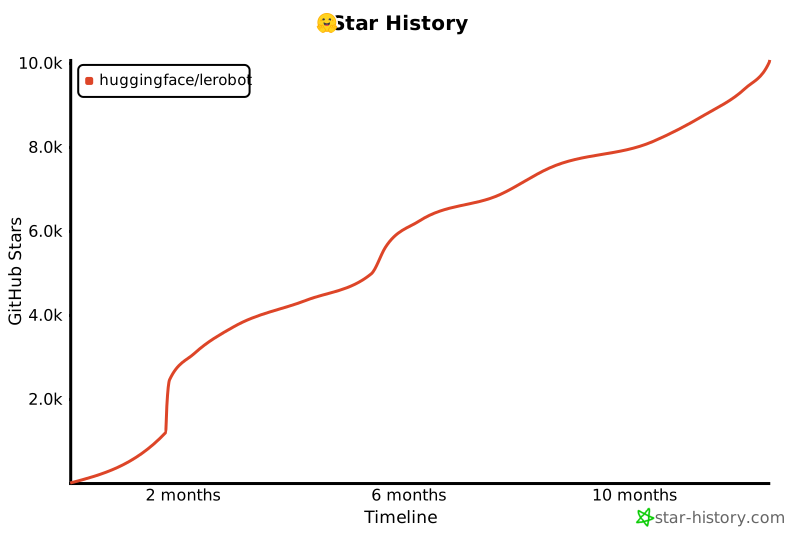](https://star-history.com/#huggingface/lerobot&Timeline)
|
||||
|
||||
@@ -29,7 +29,7 @@ ENV DEBIAN_FRONTEND=noninteractive \
|
||||
|
||||
# Install system dependencies and uv (as root)
|
||||
RUN apt-get update && apt-get install -y --no-install-recommends \
|
||||
build-essential git curl libglib2.0-0 libegl1-mesa ffmpeg \
|
||||
build-essential git curl libglib2.0-0 libegl1-mesa-dev ffmpeg \
|
||||
libusb-1.0-0-dev speech-dispatcher libgeos-dev portaudio19-dev \
|
||||
&& curl -LsSf https://astral.sh/uv/install.sh | sh \
|
||||
&& mv /root/.local/bin/uv /usr/local/bin/uv \
|
||||
|
||||
@@ -0,0 +1,3 @@
|
||||
# docs-requirements.txt
|
||||
hf-doc-builder @ git+https://github.com/huggingface/doc-builder.git@main
|
||||
watchdog>=6.0.0
|
||||
+1
-1
@@ -20,7 +20,7 @@ To generate the documentation, you first have to build it. Several packages are
|
||||
you can install them with the following command, at the root of the code repository:
|
||||
|
||||
```bash
|
||||
pip install -e ".[docs]"
|
||||
pip install -e . -r docs-requirements.txt
|
||||
```
|
||||
|
||||
You will also need `nodejs`. Please refer to their [installation page](https://nodejs.org/en/download)
|
||||
|
||||
@@ -13,14 +13,14 @@
|
||||
title: Cameras
|
||||
- local: integrate_hardware
|
||||
title: Bring Your Own Hardware
|
||||
- local: processor_tutorial
|
||||
title: RobotProcessor Pipeline
|
||||
- local: hilserl
|
||||
title: Train a Robot with RL
|
||||
- local: hilserl_sim
|
||||
title: Train RL in Simulation
|
||||
- local: async
|
||||
title: Use Async Inference
|
||||
- local: libero
|
||||
title: Using LIBERO
|
||||
title: "Tutorials"
|
||||
- sections:
|
||||
- local: smolvla
|
||||
@@ -37,10 +37,14 @@
|
||||
title: Koch v1.1
|
||||
- local: lekiwi
|
||||
title: LeKiwi
|
||||
- local: reachy2
|
||||
title: Reachy 2
|
||||
title: "Robots"
|
||||
- sections:
|
||||
- local: notebooks
|
||||
title: Notebooks
|
||||
- local: feetech
|
||||
title: Updating Feetech Firmware
|
||||
title: "Resources"
|
||||
- sections:
|
||||
- local: contributing
|
||||
|
||||
@@ -9,7 +9,7 @@ To instantiate a camera, you need a camera identifier. This identifier might cha
|
||||
To find the camera indices of the cameras plugged into your system, run the following script:
|
||||
|
||||
```bash
|
||||
python -m lerobot.find_cameras opencv # or realsense for Intel Realsense cameras
|
||||
lerobot-find-cameras opencv # or realsense for Intel Realsense cameras
|
||||
```
|
||||
|
||||
The output will look something like this if you have two cameras connected:
|
||||
|
||||
@@ -0,0 +1,71 @@
|
||||
# Feetech Motor Firmware Update
|
||||
|
||||
This tutorial guides you through updating the firmware of Feetech motors using the official Feetech software.
|
||||
|
||||
## Prerequisites
|
||||
|
||||
- Windows computer (Feetech software is only available for Windows)
|
||||
- Feetech motor control board
|
||||
- USB cable to connect the control board to your computer
|
||||
- Feetech motors connected to the control board
|
||||
|
||||
## Step 1: Download Feetech Software
|
||||
|
||||
1. Visit the official Feetech software download page: [https://www.feetechrc.com/software.html](https://www.feetechrc.com/software.html)
|
||||
2. Download the latest version of the Feetech debugging software (FD)
|
||||
3. Install the software on your Windows computer
|
||||
|
||||
## Step 2: Hardware Setup
|
||||
|
||||
1. Connect your Feetech motors to the motor control board
|
||||
2. Connect the motor control board to your Windows computer via USB cable
|
||||
3. Ensure power is supplied to the motors
|
||||
|
||||
## Step 3: Configure Connection
|
||||
|
||||
1. Launch the Feetech debugging software
|
||||
2. Select the correct COM port from the port dropdown menu
|
||||
- If unsure which port to use, check Windows Device Manager under "Ports (COM & LPT)"
|
||||
3. Set the appropriate baud rate (typically 1000000 for most Feetech motors)
|
||||
4. Click "Open" to establish communication with the control board
|
||||
|
||||
## Step 4: Scan for Motors
|
||||
|
||||
1. Once connected, click the "Search" button to detect all connected motors
|
||||
2. The software will automatically discover and list all motors on the bus
|
||||
3. Each motor will appear with its ID number
|
||||
|
||||
## Step 5: Update Firmware
|
||||
|
||||
For each motor you want to update:
|
||||
|
||||
1. **Select the motor** from the list by clicking on it
|
||||
2. **Click on Upgrade tab**:
|
||||
3. **Click on Online button**:
|
||||
- If an potential firmware update is found, it will be displayed in the box
|
||||
4. **Click on Upgrade button**:
|
||||
- The update progress will be displayed
|
||||
|
||||
## Step 6: Verify Update
|
||||
|
||||
1. After the update completes, the software should automatically refresh the motor information
|
||||
2. Verify that the firmware version has been updated to the expected version
|
||||
|
||||
## Important Notes
|
||||
|
||||
⚠️ **Warning**: Do not disconnect power or USB during firmware updates, it will potentially brick the motor.
|
||||
|
||||
## Bonus: Motor Debugging on Linux/macOS
|
||||
|
||||
For debugging purposes only, you can use the open-source Feetech Debug Tool:
|
||||
|
||||
- **Repository**: [FT_SCServo_Debug_Qt](https://github.com/CarolinePascal/FT_SCServo_Debug_Qt/tree/fix/port-search-timer)
|
||||
|
||||
### Installation Instructions
|
||||
|
||||
Follow the instructions in the repository to install the tool, for Ubuntu you can directly install it, for MacOS you need to build it from source.
|
||||
|
||||
**Limitations:**
|
||||
|
||||
- This tool is for debugging and parameter adjustment only
|
||||
- Firmware updates must still be done on Windows with official Feetech software
|
||||
+57
-127
@@ -56,41 +56,27 @@ pip install -e ".[hilserl]"
|
||||
|
||||
### Understanding Configuration
|
||||
|
||||
The training process begins with proper configuration for the HILSerl environment. The main configuration class is `GymManipulatorConfig` in `lerobot/scripts/rl/gym_manipulator.py`, which contains nested `HILSerlRobotEnvConfig` and `DatasetConfig`. The configuration is organized into focused, nested sub-configs:
|
||||
The training process begins with proper configuration for the HILSerl environment. The configuration class of interest is `HILSerlRobotEnvConfig` in `lerobot/envs/configs.py`. Which is defined as:
|
||||
|
||||
<!-- prettier-ignore-start -->
|
||||
```python
|
||||
class GymManipulatorConfig:
|
||||
env: HILSerlRobotEnvConfig # Environment configuration (nested)
|
||||
dataset: DatasetConfig # Dataset recording/replay configuration (nested)
|
||||
mode: str | None = None # "record", "replay", or None (for training)
|
||||
|
||||
class HILSerlRobotEnvConfig(EnvConfig):
|
||||
robot: RobotConfig | None = None # Main robot agent (defined in `lerobot/robots`)
|
||||
teleop: TeleoperatorConfig | None = None # Teleoperator agent, e.g., gamepad or leader arm
|
||||
processor: HILSerlProcessorConfig # Processing pipeline configuration (nested)
|
||||
teleop: TeleoperatorConfig | None = None # Teleoperator agent, e.g., gamepad or leader arm, (defined in `lerobot/teleoperators`)
|
||||
wrapper: EnvTransformConfig | None = None # Environment wrapper settings; check `lerobot/scripts/server/gym_manipulator.py`
|
||||
fps: int = 10 # Control frequency
|
||||
name: str = "real_robot" # Environment name
|
||||
device: str = "cuda" # Compute device
|
||||
fps: int = 30 # Control frequency
|
||||
|
||||
# Nested processor configuration
|
||||
class HILSerlProcessorConfig:
|
||||
control_mode: str = "gamepad" # Control mode
|
||||
observation: ObservationConfig # Observation processing settings
|
||||
image_preprocessing: ImagePreprocessingConfig # Image crop/resize settings
|
||||
gripper: GripperConfig # Gripper control and penalty settings
|
||||
reset: ResetConfig # Environment reset and timing settings
|
||||
inverse_kinematics: InverseKinematicsConfig # IK processing settings
|
||||
reward_classifier: RewardClassifierConfig # Reward classifier settings
|
||||
|
||||
# Dataset configuration
|
||||
class DatasetConfig:
|
||||
repo_id: str # LeRobot dataset repository ID
|
||||
mode: str = None # "record", "replay", or None (for training)
|
||||
repo_id: str | None = None # LeRobot dataset repository ID
|
||||
dataset_root: str | None = None # Local dataset root (optional)
|
||||
task: str # Task identifier
|
||||
num_episodes: int # Number of episodes for recording
|
||||
episode: int # Episode index for replay
|
||||
push_to_hub: bool # Whether to push datasets to Hub
|
||||
task: str = "" # Task identifier
|
||||
num_episodes: int = 10 # Number of episodes for recording
|
||||
episode: int = 0 # episode index for replay
|
||||
device: str = "cuda" # Compute device
|
||||
push_to_hub: bool = True # Whether to push the recorded datasets to Hub
|
||||
pretrained_policy_name_or_path: str | None = None # For policy loading
|
||||
reward_classifier_pretrained_path: str | None = None # For reward model
|
||||
number_of_steps_after_success: int = 0 # For reward classifier, collect more positive examples after a success to train a classifier
|
||||
```
|
||||
<!-- prettier-ignore-end -->
|
||||
|
||||
@@ -144,31 +130,22 @@ With the bounds defined, you can safely collect demonstrations for training. Tra
|
||||
|
||||
Create a configuration file for recording demonstrations (or edit an existing one like [env_config_so100.json](https://huggingface.co/datasets/aractingi/lerobot-example-config-files/blob/main/env_config_so100.json)):
|
||||
|
||||
1. Set `mode` to `"record"` at the root level
|
||||
2. Specify a unique `repo_id` for your dataset in the `dataset` section (e.g., "username/task_name")
|
||||
3. Set `num_episodes` in the `dataset` section to the number of demonstrations you want to collect
|
||||
4. Set `env.processor.image_preprocessing.crop_params_dict` to `{}` initially (we'll determine crops later)
|
||||
5. Configure `env.robot`, `env.teleop`, and other hardware settings in the `env` section
|
||||
1. Set `mode` to `"record"`
|
||||
2. Specify a unique `repo_id` for your dataset (e.g., "username/task_name")
|
||||
3. Set `num_episodes` to the number of demonstrations you want to collect
|
||||
4. Set `crop_params_dict` to `null` initially (we'll determine crops later)
|
||||
5. Configure `robot`, `cameras`, and other hardware settings
|
||||
|
||||
Example configuration section:
|
||||
|
||||
```json
|
||||
{
|
||||
"env": {
|
||||
"type": "gym_manipulator",
|
||||
"fps": 10
|
||||
// ... robot, teleop, processor configs ...
|
||||
},
|
||||
"dataset": {
|
||||
"repo_id": "username/pick_lift_cube",
|
||||
"dataset_root": null,
|
||||
"task": "pick_and_lift",
|
||||
"num_episodes": 15,
|
||||
"episode": 0,
|
||||
"push_to_hub": true
|
||||
},
|
||||
"mode": "record"
|
||||
}
|
||||
"mode": "record",
|
||||
"repo_id": "username/pick_lift_cube",
|
||||
"dataset_root": null,
|
||||
"task": "pick_and_lift",
|
||||
"num_episodes": 15,
|
||||
"episode": 0,
|
||||
"push_to_hub": true
|
||||
```
|
||||
|
||||
### Using a Teleoperation Device
|
||||
@@ -214,17 +191,10 @@ The gamepad provides a very convenient way to control the robot and the episode
|
||||
To setup the gamepad, you need to set the `control_mode` to `"gamepad"` and define the `teleop` section in the configuration file.
|
||||
|
||||
```json
|
||||
{
|
||||
"env": {
|
||||
"teleop": {
|
||||
"type": "gamepad",
|
||||
"use_gripper": true
|
||||
"type": "gamepad",
|
||||
"use_gripper": true
|
||||
},
|
||||
"processor": {
|
||||
"control_mode": "gamepad"
|
||||
}
|
||||
}
|
||||
}
|
||||
```
|
||||
|
||||
<p align="center">
|
||||
@@ -246,18 +216,11 @@ The SO101 leader arm has reduced gears that allows it to move and track the foll
|
||||
To setup the SO101 leader, you need to set the `control_mode` to `"leader"` and define the `teleop` section in the configuration file.
|
||||
|
||||
```json
|
||||
{
|
||||
"env": {
|
||||
"teleop": {
|
||||
"type": "so101_leader",
|
||||
"port": "/dev/tty.usbmodem585A0077921",
|
||||
"use_degrees": true
|
||||
"type": "so101_leader",
|
||||
"port": "/dev/tty.usbmodem585A0077921", # check your port number
|
||||
"use_degrees": true
|
||||
},
|
||||
"processor": {
|
||||
"control_mode": "leader"
|
||||
}
|
||||
}
|
||||
}
|
||||
```
|
||||
|
||||
In order to annotate the success/failure of the episode, **you will need** to use a keyboard to press `s` for success, `esc` for failure.
|
||||
@@ -288,7 +251,7 @@ python -m lerobot.scripts.rl.gym_manipulator --config_path src/lerobot/configs/e
|
||||
|
||||
During recording:
|
||||
|
||||
1. The robot will reset to the initial position defined in the configuration file `env.processor.reset.fixed_reset_joint_positions`
|
||||
1. The robot will reset to the initial position defined in the configuration file `fixed_reset_joint_positions`
|
||||
2. Complete the task successfully
|
||||
3. The episode ends with a reward of 1 when you press the "success" button
|
||||
4. If the time limit is reached, or the fail button is pressed, the episode ends with a reward of 0
|
||||
@@ -347,19 +310,11 @@ observation.images.front: [180, 250, 120, 150]
|
||||
Add these crop parameters to your training configuration:
|
||||
|
||||
```json
|
||||
{
|
||||
"env": {
|
||||
"processor": {
|
||||
"image_preprocessing": {
|
||||
"crop_params_dict": {
|
||||
"observation.images.side": [180, 207, 180, 200],
|
||||
"observation.images.front": [180, 250, 120, 150]
|
||||
},
|
||||
"resize_size": [128, 128]
|
||||
}
|
||||
}
|
||||
}
|
||||
}
|
||||
"crop_params_dict": {
|
||||
"observation.images.side": [180, 207, 180, 200],
|
||||
"observation.images.front": [180, 250, 120, 150]
|
||||
},
|
||||
"resize_size": [128, 128]
|
||||
```
|
||||
|
||||
**Recommended image resolution**
|
||||
@@ -388,35 +343,26 @@ python -m lerobot.scripts.rl.gym_manipulator --config_path src/lerobot/configs/r
|
||||
|
||||
**Key Parameters for Data Collection**
|
||||
|
||||
- **mode**: set it to `"record"` to collect a dataset (at root level)
|
||||
- **dataset.repo_id**: `"hf_username/dataset_name"`, name of the dataset and repo on the hub
|
||||
- **dataset.num_episodes**: Number of episodes to record
|
||||
- **env.processor.reset.number_of_steps_after_success**: Number of additional frames to record after a success (reward=1) is detected
|
||||
- **env.fps**: Number of frames per second to record
|
||||
- **dataset.push_to_hub**: Whether to push the dataset to the hub
|
||||
- **mode**: set it to `"record"` to collect a dataset
|
||||
- **repo_id**: `"hf_username/dataset_name"`, name of the dataset and repo on the hub
|
||||
- **num_episodes**: Number of episodes to record
|
||||
- **number_of_steps_after_success**: Number of additional frames to record after a success (reward=1) is detected
|
||||
- **fps**: Number of frames per second to record
|
||||
- **push_to_hub**: Whether to push the dataset to the hub
|
||||
|
||||
The `env.processor.reset.number_of_steps_after_success` parameter is crucial as it allows you to collect more positive examples. When a success is detected, the system will continue recording for the specified number of steps while maintaining the reward=1 label. Otherwise, there won't be enough states in the dataset labeled to 1 to train a good classifier.
|
||||
The `number_of_steps_after_success` parameter is crucial as it allows you to collect more positive examples. When a success is detected, the system will continue recording for the specified number of steps while maintaining the reward=1 label. Otherwise, there won't be enough states in the dataset labeled to 1 to train a good classifier.
|
||||
|
||||
Example configuration section for data collection:
|
||||
|
||||
```json
|
||||
{
|
||||
"env": {
|
||||
"type": "gym_manipulator",
|
||||
"fps": 10,
|
||||
"processor": {
|
||||
"reset": {
|
||||
"number_of_steps_after_success": 15
|
||||
}
|
||||
}
|
||||
},
|
||||
"dataset": {
|
||||
"repo_id": "hf_username/dataset_name",
|
||||
"dataset_root": "data/your_dataset",
|
||||
"num_episodes": 20,
|
||||
"push_to_hub": true
|
||||
},
|
||||
"mode": "record"
|
||||
"mode": "record",
|
||||
"repo_id": "hf_username/dataset_name",
|
||||
"dataset_root": "data/your_dataset",
|
||||
"num_episodes": 20,
|
||||
"push_to_hub": true,
|
||||
"fps": 10,
|
||||
"number_of_steps_after_success": 15
|
||||
}
|
||||
```
|
||||
|
||||
@@ -466,7 +412,7 @@ Example configuration for training the [reward classifier](https://huggingface.c
|
||||
To train the classifier, use the `train.py` script with your configuration:
|
||||
|
||||
```bash
|
||||
python -m lerobot.scripts.train --config_path path/to/reward_classifier_train_config.json
|
||||
lerobot-train --config_path path/to/reward_classifier_train_config.json
|
||||
```
|
||||
|
||||
**Deploying and Testing the Model**
|
||||
@@ -475,17 +421,9 @@ To use your trained reward classifier, configure the `HILSerlRobotEnvConfig` to
|
||||
|
||||
<!-- prettier-ignore-start -->
|
||||
```python
|
||||
config = GymManipulatorConfig(
|
||||
env=HILSerlRobotEnvConfig(
|
||||
processor=HILSerlProcessorConfig(
|
||||
reward_classifier=RewardClassifierConfig(
|
||||
pretrained_path="path_to_your_pretrained_trained_model"
|
||||
)
|
||||
),
|
||||
# Other environment parameters
|
||||
),
|
||||
dataset=DatasetConfig(...),
|
||||
mode=None # For training
|
||||
env_config = HILSerlRobotEnvConfig(
|
||||
reward_classifier_pretrained_path="path_to_your_pretrained_trained_model",
|
||||
# Other environment parameters
|
||||
)
|
||||
```
|
||||
<!-- prettier-ignore-end -->
|
||||
@@ -494,15 +432,7 @@ or set the argument in the json config file.
|
||||
|
||||
```json
|
||||
{
|
||||
"env": {
|
||||
"processor": {
|
||||
"reward_classifier": {
|
||||
"pretrained_path": "path_to_your_pretrained_model",
|
||||
"success_threshold": 0.7,
|
||||
"success_reward": 1.0
|
||||
}
|
||||
}
|
||||
}
|
||||
"reward_classifier_pretrained_path": "path_to_your_pretrained_model"
|
||||
}
|
||||
```
|
||||
|
||||
@@ -528,7 +458,7 @@ The reward classifier will automatically provide rewards based on the visual inp
|
||||
3. **Train the classifier**:
|
||||
|
||||
```bash
|
||||
python -m lerobot.scripts.train --config_path src/lerobot/configs/reward_classifier_train_config.json
|
||||
lerobot-train --config_path src/lerobot/configs/reward_classifier_train_config.json
|
||||
```
|
||||
|
||||
4. **Test the classifier**:
|
||||
|
||||
+11
-11
@@ -19,7 +19,7 @@ pip install -e ".[hopejr]"
|
||||
Before starting calibration and operation, you need to identify the USB ports for each HopeJR component. Run this script to find the USB ports for the arm, hand, glove, and exoskeleton:
|
||||
|
||||
```bash
|
||||
python -m lerobot.find_port
|
||||
lerobot-find-port
|
||||
```
|
||||
|
||||
This will display the available USB ports and their associated devices. Make note of the port paths (e.g., `/dev/tty.usbmodem58760433331`, `/dev/tty.usbmodem11301`) as you'll need to specify them in the `--robot.port` and `--teleop.port` parameters when recording data, replaying episodes, or running teleoperation scripts.
|
||||
@@ -31,7 +31,7 @@ Before performing teleoperation, HopeJR's limbs need to be calibrated. Calibrati
|
||||
### 1.1 Calibrate Robot Hand
|
||||
|
||||
```bash
|
||||
python -m lerobot.calibrate \
|
||||
lerobot-calibrate \
|
||||
--robot.type=hope_jr_hand \
|
||||
--robot.port=/dev/tty.usbmodem58760432281 \
|
||||
--robot.id=blue \
|
||||
@@ -81,7 +81,7 @@ Once you have set the appropriate boundaries for all joints, click "Save" to sav
|
||||
### 1.2 Calibrate Teleoperator Glove
|
||||
|
||||
```bash
|
||||
python -m lerobot.calibrate \
|
||||
lerobot-calibrate \
|
||||
--teleop.type=homunculus_glove \
|
||||
--teleop.port=/dev/tty.usbmodem11201 \
|
||||
--teleop.id=red \
|
||||
@@ -120,7 +120,7 @@ Once calibration is complete, the system will save the calibration to `/Users/yo
|
||||
### 1.3 Calibrate Robot Arm
|
||||
|
||||
```bash
|
||||
python -m lerobot.calibrate \
|
||||
lerobot-calibrate \
|
||||
--robot.type=hope_jr_arm \
|
||||
--robot.port=/dev/tty.usbserial-1110 \
|
||||
--robot.id=white
|
||||
@@ -146,7 +146,7 @@ Use the calibration interface to set the range boundaries for each joint. Move e
|
||||
### 1.4 Calibrate Teleoperator Exoskeleton
|
||||
|
||||
```bash
|
||||
python -m lerobot.calibrate \
|
||||
lerobot-calibrate \
|
||||
--teleop.type=homunculus_arm \
|
||||
--teleop.port=/dev/tty.usbmodem11201 \
|
||||
--teleop.id=black
|
||||
@@ -178,7 +178,7 @@ Due to global variable conflicts in the Feetech middleware, teleoperation for ar
|
||||
### Hand
|
||||
|
||||
```bash
|
||||
python -m lerobot.teleoperate \
|
||||
lerobot-teleoperate \
|
||||
--robot.type=hope_jr_hand \
|
||||
--robot.port=/dev/tty.usbmodem58760432281 \
|
||||
--robot.id=blue \
|
||||
@@ -194,7 +194,7 @@ python -m lerobot.teleoperate \
|
||||
### Arm
|
||||
|
||||
```bash
|
||||
python -m lerobot.teleoperate \
|
||||
lerobot-teleoperate \
|
||||
--robot.type=hope_jr_arm \
|
||||
--robot.port=/dev/tty.usbserial-1110 \
|
||||
--robot.id=white \
|
||||
@@ -214,7 +214,7 @@ Record, Replay and Train with Hope-JR is still experimental.
|
||||
This step records the dataset, which can be seen as an example [here](https://huggingface.co/datasets/nepyope/hand_record_test_with_video_data/settings).
|
||||
|
||||
```bash
|
||||
python -m lerobot.record \
|
||||
lerobot-record \
|
||||
--robot.type=hope_jr_hand \
|
||||
--robot.port=/dev/tty.usbmodem58760432281 \
|
||||
--robot.id=right \
|
||||
@@ -236,7 +236,7 @@ python -m lerobot.record \
|
||||
### Replay
|
||||
|
||||
```bash
|
||||
python -m lerobot.replay \
|
||||
lerobot-replay \
|
||||
--robot.type=hope_jr_hand \
|
||||
--robot.port=/dev/tty.usbmodem58760432281 \
|
||||
--robot.id=right \
|
||||
@@ -248,7 +248,7 @@ python -m lerobot.replay \
|
||||
### Train
|
||||
|
||||
```bash
|
||||
python -m lerobot.scripts.train \
|
||||
lerobot-train \
|
||||
--dataset.repo_id=nepyope/hand_record_test_with_video_data \
|
||||
--policy.type=act \
|
||||
--output_dir=outputs/train/hopejr_hand \
|
||||
@@ -263,7 +263,7 @@ python -m lerobot.scripts.train \
|
||||
This training run can be viewed as an example [here](https://wandb.ai/tino/lerobot/runs/rp0k8zvw?nw=nwusertino).
|
||||
|
||||
```bash
|
||||
python -m lerobot.record \
|
||||
lerobot-record \
|
||||
--robot.type=hope_jr_hand \
|
||||
--robot.port=/dev/tty.usbmodem58760432281 \
|
||||
--robot.id=right \
|
||||
|
||||
+10
-10
@@ -45,7 +45,7 @@ Note that the `id` associated with a robot is used to store the calibration file
|
||||
<hfoptions id="teleoperate_so101">
|
||||
<hfoption id="Command">
|
||||
```bash
|
||||
python -m lerobot.teleoperate \
|
||||
lerobot-teleoperate \
|
||||
--robot.type=so101_follower \
|
||||
--robot.port=/dev/tty.usbmodem58760431541 \
|
||||
--robot.id=my_awesome_follower_arm \
|
||||
@@ -101,7 +101,7 @@ With `rerun`, you can teleoperate again while simultaneously visualizing the cam
|
||||
<hfoptions id="teleoperate_koch_camera">
|
||||
<hfoption id="Command">
|
||||
```bash
|
||||
python -m lerobot.teleoperate \
|
||||
lerobot-teleoperate \
|
||||
--robot.type=koch_follower \
|
||||
--robot.port=/dev/tty.usbmodem58760431541 \
|
||||
--robot.id=my_awesome_follower_arm \
|
||||
@@ -174,7 +174,7 @@ Now you can record a dataset. To record 5 episodes and upload your dataset to th
|
||||
<hfoptions id="record">
|
||||
<hfoption id="Command">
|
||||
```bash
|
||||
python -m lerobot.record \
|
||||
lerobot-record \
|
||||
--robot.type=so101_follower \
|
||||
--robot.port=/dev/tty.usbmodem585A0076841 \
|
||||
--robot.id=my_awesome_follower_arm \
|
||||
@@ -294,7 +294,7 @@ dataset.push_to_hub()
|
||||
|
||||
#### Dataset upload
|
||||
|
||||
Locally, your dataset is stored in this folder: `~/.cache/huggingface/lerobot/{repo-id}`. At the end of data recording, your dataset will be uploaded on your Hugging Face page (e.g. https://huggingface.co/datasets/cadene/so101_test) that you can obtain by running:
|
||||
Locally, your dataset is stored in this folder: `~/.cache/huggingface/lerobot/{repo-id}`. At the end of data recording, your dataset will be uploaded on your Hugging Face page (e.g. `https://huggingface.co/datasets/${HF_USER}/so101_test`) that you can obtain by running:
|
||||
|
||||
```bash
|
||||
echo https://huggingface.co/datasets/${HF_USER}/so101_test
|
||||
@@ -376,7 +376,7 @@ You can replay the first episode on your robot with either the command below or
|
||||
<hfoptions id="replay">
|
||||
<hfoption id="Command">
|
||||
```bash
|
||||
python -m lerobot.replay \
|
||||
lerobot-replay \
|
||||
--robot.type=so101_follower \
|
||||
--robot.port=/dev/tty.usbmodem58760431541 \
|
||||
--robot.id=my_awesome_follower_arm \
|
||||
@@ -428,10 +428,10 @@ Your robot should replicate movements similar to those you recorded. For example
|
||||
|
||||
## Train a policy
|
||||
|
||||
To train a policy to control your robot, use the [`python -m lerobot.scripts.train`](../src/lerobot/scripts/train.py) script. A few arguments are required. Here is an example command:
|
||||
To train a policy to control your robot, use the [`lerobot-train`](https://github.com/huggingface/lerobot/blob/main/src/lerobot/scripts/train.py) script. A few arguments are required. Here is an example command:
|
||||
|
||||
```bash
|
||||
python -m lerobot.scripts.train \
|
||||
lerobot-train \
|
||||
--dataset.repo_id=${HF_USER}/so101_test \
|
||||
--policy.type=act \
|
||||
--output_dir=outputs/train/act_so101_test \
|
||||
@@ -444,7 +444,7 @@ python -m lerobot.scripts.train \
|
||||
Let's explain the command:
|
||||
|
||||
1. We provided the dataset as argument with `--dataset.repo_id=${HF_USER}/so101_test`.
|
||||
2. We provided the policy with `policy.type=act`. This loads configurations from [`configuration_act.py`](../src/lerobot/policies/act/configuration_act.py). Importantly, this policy will automatically adapt to the number of motor states, motor actions and cameras of your robot (e.g. `laptop` and `phone`) which have been saved in your dataset.
|
||||
2. We provided the policy with `policy.type=act`. This loads configurations from [`configuration_act.py`](https://github.com/huggingface/lerobot/blob/main/src/lerobot/policies/act/configuration_act.py). Importantly, this policy will automatically adapt to the number of motor states, motor actions and cameras of your robot (e.g. `laptop` and `phone`) which have been saved in your dataset.
|
||||
3. We provided `policy.device=cuda` since we are training on a Nvidia GPU, but you could use `policy.device=mps` to train on Apple silicon.
|
||||
4. We provided `wandb.enable=true` to use [Weights and Biases](https://docs.wandb.ai/quickstart) for visualizing training plots. This is optional but if you use it, make sure you are logged in by running `wandb login`.
|
||||
|
||||
@@ -453,7 +453,7 @@ Training should take several hours. You will find checkpoints in `outputs/train/
|
||||
To resume training from a checkpoint, below is an example command to resume from `last` checkpoint of the `act_so101_test` policy:
|
||||
|
||||
```bash
|
||||
python -m lerobot.scripts.train \
|
||||
lerobot-train \
|
||||
--config_path=outputs/train/act_so101_test/checkpoints/last/pretrained_model/train_config.json \
|
||||
--resume=true
|
||||
```
|
||||
@@ -490,7 +490,7 @@ You can use the `record` script from [`lerobot/record.py`](https://github.com/hu
|
||||
<hfoptions id="eval">
|
||||
<hfoption id="Command">
|
||||
```bash
|
||||
python -m lerobot.record \
|
||||
lerobot-record \
|
||||
--robot.type=so100_follower \
|
||||
--robot.port=/dev/ttyACM1 \
|
||||
--robot.cameras="{ up: {type: opencv, index_or_path: /dev/video10, width: 640, height: 480, fps: 30}, side: {type: intelrealsense, serial_number_or_name: 233522074606, width: 640, height: 480, fps: 30}}" \
|
||||
|
||||
@@ -96,10 +96,10 @@ If you uploaded your dataset to the hub you can [visualize your dataset online](
|
||||
|
||||
## Train a policy
|
||||
|
||||
To train a policy to control your robot, use the [`python -m lerobot.scripts.train`](../src/lerobot/scripts/train.py) script. A few arguments are required. Here is an example command:
|
||||
To train a policy to control your robot, use the [`lerobot-train`](https://github.com/huggingface/lerobot/blob/main/src/lerobot/scripts/train.py) script. A few arguments are required. Here is an example command:
|
||||
|
||||
```bash
|
||||
python -m lerobot.scripts.train \
|
||||
lerobot-train \
|
||||
--dataset.repo_id=${HF_USER}/il_gym \
|
||||
--policy.type=act \
|
||||
--output_dir=outputs/train/il_sim_test \
|
||||
@@ -111,7 +111,7 @@ python -m lerobot.scripts.train \
|
||||
Let's explain the command:
|
||||
|
||||
1. We provided the dataset as argument with `--dataset.repo_id=${HF_USER}/il_gym`.
|
||||
2. We provided the policy with `policy.type=act`. This loads configurations from [`configuration_act.py`](../src/lerobot/policies/act/configuration_act.py). Importantly, this policy will automatically adapt to the number of motor states, motor actions and cameras of your robot (e.g. `laptop` and `phone`) which have been saved in your dataset.
|
||||
2. We provided the policy with `policy.type=act`. This loads configurations from [`configuration_act.py`](https://github.com/huggingface/lerobot/blob/main/src/lerobot/policies/act/configuration_act.py). Importantly, this policy will automatically adapt to the number of motor states, motor actions and cameras of your robot (e.g. `laptop` and `phone`) which have been saved in your dataset.
|
||||
3. We provided `policy.device=cuda` since we are training on a Nvidia GPU, but you could use `policy.device=mps` to train on Apple silicon.
|
||||
4. We provided `wandb.enable=true` to use [Weights and Biases](https://docs.wandb.ai/quickstart) for visualizing training plots. This is optional but if you use it, make sure you are logged in by running `wandb login`.
|
||||
|
||||
|
||||
@@ -1,15 +1,6 @@
|
||||
# Installation
|
||||
|
||||
## Install LeRobot
|
||||
|
||||
Currently only available from source.
|
||||
|
||||
Download our source code:
|
||||
|
||||
```bash
|
||||
git clone https://github.com/huggingface/lerobot.git
|
||||
cd lerobot
|
||||
```
|
||||
## Environment Setup
|
||||
|
||||
Create a virtual environment with Python 3.10, using [`Miniconda`](https://docs.anaconda.com/miniconda/install/#quick-command-line-install)
|
||||
|
||||
@@ -40,12 +31,49 @@ conda install ffmpeg -c conda-forge
|
||||
>
|
||||
> - _[On Linux only]_ If you want to bring your own ffmpeg: Install [ffmpeg build dependencies](https://trac.ffmpeg.org/wiki/CompilationGuide/Ubuntu#GettheDependencies) and [compile ffmpeg from source with libsvtav1](https://trac.ffmpeg.org/wiki/CompilationGuide/Ubuntu#libsvtav1), and make sure you use the corresponding ffmpeg binary to your install with `which ffmpeg`.
|
||||
|
||||
Install 🤗 LeRobot:
|
||||
## Install LeRobot 🤗
|
||||
|
||||
### From Source
|
||||
|
||||
First, clone the repository and navigate into the directory:
|
||||
|
||||
```bash
|
||||
git clone https://github.com/huggingface/lerobot.git
|
||||
cd lerobot
|
||||
```
|
||||
|
||||
Then, install the library in editable mode. This is useful if you plan to contribute to the code.
|
||||
|
||||
```bash
|
||||
pip install -e .
|
||||
```
|
||||
|
||||
### Installation from PyPI
|
||||
|
||||
**Core Library:**
|
||||
Install the base package with:
|
||||
|
||||
```bash
|
||||
pip install lerobot
|
||||
```
|
||||
|
||||
_This installs only the default dependencies._
|
||||
|
||||
**Extra Features:**
|
||||
To install additional functionality, use one of the following:
|
||||
|
||||
```bash
|
||||
pip install 'lerobot[all]' # All available features
|
||||
pip install 'lerobot[aloha,pusht]' # Specific features (Aloha & Pusht)
|
||||
pip install 'lerobot[feetech]' # Feetech motor support
|
||||
```
|
||||
|
||||
_Replace `[...]` with your desired features._
|
||||
|
||||
**Available Tags:**
|
||||
For a full list of optional dependencies, see:
|
||||
https://pypi.org/project/lerobot/
|
||||
|
||||
### Troubleshooting
|
||||
|
||||
If you encounter build errors, you may need to install additional dependencies: `cmake`, `build-essential`, and `ffmpeg libs`.
|
||||
|
||||
@@ -31,7 +31,7 @@ pip install -e ".[dynamixel]"
|
||||
To find the port for each bus servo adapter, run this script:
|
||||
|
||||
```bash
|
||||
python -m lerobot.find_port
|
||||
lerobot-find-port
|
||||
```
|
||||
|
||||
<hfoptions id="example">
|
||||
@@ -98,7 +98,7 @@ For a visual reference on how to set the motor ids please refer to [this video](
|
||||
<hfoption id="Command">
|
||||
|
||||
```bash
|
||||
python -m lerobot.setup_motors \
|
||||
lerobot-setup-motors \
|
||||
--robot.type=koch_follower \
|
||||
--robot.port=/dev/tty.usbmodem575E0031751 # <- paste here the port found at previous step
|
||||
```
|
||||
@@ -174,7 +174,7 @@ Do the same steps for the leader arm but modify the command or script accordingl
|
||||
<hfoption id="Command">
|
||||
|
||||
```bash
|
||||
python -m lerobot.setup_motors \
|
||||
lerobot-setup-motors \
|
||||
--teleop.type=koch_leader \
|
||||
--teleop.port=/dev/tty.usbmodem575E0031751 \ # <- paste here the port found at previous step
|
||||
```
|
||||
@@ -211,7 +211,7 @@ Run the following command or API example to calibrate the follower arm:
|
||||
<hfoption id="Command">
|
||||
|
||||
```bash
|
||||
python -m lerobot.calibrate \
|
||||
lerobot-calibrate \
|
||||
--robot.type=koch_follower \
|
||||
--robot.port=/dev/tty.usbmodem58760431551 \ # <- The port of your robot
|
||||
--robot.id=my_awesome_follower_arm # <- Give the robot a unique name
|
||||
@@ -249,7 +249,7 @@ Do the same steps to calibrate the leader arm, run the following command or API
|
||||
<hfoption id="Command">
|
||||
|
||||
```bash
|
||||
python -m lerobot.calibrate \
|
||||
lerobot-calibrate \
|
||||
--teleop.type=koch_leader \
|
||||
--teleop.port=/dev/tty.usbmodem58760431551 \ # <- The port of your robot
|
||||
--teleop.id=my_awesome_leader_arm # <- Give the robot a unique name
|
||||
|
||||
@@ -60,7 +60,7 @@ First, we will assemble the two SO100/SO101 arms. One to attach to the mobile ba
|
||||
To find the port for each bus servo adapter, run this script:
|
||||
|
||||
```bash
|
||||
python -m lerobot.find_port
|
||||
lerobot-find-port
|
||||
```
|
||||
|
||||
<hfoptions id="example">
|
||||
@@ -116,7 +116,7 @@ The instructions for configuring the motors can be found in the SO101 [docs](./s
|
||||
You can run this command to setup motors for LeKiwi. It will first setup the motors for arm (id 6..1) and then setup motors for wheels (9,8,7)
|
||||
|
||||
```bash
|
||||
python -m lerobot.setup_motors \
|
||||
lerobot-setup-motors \
|
||||
--robot.type=lekiwi \
|
||||
--robot.port=/dev/tty.usbmodem58760431551 # <- paste here the port found at previous step
|
||||
```
|
||||
@@ -174,7 +174,7 @@ The calibration process is very important because it allows a neural network tra
|
||||
Make sure the arm is connected to the Raspberry Pi and run this script or API example (on the Raspberry Pi via SSH) to launch calibration of the follower arm:
|
||||
|
||||
```bash
|
||||
python -m lerobot.calibrate \
|
||||
lerobot-calibrate \
|
||||
--robot.type=lekiwi \
|
||||
--robot.id=my_awesome_kiwi # <- Give the robot a unique name
|
||||
```
|
||||
@@ -193,7 +193,7 @@ Then, to calibrate the leader arm (which is attached to the laptop/pc). Run the
|
||||
<hfoption id="Command">
|
||||
|
||||
```bash
|
||||
python -m lerobot.calibrate \
|
||||
lerobot-calibrate \
|
||||
--teleop.type=so100_leader \
|
||||
--teleop.port=/dev/tty.usbmodem58760431551 \ # <- The port of your robot
|
||||
--teleop.id=my_awesome_leader_arm # <- Give the robot a unique name
|
||||
|
||||
@@ -0,0 +1,230 @@
|
||||
# LIBERO
|
||||
|
||||
**LIBERO** is a benchmark designed to study **lifelong robot learning**. The idea is that robots won’t just be pretrained once in a factory, they’ll need to keep learning and adapting with their human users over time. This ongoing adaptation is called **lifelong learning in decision making (LLDM)**, and it’s a key step toward building robots that become truly personalized helpers. The benchmark was first introduced in the [LIBERO paper](https://arxiv.org/abs/2306.03310) and the [original repository](https://github.com/Lifelong-Robot-Learning/LIBERO).
|
||||
|
||||
To make progress on this challenge, LIBERO provides a set of standardized tasks that focus on **knowledge transfer**: how well a robot can apply what it has already learned to new situations. By evaluating on LIBERO, different algorithms can be compared fairly and researchers can build on each other’s work.
|
||||
|
||||
LIBERO includes **five task suites**:
|
||||
|
||||
- **LIBERO-Spatial (`libero_spatial`)** – tasks that require reasoning about spatial relations.
|
||||
- **LIBERO-Object (`libero_object`)** – tasks centered on manipulating different objects.
|
||||
- **LIBERO-Goal (`libero_goal`)** – goal-conditioned tasks where the robot must adapt to changing targets.
|
||||
- **LIBERO-90 (`libero_90`)** – 90 short-horizon tasks from the LIBERO-100 collection.
|
||||
- **LIBERO-Long (`libero_10`)** – 10 long-horizon tasks from the LIBERO-100 collection.
|
||||
|
||||
Together, these suites cover **130 tasks**, ranging from simple object manipulations to complex multi-step scenarios. LIBERO is meant to grow over time, and to serve as a shared benchmark where the community can test and improve lifelong learning algorithms.
|
||||
|
||||
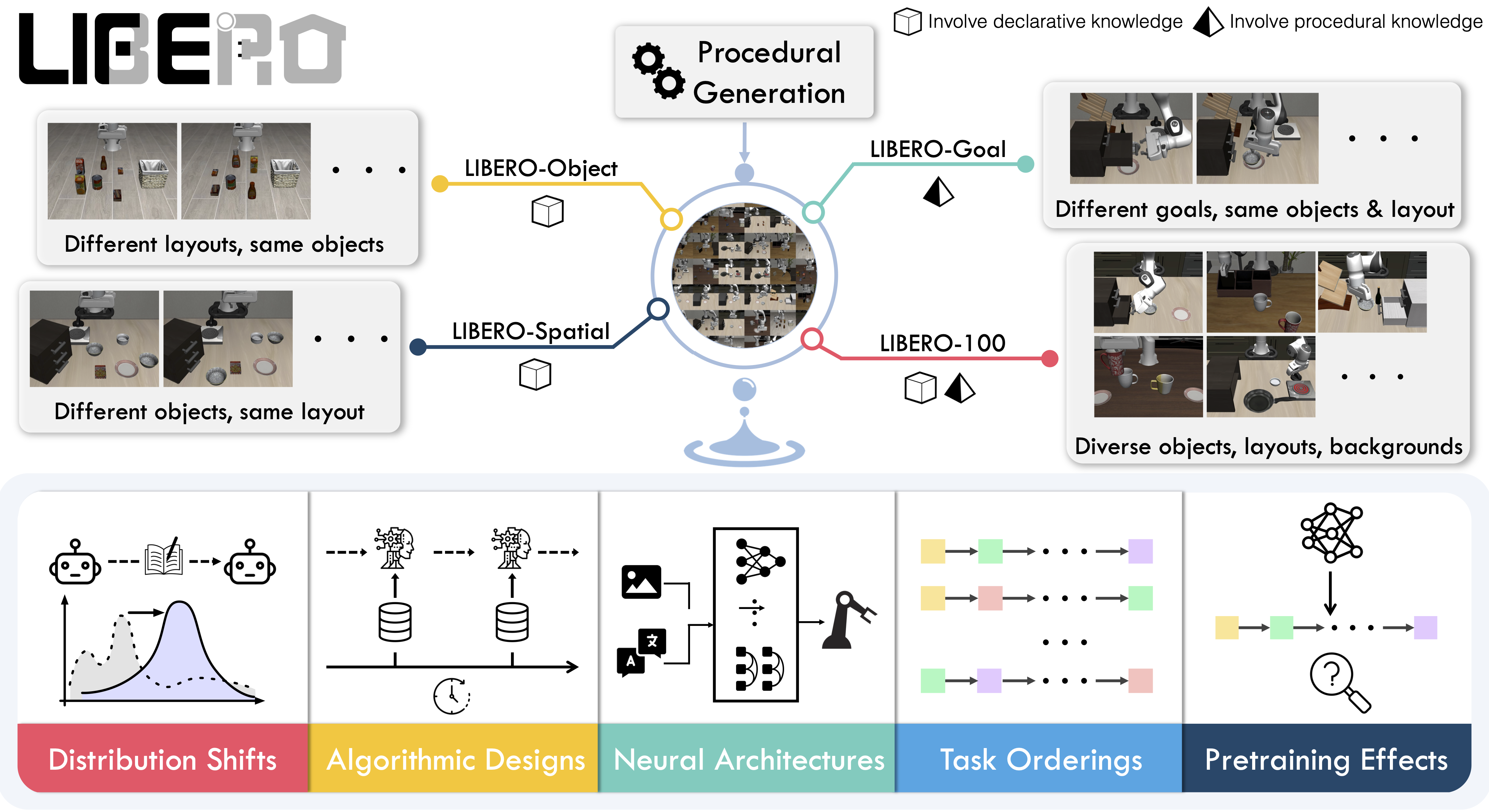
|
||||
_Figure 1: An overview of the LIBERO benchmark._
|
||||
|
||||
## Evaluating with LIBERO
|
||||
|
||||
At **LeRobot**, we ported [LIBERO](https://github.com/Lifelong-Robot-Learning/LIBERO) into our framework and used it primarily to **benchmark [SmolVLA](https://huggingface.co/docs/lerobot/en/smolvla)**, our lightweight Vision-Language-Action model, comparing it against state-of-the-art VLA models such as Pi0, OpenVLA, Octo, and Diffusion Policy.
|
||||
|
||||
LIBERO is now part of our **multi-eval supported simulation**, allowing you to benchmark your policies either on a **single suite of tasks** or across **multiple suites at once** with just a single flag.
|
||||
|
||||
To install LIBERO, first follow the [LeRobot Installation Guide](https://huggingface.co/docs/lerobot/installation).
|
||||
Once LeRobot is installed, there are two options:
|
||||
|
||||
1. **Install via pip** (recommended):
|
||||
|
||||
```bash
|
||||
pip install "lerobot[libero,smolvla]"
|
||||
```
|
||||
|
||||
2. **Install from source**:
|
||||
```bash
|
||||
git clone https://github.com/huggingface/lerobot.git
|
||||
cd lerobot
|
||||
pip install -e ".[libero,smolvla]"
|
||||
```
|
||||
|
||||
### Single-suite evaluation
|
||||
|
||||
Evaluate a policy on one LIBERO suite:
|
||||
|
||||
```bash
|
||||
python src/lerobot/scripts/eval.py \
|
||||
--policy.path="your-policy-id" \
|
||||
--env.type=libero \
|
||||
--env.task=libero_object \
|
||||
--env.multitask_eval=False \
|
||||
--eval.batch_size=2 \
|
||||
--eval.n_episodes=3
|
||||
```
|
||||
|
||||
- `--env.task` picks the suite (`libero_object`, `libero_spatial`, etc.).
|
||||
- `--eval.batch_size` controls how many environments run in parallel.
|
||||
- `--eval.n_episodes` sets how many episodes to run in total.
|
||||
|
||||
---
|
||||
|
||||
### Multi-suite evaluation
|
||||
|
||||
Benchmark a policy across multiple suites at once:
|
||||
|
||||
```bash
|
||||
python src/lerobot/scripts/eval.py \
|
||||
--policy.path="your-policy-id" \
|
||||
--env.type=libero \
|
||||
--env.task=libero_object \
|
||||
--env.multitask_eval=True \
|
||||
--eval.batch_size=1 \
|
||||
--eval.n_episodes=2
|
||||
```
|
||||
|
||||
- Pass a comma-separated list to `--env.task` for multi-suite evaluation.
|
||||
- Set `-env.multitask_eval=True` to enable evaluation across all tasks in those suites.
|
||||
|
||||
### Policy inputs and outputs
|
||||
|
||||
When using LIBERO through LeRobot, policies interact with the environment via **observations** and **actions**:
|
||||
|
||||
- **Observations**
|
||||
- `observation.state` – proprioceptive features (agent state).
|
||||
- `observation.images.image` – main camera view (`agentview_image`).
|
||||
- `observation.images.image2` – wrist camera view (`robot0_eye_in_hand_image`).
|
||||
|
||||
⚠️ **Note:** LeRobot enforces the `.images.*` prefix for any visual features. Make sure your dataset metadata keys match this convention when evaluating.
|
||||
|
||||
## Input Features and Metadata Alignment
|
||||
|
||||
To train or evaluate a policy, you use `make_policy`, which builds a feature-naming dictionary for the observations the policy expects.
|
||||
This mapping can come from:
|
||||
- Dataset metadata
|
||||
- The evaluation environment
|
||||
- The policy path (if a pretrained repo ID is provided)
|
||||
|
||||
### Common Issues
|
||||
|
||||
A common problem is when the keys in the dataset, environment, and policy config do not match. For example:
|
||||
- `wrist_image` vs `observation.images.image2`
|
||||
- `observation.image2` (as in SmolVLA) vs the `.images.*` prefix convention
|
||||
|
||||
Such mismatches will cause `KeyError`s. This may be due to assumptions in `make_policy` or missing error handling.
|
||||
|
||||
***
|
||||
|
||||
### How to Check Expected Features
|
||||
- Open your policy config (`config.json`), e.g. [example here](https://huggingface.co/jadechoghari/smolvla-libero/blob/main/config.json).
|
||||
- Or add a breakpoint in `train.py` and inspect:
|
||||
|
||||
````python
|
||||
print(policy.config.input_features)
|
||||
To ensure you can just check what your policy expects as `input_features`:
|
||||
|
||||
- Open your policy config (`config.json`), e.g. [example here](https://huggingface.co/jadechoghari/smolvla-libero/blob/main/config.json).
|
||||
- Or add a breakpoint in `train.py` and inspect:
|
||||
```python
|
||||
print(policy.config.input_features)
|
||||
Fixing KeyErrors (Preprocessing Example)
|
||||
````
|
||||
|
||||
## Fixing KeyErrors (Preprocessing Example)
|
||||
|
||||
If your dataset columns do not follow the expected naming, you can rename them in-place before training:
|
||||
|
||||
````python
|
||||
import pyarrow.parquet as pq
|
||||
import shutil
|
||||
|
||||
def rename_columns(parquet_path, rename_map):
|
||||
table = pq.read_table(parquet_path)
|
||||
schema = table.schema
|
||||
new_names = [rename_map.get(name, name) for name in schema.names]
|
||||
renamed_table = table.rename_columns(new_names)
|
||||
backup_path = parquet_path + ".bak"
|
||||
shutil.copy(parquet_path, backup_path)
|
||||
pq.write_table(renamed_table, parquet_path)
|
||||
print(f"patched {parquet_path}, backup at {backup_path}")
|
||||
|
||||
# example mapping: align dataset keys to LeRobot convention
|
||||
rename_map = {
|
||||
"image": "observation.images.image",
|
||||
"wrist_image": "observation.images.image2",
|
||||
}
|
||||
|
||||
rename_columns("episode_000001.parquet", rename_map)
|
||||
|
||||
|
||||
|
||||
- **Actions**
|
||||
- Continuous control values in a `Box(-1, 1, shape=(7,))` space.
|
||||
|
||||
We also provide a notebook for quick testing:
|
||||
Training with LIBERO
|
||||
|
||||
## Training with LIBERO
|
||||
|
||||
When training on LIBERO tasks, make sure your dataset parquet and metadata keys follow the LeRobot convention.
|
||||
|
||||
The environment expects:
|
||||
|
||||
- `observation.state` → 8-dim agent state
|
||||
- `observation.images.image` → main camera (`agentview_image`)
|
||||
- `observation.images.image2` → wrist camera (`robot0_eye_in_hand_image`)
|
||||
|
||||
⚠️ Cleaning the dataset upfront is **cleaner and more efficient** than remapping keys inside the code. We plan to provide a script to easily preprocess such data.
|
||||
To avoid potential mismatches and `KeyError`s, we provide a **preprocessed LIBERO dataset** that is fully compatible with the current LeRobot codebase and requires no additional manipulations.
|
||||
|
||||
- 🔗 [Preprocessed LIBERO dataset (Hugging Face LeRobot org)](https://huggingface.co/datasets/HuggingFaceVLA/libero)
|
||||
- 🔗 [Original LIBERO dataset (physical-intelligence)](https://huggingface.co/datasets/physical-intelligence/libero)
|
||||
|
||||
The preprocessed dataset follows LeRobot naming conventions (e.g., `.images.*` prefix for visual features) and aligns with policy configs out-of-the-box.
|
||||
The original dataset is acknowledged here as the primary source.
|
||||
---
|
||||
|
||||
### Example training command
|
||||
|
||||
```bash
|
||||
python src/lerobot/scripts/train.py \
|
||||
--policy.type=smolvla \
|
||||
--policy.repo_id=${HF_USER}/libero-test \
|
||||
--dataset.repo_id=jadechoghari/smol-libero3 \
|
||||
--env.type=libero \
|
||||
--env.task=libero_10 \
|
||||
--output_dir=./outputs/ \
|
||||
--steps=100000 \
|
||||
--batch_size=4 \
|
||||
--env.multitask_eval=True \
|
||||
--eval.batch_size=1 \
|
||||
--eval.n_episodes=1 \
|
||||
--eval_freq=1000 \
|
||||
````
|
||||
|
||||
---
|
||||
|
||||
### Note on rendering
|
||||
|
||||
LeRobot uses MuJoCo for simulation. You need to set the rendering backend before training or evaluation:
|
||||
|
||||
- `export MUJOCO_GL=egl` → for headless servers (e.g. HPC, cloud)
|
||||
|
||||
---
|
||||
|
||||
## Colab Note on Parallel Evaluation
|
||||
|
||||
When running evaluation on Colab, you may encounter warnings such as:
|
||||
|
||||
```
|
||||
UserWarning: resource_tracker: There appear to be 1 leaked semaphore objects to clean up at shutdown
|
||||
```
|
||||
|
||||
This happens because Colab’s rendering contexts are **not thread-safe**, and `ThreadPoolExecutor(max_workers=num_workers)` can trigger segfaults or leaked semaphore warnings.
|
||||
|
||||
**Colab Note:**
|
||||
Parallel evaluation is not supported in Colab. To avoid these issues, run sequentially or disable multitask evaluation:
|
||||
|
||||
Run sequentially:
|
||||
|
||||
```bash
|
||||
--env.max_parallel_tasks=1
|
||||
```
|
||||
|
||||
Or disable multitask evaluation:
|
||||
|
||||
```bash
|
||||
--env.multitask_eval=False
|
||||
```
|
||||
|
||||
If you want to take advantage of **parallel evaluation**, we recommend **not using Colab**. Instead, run locally or on a proper compute environment where multi-threaded rendering is easily supported.
|
||||
@@ -0,0 +1,14 @@
|
||||
## Paper
|
||||
|
||||
https://tonyzhaozh.github.io/aloha
|
||||
|
||||
## Citation
|
||||
|
||||
```bibtex
|
||||
@article{zhao2023learning,
|
||||
title={Learning fine-grained bimanual manipulation with low-cost hardware},
|
||||
author={Zhao, Tony Z and Kumar, Vikash and Levine, Sergey and Finn, Chelsea},
|
||||
journal={arXiv preprint arXiv:2304.13705},
|
||||
year={2023}
|
||||
}
|
||||
```
|
||||
@@ -0,0 +1,14 @@
|
||||
## Paper
|
||||
|
||||
https://diffusion-policy.cs.columbia.edu
|
||||
|
||||
## Citation
|
||||
|
||||
```bibtex
|
||||
@article{chi2024diffusionpolicy,
|
||||
author = {Cheng Chi and Zhenjia Xu and Siyuan Feng and Eric Cousineau and Yilun Du and Benjamin Burchfiel and Russ Tedrake and Shuran Song},
|
||||
title ={Diffusion Policy: Visuomotor Policy Learning via Action Diffusion},
|
||||
journal = {The International Journal of Robotics Research},
|
||||
year = {2024},
|
||||
}
|
||||
```
|
||||
@@ -0,0 +1,14 @@
|
||||
## Paper
|
||||
|
||||
https://arxiv.org/abs/2506.01844
|
||||
|
||||
## Citation
|
||||
|
||||
```bibtex
|
||||
@article{shukor2025smolvla,
|
||||
title={SmolVLA: A Vision-Language-Action Model for Affordable and Efficient Robotics},
|
||||
author={Shukor, Mustafa and Aubakirova, Dana and Capuano, Francesco and Kooijmans, Pepijn and Palma, Steven and Zouitine, Adil and Aractingi, Michel and Pascal, Caroline and Russi, Martino and Marafioti, Andres and Alibert, Simon and Cord, Matthieu and Wolf, Thomas and Cadene, Remi},
|
||||
journal={arXiv preprint arXiv:2506.01844},
|
||||
year={2025}
|
||||
}
|
||||
```
|
||||
@@ -0,0 +1,14 @@
|
||||
## Paper
|
||||
|
||||
https://www.nicklashansen.com/td-mpc/
|
||||
|
||||
## Citation
|
||||
|
||||
```bibtex
|
||||
@inproceedings{Hansen2022tdmpc,
|
||||
title={Temporal Difference Learning for Model Predictive Control},
|
||||
author={Nicklas Hansen and Xiaolong Wang and Hao Su},
|
||||
booktitle={ICML},
|
||||
year={2022}
|
||||
}
|
||||
```
|
||||
@@ -0,0 +1,14 @@
|
||||
## Paper
|
||||
|
||||
https://sjlee.cc/vq-bet/
|
||||
|
||||
## Citation
|
||||
|
||||
```bibtex
|
||||
@article{lee2024behavior,
|
||||
title={Behavior generation with latent actions},
|
||||
author={Lee, Seungjae and Wang, Yibin and Etukuru, Haritheja and Kim, H Jin and Shafiullah, Nur Muhammad Mahi and Pinto, Lerrel},
|
||||
journal={arXiv preprint arXiv:2403.03181},
|
||||
year={2024}
|
||||
}
|
||||
```
|
||||
File diff suppressed because it is too large
Load Diff
@@ -0,0 +1,288 @@
|
||||
# Reachy 2
|
||||
|
||||
Reachy 2 is an open-source humanoid robot made by Pollen Robotics, specifically designed for the development of embodied AI and real-world applications.
|
||||
Check out [Pollen Robotics website](https://www.pollen-robotics.com/reachy/), or access [Reachy 2 documentation](https://docs.pollen-robotics.com/) for more information on the platform!
|
||||
|
||||
## Teleoperate Reachy 2
|
||||
|
||||
Currently, there are two ways to teleoperate Reachy 2:
|
||||
|
||||
- Pollen Robotics’ VR teleoperation (not included in LeRobot).
|
||||
- Robot-to-robot teleoperation (use one Reachy 2 to control another).
|
||||
|
||||
## Reachy 2 Simulation
|
||||
|
||||
**(Linux only)** You can run Reachy 2 in simulation (Gazebo or MuJoCo) using the provided [Docker image](https://hub.docker.com/r/pollenrobotics/reachy2_core).
|
||||
|
||||
1. Install [Docker Engine](https://docs.docker.com/engine/).
|
||||
2. Run (for MuJoCo):
|
||||
|
||||
```
|
||||
docker run --rm -it \
|
||||
--name reachy \
|
||||
--privileged \
|
||||
--network host \
|
||||
--ipc host \
|
||||
--device-cgroup-rule='c 189:* rwm' \
|
||||
--group-add audio \
|
||||
-e ROS_DOMAIN_ID="$ROS_DOMAIN_ID" \
|
||||
-e DISPLAY="$DISPLAY" \
|
||||
-e RCUTILS_CONSOLE_OUTPUT_FORMAT="[{severity}]: {message}" \
|
||||
-e REACHY2_CORE_SERVICE_FAKE="${REACHY2_CORE_SERVICE_FAKE:-true}" \
|
||||
-v /dev:/dev \
|
||||
-v "$HOME/.reachy_config":/home/reachy/.reachy_config_override \
|
||||
-v "$HOME/.reachy.log":/home/reachy/.ros/log \
|
||||
-v /usr/lib/x86_64-linux-gnu:/opt/host-libs \
|
||||
--entrypoint /package/launch.sh \
|
||||
pollenrobotics/reachy2_core:1.7.5.9_deploy \
|
||||
start_rviz:=true start_sdk_server:=true mujoco:=true
|
||||
```
|
||||
|
||||
> If MuJoCo runs slowly (low simulation frequency), append `-e LD_LIBRARY_PATH="/opt/host-libs:$LD_LIBRARY_PATH" \` to the previous command to improve performance:
|
||||
>
|
||||
> ```
|
||||
> docker run --rm -it \
|
||||
> --name reachy \
|
||||
> --privileged \
|
||||
> --network host \
|
||||
> --ipc host \
|
||||
> --device-cgroup-rule='c 189:* rwm' \
|
||||
> --group-add audio \
|
||||
> -e ROS_DOMAIN_ID="$ROS_DOMAIN_ID" \
|
||||
> -e DISPLAY="$DISPLAY" \
|
||||
> -e RCUTILS_CONSOLE_OUTPUT_FORMAT="[{severity}]: {message}" \
|
||||
> -e REACHY2_CORE_SERVICE_FAKE="${REACHY2_CORE_SERVICE_FAKE:-true}" \
|
||||
> -e LD_LIBRARY_PATH="/opt/host-libs:$LD_LIBRARY_PATH" \
|
||||
> -v /dev:/dev \
|
||||
> -v "$HOME/.reachy_config":/home/reachy/.reachy_config_override \
|
||||
> -v "$HOME/.reachy.log":/home/reachy/.ros/log \
|
||||
> -v /usr/lib/x86_64-linux-gnu:/opt/host-libs \
|
||||
> --entrypoint /package/launch.sh \
|
||||
> pollenrobotics/reachy2_core:1.7.5.9_deploy \
|
||||
> start_rviz:=true start_sdk_server:=true mujoco:=true
|
||||
> ```
|
||||
|
||||
## Setup
|
||||
|
||||
### Prerequisites
|
||||
|
||||
- On your robot, check the **service images** meet the minimum versions:
|
||||
- **reachy2-core >= 1.7.5.2**
|
||||
- **webrtc >= 2.0.1.1**
|
||||
|
||||
Then, if you want to use VR teleoperation:
|
||||
|
||||
- Install the [Reachy 2 teleoperation application](https://docs.pollen-robotics.com/teleoperation/teleoperation-introduction/discover-teleoperation/).
|
||||
Use version **>=v1.2.0**
|
||||
|
||||
We recommend using two computers: one for teleoperation (Windows required) and another for recording with LeRobot.
|
||||
|
||||
### Install LeRobot
|
||||
|
||||
Follow the [installation instructions](https://github.com/huggingface/lerobot#installation) to install LeRobot.
|
||||
|
||||
Install LeRobot with Reachy 2 dependencies:
|
||||
|
||||
```bash
|
||||
pip install -e ".[reachy2]"
|
||||
```
|
||||
|
||||
### (Optional but recommended) Install pollen_data_acquisition_server
|
||||
|
||||
How you manage Reachy 2 recording sessions is up to you, but the **easiest** way is to use this server so you can control sessions directly from the VR teleoperation app.
|
||||
|
||||
> **Note:** Currently, only the VR teleoperation application works as a client for this server, so this step primarily targets teleoperation. You’re free to develop custom clients to manage sessions to your needs.
|
||||
|
||||
In your LeRobot environment, install the server from source:
|
||||
|
||||
```bash
|
||||
git clone https://github.com/pollen-robotics/pollen_data_acquisition_server.git
|
||||
cd pollen_data_acquisition_server
|
||||
pip install -e .
|
||||
```
|
||||
|
||||
Find the [pollen_data_acquisition_server documentation here](https://github.com/pollen-robotics/pollen_data_acquisition_server).
|
||||
|
||||
## Step 1: Recording
|
||||
|
||||
### Get Reachy 2 IP address
|
||||
|
||||
Before starting teleoperation and data recording, find the [robot's IP address](https://docs.pollen-robotics.com/getting-started/setup-reachy2/connect-reachy2/).
|
||||
We strongly recommend connecting all devices (PC and robot) via **Ethernet**.
|
||||
|
||||
### Launch recording
|
||||
|
||||
There are two ways to manage recording sessions when using the Reachy 2 VR teleoperation application:
|
||||
|
||||
- **Using the data acquisition server (recommended for VR teleop)**: The VR app orchestrates sessions (via the server it tells LeRobot when to create datasets, start/stop episodes) while also controlling the robot’s motions.
|
||||
- **Using LeRobot’s record script**: LeRobot owns session control and decides when to start/stop episodes. If you also use the VR teleop app, it’s only for motion control.
|
||||
|
||||
### Option 1: Using Pollen data acquisition server (recommended for VR teleop)
|
||||
|
||||
Make sure you have installed pollen_data_acquisition_server, as explained in the Setup section.
|
||||
|
||||
Launch the data acquisition server to be able to manage your session directly from the teleoperation application:
|
||||
|
||||
```bash
|
||||
python -m pollen_data_acquisition_server.server
|
||||
```
|
||||
|
||||
Then get into the teleoperation application and choose "Data acquisition session".
|
||||
You can finally setup your session by following the screens displayed.
|
||||
|
||||
> Even without the VR app, you can use the `pollen_data_acquisition_server` with your own client implementation.
|
||||
|
||||
### Option 2: Using lerobot.record
|
||||
|
||||
Reachy 2 is fully supported by LeRobot’s recording features.
|
||||
If you choose this option but still want to use the VR teleoperation application, select "Standard session" in the app.
|
||||
|
||||
**Example: start a recording without the mobile base:**
|
||||
First add reachy2 and reachy2_teleoperator to the imports of the record script. Then you can use the following command:
|
||||
|
||||
```bash
|
||||
python -m lerobot.record \
|
||||
--robot.type=reachy2 \
|
||||
--robot.ip_address=192.168.0.200 \
|
||||
--robot.id=r2-0000 \
|
||||
--robot.use_external_commands=true \
|
||||
--robot.with_mobile_base=false \
|
||||
--teleop.type=reachy2_teleoperator \
|
||||
--teleop.ip_address=192.168.0.200 \
|
||||
--teleop.with_mobile_base=false \
|
||||
--dataset.repo_id=pollen_robotics/record_test \
|
||||
--dataset.single_task="Reachy 2 recording test" \
|
||||
--dataset.num_episodes=1 \
|
||||
--dataset.episode_time_s=5 \
|
||||
--dataset.fps=15 \
|
||||
--dataset.push_to_hub=true \
|
||||
--dataset.private=true \
|
||||
--display_data=true
|
||||
```
|
||||
|
||||
#### Specific Options
|
||||
|
||||
**Extended setup overview (all options included):**
|
||||
|
||||
```bash
|
||||
python -m lerobot.record \
|
||||
--robot.type=reachy2 \
|
||||
--robot.ip_address=192.168.0.200 \
|
||||
--robot.use_external_commands=true \
|
||||
--robot.with_mobile_base=true \
|
||||
--robot.with_l_arm=true \
|
||||
--robot.with_r_arm=true \
|
||||
--robot.with_neck=true \
|
||||
--robot.with_antennas=true \
|
||||
--robot.with_left_teleop_camera=true \
|
||||
--robot.with_right_teleop_camera=true \
|
||||
--robot.with_torso_camera=false \
|
||||
--robot.disable_torque_on_disconnect=false \
|
||||
--robot.max_relative_target=5.0 \
|
||||
--teleop.type=reachy2_teleoperator \
|
||||
--teleop.ip_address=192.168.0.200 \
|
||||
--teleop.use_present_position=false \
|
||||
--teleop.with_mobile_base=false \
|
||||
--teleop.with_l_arm=true \
|
||||
--teleop.with_r_arm=true \
|
||||
--teleop.with_neck=true \
|
||||
--teleop.with_antennas=true \
|
||||
--dataset.repo_id=pollen_robotics/record_test \
|
||||
--dataset.single_task="Reachy 2 recording test" \
|
||||
--dataset.num_episodes=1 \
|
||||
--dataset.episode_time_s=5 \
|
||||
--dataset.fps=15 \
|
||||
--dataset.push_to_hub=true \
|
||||
--dataset.private=true \
|
||||
--display_data=true
|
||||
```
|
||||
|
||||
##### `--robot.use_external_commands`
|
||||
|
||||
Determine whether LeRobot robot.send_action() sends commands to the robot.
|
||||
**Must** be set to false while using the VR teleoperation application, as the app already sends commands.
|
||||
|
||||
##### `--teleop.use_present_position`
|
||||
|
||||
Determine whether the teleoperator reads the goal or present position of the robot.
|
||||
Must be set to true if a compliant Reachy 2 is used to control another one.
|
||||
|
||||
##### Use the relevant parts
|
||||
|
||||
From our initial tests, recording **all** joints when only some are moving can reduce model quality with certain policies.
|
||||
To avoid this, you can exclude specific parts from recording and replay using:
|
||||
|
||||
````
|
||||
--robot.with_<part>=false
|
||||
```,
|
||||
with `<part>` being one of : `mobile_base`, `l_arm`, `r_arm", `neck`, `antennas`.
|
||||
It determine whether the corresponding part is recorded in the observations. True if not set.
|
||||
|
||||
By default, **all parts are recorded**.
|
||||
|
||||
The same per-part mechanism is available in `reachy2_teleoperator` as well.
|
||||
|
||||
````
|
||||
|
||||
--teleop.with\_<part>
|
||||
|
||||
```
|
||||
with `<part>` being one of : `mobile_base`, `l_arm`, `r_arm", `neck`, `antennas`.
|
||||
Determine whether the corresponding part is recorded in the actions. True if not set.
|
||||
|
||||
> **Important:** In a given session, the **enabled parts must match** on both the robot and the teleoperator.
|
||||
For example, if the robot runs with `--robot.with_mobile_base=false`, the teleoperator must disable the same part `--teleoperator.with_mobile_base=false`.
|
||||
|
||||
##### Use the relevant cameras
|
||||
|
||||
You can do the same for **cameras**. By default, only the **teleoperation cameras** are recorded (both `left_teleop_camera` and `right_teleop_camera`). Enable or disable each camera with:
|
||||
|
||||
```
|
||||
|
||||
--robot.with_left_teleop_camera=<true|false>
|
||||
--robot.with_right_teleop_camera=<true|false>
|
||||
--robot.with_torso_camera=<true|false>
|
||||
|
||||
````
|
||||
|
||||
|
||||
## Step 2: Replay
|
||||
|
||||
Make sure the robot is configured with the same parts as the dataset:
|
||||
|
||||
```bash
|
||||
python -m lerobot.replay \
|
||||
--robot.type=reachy2 \
|
||||
--robot.ip_address=192.168.0.200 \
|
||||
--robot.use_external_commands=false \
|
||||
--robot.with_mobile_base=false \
|
||||
--dataset.repo_id=pollen_robotics/record_test \
|
||||
--dataset.episode=0
|
||||
--display_data=true
|
||||
````
|
||||
|
||||
## Step 3: Train
|
||||
|
||||
```bash
|
||||
python -m lerobot.scripts.train \
|
||||
--dataset.repo_id=pollen_robotics/record_test \
|
||||
--policy.type=act \
|
||||
--output_dir=outputs/train/reachy2_test \
|
||||
--job_name=reachy2 \
|
||||
--policy.device=mps \
|
||||
--wandb.enable=true \
|
||||
--policy.repo_id=pollen_robotics/record_test_policy
|
||||
```
|
||||
|
||||
## Step 4: Evaluate
|
||||
|
||||
```bash
|
||||
python -m lerobot.record \
|
||||
--robot.type=reachy2 \
|
||||
--robot.ip_address=192.168.0.200 \
|
||||
--display_data=false \
|
||||
--dataset.repo_id=pollen_robotics/eval_record_test \
|
||||
--dataset.single_task="Evaluate reachy2 policy" \
|
||||
--dataset.num_episodes=10 \
|
||||
--policy.path=outputs/train/reachy2_test/checkpoints/last/pretrained_model
|
||||
```
|
||||
@@ -54,7 +54,7 @@ If you don't have a gpu device, you can train using our notebook on [.
|
||||
|
||||
```bash
|
||||
cd lerobot && python -m lerobot.scripts.train \
|
||||
cd lerobot && lerobot-train \
|
||||
--policy.path=lerobot/smolvla_base \
|
||||
--dataset.repo_id=${HF_USER}/mydataset \
|
||||
--batch_size=64 \
|
||||
@@ -73,7 +73,7 @@ cd lerobot && python -m lerobot.scripts.train \
|
||||
Fine-tuning is an art. For a complete overview of the options for finetuning, run
|
||||
|
||||
```bash
|
||||
python -m lerobot.scripts.train --help
|
||||
lerobot-train --help
|
||||
```
|
||||
|
||||
<p align="center">
|
||||
@@ -97,7 +97,7 @@ Similarly for when recording an episode, it is recommended that you are logged i
|
||||
Once you are logged in, you can run inference in your setup by doing:
|
||||
|
||||
```bash
|
||||
python -m lerobot.record \
|
||||
lerobot-record \
|
||||
--robot.type=so101_follower \
|
||||
--robot.port=/dev/ttyACM0 \ # <- Use your port
|
||||
--robot.id=my_blue_follower_arm \ # <- Use your robot id
|
||||
|
||||
@@ -26,7 +26,7 @@ Unlike the SO-101, the motor connectors are not easily accessible once the arm i
|
||||
To find the port for each bus servo adapter, run this script:
|
||||
|
||||
```bash
|
||||
python -m lerobot.find_port
|
||||
lerobot-find-port
|
||||
```
|
||||
|
||||
<hfoptions id="example">
|
||||
@@ -93,7 +93,7 @@ For a visual reference on how to set the motor ids please refer to [this video](
|
||||
<hfoption id="Command">
|
||||
|
||||
```bash
|
||||
python -m lerobot.setup_motors \
|
||||
lerobot-setup-motors \
|
||||
--robot.type=so100_follower \
|
||||
--robot.port=/dev/tty.usbmodem585A0076841 # <- paste here the port found at previous step
|
||||
```
|
||||
@@ -168,7 +168,7 @@ Do the same steps for the leader arm.
|
||||
<hfoptions id="setup_motors">
|
||||
<hfoption id="Command">
|
||||
```bash
|
||||
python -m lerobot.setup_motors \
|
||||
lerobot-setup-motors \
|
||||
--teleop.type=so100_leader \
|
||||
--teleop.port=/dev/tty.usbmodem575E0031751 # <- paste here the port found at previous step
|
||||
```
|
||||
@@ -568,7 +568,7 @@ Run the following command or API example to calibrate the follower arm:
|
||||
<hfoption id="Command">
|
||||
|
||||
```bash
|
||||
python -m lerobot.calibrate \
|
||||
lerobot-calibrate \
|
||||
--robot.type=so100_follower \
|
||||
--robot.port=/dev/tty.usbmodem58760431551 \ # <- The port of your robot
|
||||
--robot.id=my_awesome_follower_arm # <- Give the robot a unique name
|
||||
@@ -606,7 +606,7 @@ Do the same steps to calibrate the leader arm, run the following command or API
|
||||
<hfoption id="Command">
|
||||
|
||||
```bash
|
||||
python -m lerobot.calibrate \
|
||||
lerobot-calibrate \
|
||||
--teleop.type=so100_leader \
|
||||
--teleop.port=/dev/tty.usbmodem58760431551 \ # <- The port of your robot
|
||||
--teleop.id=my_awesome_leader_arm # <- Give the robot a unique name
|
||||
|
||||
@@ -162,7 +162,7 @@ It is advisable to install one 3-pin cable in the motor after placing them befor
|
||||
To find the port for each bus servo adapter, connect MotorBus to your computer via USB and power. Run the following script and disconnect the MotorBus when prompted:
|
||||
|
||||
```bash
|
||||
python -m lerobot.find_port
|
||||
lerobot-find-port
|
||||
```
|
||||
|
||||
<hfoptions id="example">
|
||||
@@ -240,7 +240,7 @@ Connect the usb cable from your computer and the power supply to the follower ar
|
||||
<hfoption id="Command">
|
||||
|
||||
```bash
|
||||
python -m lerobot.setup_motors \
|
||||
lerobot-setup-motors \
|
||||
--robot.type=so101_follower \
|
||||
--robot.port=/dev/tty.usbmodem585A0076841 # <- paste here the port found at previous step
|
||||
```
|
||||
@@ -316,7 +316,7 @@ Do the same steps for the leader arm.
|
||||
<hfoption id="Command">
|
||||
|
||||
```bash
|
||||
python -m lerobot.setup_motors \
|
||||
lerobot-setup-motors \
|
||||
--teleop.type=so101_leader \
|
||||
--teleop.port=/dev/tty.usbmodem575E0031751 # <- paste here the port found at previous step
|
||||
```
|
||||
@@ -353,7 +353,7 @@ Run the following command or API example to calibrate the follower arm:
|
||||
<hfoption id="Command">
|
||||
|
||||
```bash
|
||||
python -m lerobot.calibrate \
|
||||
lerobot-calibrate \
|
||||
--robot.type=so101_follower \
|
||||
--robot.port=/dev/tty.usbmodem58760431551 \ # <- The port of your robot
|
||||
--robot.id=my_awesome_follower_arm # <- Give the robot a unique name
|
||||
@@ -402,7 +402,7 @@ Do the same steps to calibrate the leader arm, run the following command or API
|
||||
<hfoption id="Command">
|
||||
|
||||
```bash
|
||||
python -m lerobot.calibrate \
|
||||
lerobot-calibrate \
|
||||
--teleop.type=so101_leader \
|
||||
--teleop.port=/dev/tty.usbmodem58760431551 \ # <- The port of your robot
|
||||
--teleop.id=my_awesome_leader_arm # <- Give the robot a unique name
|
||||
|
||||
@@ -62,7 +62,7 @@ By default, every field takes its default value specified in the dataclass. If a
|
||||
Let's say that we want to train [Diffusion Policy](../src/lerobot/policies/diffusion) on the [pusht](https://huggingface.co/datasets/lerobot/pusht) dataset, using the [gym_pusht](https://github.com/huggingface/gym-pusht) environment for evaluation. The command to do so would look like this:
|
||||
|
||||
```bash
|
||||
python -m lerobot.scripts.train \
|
||||
lerobot-train \
|
||||
--dataset.repo_id=lerobot/pusht \
|
||||
--policy.type=diffusion \
|
||||
--env.type=pusht
|
||||
@@ -77,7 +77,7 @@ Let's break this down:
|
||||
Let's see another example. Let's say you've been training [ACT](../src/lerobot/policies/act) on [lerobot/aloha_sim_insertion_human](https://huggingface.co/datasets/lerobot/aloha_sim_insertion_human) using the [gym-aloha](https://github.com/huggingface/gym-aloha) environment for evaluation with:
|
||||
|
||||
```bash
|
||||
python -m lerobot.scripts.train \
|
||||
lerobot-train \
|
||||
--policy.type=act \
|
||||
--dataset.repo_id=lerobot/aloha_sim_insertion_human \
|
||||
--env.type=aloha \
|
||||
@@ -90,7 +90,7 @@ We now want to train a different policy for aloha on another task. We'll change
|
||||
Looking at the [`AlohaEnv`](../src/lerobot/envs/configs.py) config, the task is `"AlohaInsertion-v0"` by default, which corresponds to the task we trained on in the command above. The [gym-aloha](https://github.com/huggingface/gym-aloha?tab=readme-ov-file#description) environment also has the `AlohaTransferCube-v0` task which corresponds to this other task we want to train on. Putting this together, we can train this new policy on this different task using:
|
||||
|
||||
```bash
|
||||
python -m lerobot.scripts.train \
|
||||
lerobot-train \
|
||||
--policy.type=act \
|
||||
--dataset.repo_id=lerobot/aloha_sim_transfer_cube_human \
|
||||
--env.type=aloha \
|
||||
@@ -127,7 +127,7 @@ Now, let's assume that we want to reproduce the run just above. That run has pro
|
||||
We can then simply load the config values from this file using:
|
||||
|
||||
```bash
|
||||
python -m lerobot.scripts.train \
|
||||
lerobot-train \
|
||||
--config_path=outputs/train/act_aloha_transfer/checkpoints/last/pretrained_model/ \
|
||||
--output_dir=outputs/train/act_aloha_transfer_2
|
||||
```
|
||||
@@ -137,7 +137,7 @@ python -m lerobot.scripts.train \
|
||||
Similarly to Hydra, we can still override some parameters in the CLI if we want to, e.g.:
|
||||
|
||||
```bash
|
||||
python -m lerobot.scripts.train \
|
||||
lerobot-train \
|
||||
--config_path=outputs/train/act_aloha_transfer/checkpoints/last/pretrained_model/ \
|
||||
--output_dir=outputs/train/act_aloha_transfer_2
|
||||
--policy.n_action_steps=80
|
||||
@@ -148,7 +148,7 @@ python -m lerobot.scripts.train \
|
||||
`--config_path` can also accept the repo_id of a repo on the hub that contains a `train_config.json` file, e.g. running:
|
||||
|
||||
```bash
|
||||
python -m lerobot.scripts.train --config_path=lerobot/diffusion_pusht
|
||||
lerobot-train --config_path=lerobot/diffusion_pusht
|
||||
```
|
||||
|
||||
will start a training run with the same configuration used for training [lerobot/diffusion_pusht](https://huggingface.co/lerobot/diffusion_pusht)
|
||||
@@ -160,7 +160,7 @@ Being able to resume a training run is important in case it crashed or aborted f
|
||||
Let's reuse the command from the previous run and add a few more options:
|
||||
|
||||
```bash
|
||||
python -m lerobot.scripts.train \
|
||||
lerobot-train \
|
||||
--policy.type=act \
|
||||
--dataset.repo_id=lerobot/aloha_sim_transfer_cube_human \
|
||||
--env.type=aloha \
|
||||
@@ -179,7 +179,7 @@ INFO 2025-01-24 16:10:56 ts/train.py:263 Checkpoint policy after step 100
|
||||
Now let's simulate a crash by killing the process (hit `ctrl`+`c`). We can then simply resume this run from the last checkpoint available with:
|
||||
|
||||
```bash
|
||||
python -m lerobot.scripts.train \
|
||||
lerobot-train \
|
||||
--config_path=outputs/train/run_resumption/checkpoints/last/pretrained_model/ \
|
||||
--resume=true
|
||||
```
|
||||
@@ -190,7 +190,7 @@ Another reason for which you might want to resume a run is simply to extend trai
|
||||
You could double the number of steps of the previous run with:
|
||||
|
||||
```bash
|
||||
python -m lerobot.scripts.train \
|
||||
lerobot-train \
|
||||
--config_path=outputs/train/run_resumption/checkpoints/last/pretrained_model/ \
|
||||
--resume=true \
|
||||
--steps=200000
|
||||
@@ -224,7 +224,7 @@ In addition to the features currently in Draccus, we've added a special `.path`
|
||||
For example, we could fine-tune a [policy pre-trained on the aloha transfer task](https://huggingface.co/lerobot/act_aloha_sim_transfer_cube_human) on the aloha insertion task. We can achieve this with:
|
||||
|
||||
```bash
|
||||
python -m lerobot.scripts.train \
|
||||
lerobot-train \
|
||||
--policy.path=lerobot/act_aloha_sim_transfer_cube_human \
|
||||
--dataset.repo_id=lerobot/aloha_sim_insertion_human \
|
||||
--env.type=aloha \
|
||||
@@ -270,7 +270,7 @@ We'll summarize here the main use cases to remember from this tutorial.
|
||||
#### Train a policy from scratch – CLI
|
||||
|
||||
```bash
|
||||
python -m lerobot.scripts.train \
|
||||
lerobot-train \
|
||||
--policy.type=act \ # <- select 'act' policy
|
||||
--env.type=pusht \ # <- select 'pusht' environment
|
||||
--dataset.repo_id=lerobot/pusht # <- train on this dataset
|
||||
@@ -279,7 +279,7 @@ python -m lerobot.scripts.train \
|
||||
#### Train a policy from scratch - config file + CLI
|
||||
|
||||
```bash
|
||||
python -m lerobot.scripts.train \
|
||||
lerobot-train \
|
||||
--config_path=path/to/pretrained_model \ # <- can also be a repo_id
|
||||
--policy.n_action_steps=80 # <- you may still override values
|
||||
```
|
||||
@@ -287,7 +287,7 @@ python -m lerobot.scripts.train \
|
||||
#### Resume/continue a training run
|
||||
|
||||
```bash
|
||||
python -m lerobot.scripts.train \
|
||||
lerobot-train \
|
||||
--config_path=checkpoint/pretrained_model/ \
|
||||
--resume=true \
|
||||
--steps=200000 # <- you can change some training parameters
|
||||
@@ -296,7 +296,7 @@ python -m lerobot.scripts.train \
|
||||
#### Fine-tuning
|
||||
|
||||
```bash
|
||||
python -m lerobot.scripts.train \
|
||||
lerobot-train \
|
||||
--policy.path=lerobot/act_aloha_sim_transfer_cube_human \ # <- can also be a local path to a checkpoint
|
||||
--dataset.repo_id=lerobot/aloha_sim_insertion_human \
|
||||
--env.type=aloha \
|
||||
|
||||
@@ -0,0 +1,58 @@
|
||||
#!/bin/bash
|
||||
|
||||
# storage / caches
|
||||
RAID=/raid/jade
|
||||
export TRANSFORMERS_CACHE=$RAID/.cache/huggingface/transformers
|
||||
export HF_HOME=$RAID/.cache/huggingface
|
||||
export HF_DATASETS_CACHE=$RAID/.cache/huggingface/datasets
|
||||
export HF_LEROBOT_HOME=$RAID/.cache/huggingface/lerobot
|
||||
export WANDB_CACHE_DIR=$RAID/.cache/wandb
|
||||
export TMPDIR=$RAID/.cache/tmp
|
||||
mkdir -p $TMPDIR
|
||||
export WANDB_MODE=offline
|
||||
export HF_DATASETS_OFFLINE=1
|
||||
export HF_HUB_OFFLINE=1
|
||||
export TOKENIZERS_PARALLELISM=false
|
||||
export MUJOCO_GL=egl
|
||||
export CUDA_VISIBLE_DEVICES=2
|
||||
|
||||
# CONFIGURATION
|
||||
POLICY_PATH="/raid/jade/logs/lerobot/lerobot_2_HuggingFaceVLA_libero_smolvla_lr1e-4bs32steps100000/checkpoints/100000/pretrained_model"
|
||||
POLICY_PATH="/raid/jade/models/smolvlamust"
|
||||
TASK=libero_spatial,libero_object
|
||||
ENV_TYPE="libero"
|
||||
BATCH_SIZE=1
|
||||
N_EPISODES=1
|
||||
# storage / caches
|
||||
RAID=/raid/jade
|
||||
N_ACTION_STEPS=1
|
||||
export TRANSFORMERS_CACHE=$RAID/.cache/huggingface/transformers
|
||||
export HF_HOME=$RAID/.cache/huggingface
|
||||
export HF_DATASETS_CACHE=$RAID/.cache/huggingface/datasets
|
||||
export HF_LEROBOT_HOME=$RAID/.cache/huggingface/lerobot
|
||||
export WANDB_CACHE_DIR=$RAID/.cache/wandb
|
||||
export TMPDIR=$RAID/.cache/tmp
|
||||
mkdir -p $TMPDIR
|
||||
export WANDB_MODE=offline
|
||||
# export HF_DATASETS_OFFLINE=1
|
||||
# export HF_HUB_OFFLINE=1
|
||||
export TOKENIZERS_PARALLELISM=false
|
||||
export MUJOCO_GL=egl
|
||||
export MUJOCO_GL=egl
|
||||
unset HF_HUB_OFFLINE
|
||||
# RUN EVALUATION
|
||||
python src/lerobot/scripts/eval.py \
|
||||
--policy.path="$POLICY_PATH" \
|
||||
--env.type="$ENV_TYPE" \
|
||||
--eval.batch_size="$BATCH_SIZE" \
|
||||
--eval.n_episodes="$N_EPISODES" \
|
||||
--env.multitask_eval=True \
|
||||
--env.task=$TASK \
|
||||
# python examples/evaluate_libero.py \
|
||||
# --policy_path "$POLICY_PATH" \
|
||||
# --task_suite_name "$TASK" \
|
||||
# --num_steps_wait 10 \
|
||||
# --num_trials_per_task 10 \
|
||||
# --video_out_path "data/libero/videos" \
|
||||
# --device "cuda" \
|
||||
# --seed 7
|
||||
@@ -18,7 +18,7 @@ Replays the actions of an episode from a dataset on a robot.
|
||||
Example:
|
||||
|
||||
```shell
|
||||
python -m lerobot.replay \
|
||||
lerobot-replay \
|
||||
--robot.type=so100_follower \
|
||||
--robot.port=/dev/tty.usbmodem58760431541 \
|
||||
--robot.id=black \
|
||||
|
||||
@@ -0,0 +1,193 @@
|
||||
#!/usr/bin/env python
|
||||
|
||||
"""Script to create and push a PI0OpenPI model to HuggingFace hub with proper config format."""
|
||||
|
||||
import tempfile
|
||||
from pathlib import Path
|
||||
|
||||
import torch
|
||||
from huggingface_hub import HfApi, create_repo
|
||||
|
||||
from lerobot.policies.pi0_openpi import PI0OpenPIConfig, PI0OpenPIPolicy
|
||||
|
||||
|
||||
def create_and_push_model(
|
||||
repo_id: str,
|
||||
private: bool = False,
|
||||
token: str = None,
|
||||
):
|
||||
"""Create a PI0OpenPI model with proper config and push to HuggingFace hub.
|
||||
|
||||
Args:
|
||||
repo_id: HuggingFace repository ID (e.g., "username/model-name")
|
||||
private: Whether to create a private repository
|
||||
token: HuggingFace API token (optional, will use cached token if not provided)
|
||||
"""
|
||||
print("=" * 60)
|
||||
print("PI0OpenPI Model Hub Upload")
|
||||
print("=" * 60)
|
||||
|
||||
# Create configuration
|
||||
print("\nCreating PI0OpenPI configuration...")
|
||||
config = PI0OpenPIConfig(
|
||||
# Model architecture
|
||||
paligemma_variant="gemma_2b",
|
||||
action_expert_variant="gemma_300m",
|
||||
pi05=False, # Use PI0 (not PI0.5)
|
||||
dtype="float32", # Use float32 for compatibility
|
||||
# Input/output dimensions
|
||||
action_dim=32, # see openpi `Pi0Config`
|
||||
state_dim=32,
|
||||
chunk_size=50,
|
||||
n_action_steps=50,
|
||||
# Image inputs, see openpi `model.py, IMAGE_KEYS`
|
||||
image_keys=(
|
||||
"observation.images.base_0_rgb",
|
||||
"observation.images.left_wrist_0_rgb",
|
||||
"observation.images.right_wrist_0_rgb",
|
||||
),
|
||||
# Training settings
|
||||
gradient_checkpointing=False,
|
||||
compile_model=False,
|
||||
device=None, # Auto-detect
|
||||
# Tokenizer settings
|
||||
tokenizer_max_length=48, # see openpi `__post_init__`, use pi0=48 and pi05=200
|
||||
)
|
||||
|
||||
print(f" - Config type: {config.__class__.__name__}")
|
||||
print(f" - PaliGemma variant: {config.paligemma_variant}")
|
||||
print(f" - Action expert variant: {config.action_expert_variant}")
|
||||
print(f" - Action dim: {config.action_dim}")
|
||||
print(f" - State dim: {config.state_dim}")
|
||||
|
||||
# Create dummy dataset stats for normalization
|
||||
print("\nCreating dataset statistics...")
|
||||
dataset_stats = {
|
||||
"observation.state": {
|
||||
"mean": torch.zeros(config.state_dim),
|
||||
"std": torch.ones(config.state_dim),
|
||||
"min": torch.full((config.state_dim,), -5.0),
|
||||
"max": torch.full((config.state_dim,), 5.0),
|
||||
},
|
||||
"action": {
|
||||
"mean": torch.zeros(config.action_dim),
|
||||
"std": torch.ones(config.action_dim),
|
||||
"min": torch.full((config.action_dim,), -1.0),
|
||||
"max": torch.full((config.action_dim,), 1.0),
|
||||
},
|
||||
}
|
||||
|
||||
# Add image stats
|
||||
for key in config.image_keys:
|
||||
dataset_stats[key] = {
|
||||
"mean": torch.tensor([0.485, 0.456, 0.406]), # TODO(pepijn): fix this, now its ImageNet mean
|
||||
"std": torch.tensor([0.229, 0.224, 0.225]), # TODO(pepijn): fix this, now its ImageNet std
|
||||
"min": torch.tensor([0.0, 0.0, 0.0]),
|
||||
"max": torch.tensor([1.0, 1.0, 1.0]),
|
||||
}
|
||||
|
||||
# Create the policy
|
||||
print("\nInitializing PI0OpenPI policy...")
|
||||
print(" (This may take a moment as it loads the tokenizer and initializes the model)")
|
||||
policy = PI0OpenPIPolicy(config, dataset_stats)
|
||||
|
||||
# Initialize with small random weights (optional - for testing)
|
||||
# Note: In practice, you would load your trained weights here
|
||||
print("\nInitializing model weights...")
|
||||
for name, param in policy.named_parameters():
|
||||
if "weight" in name:
|
||||
if "norm" in name.lower() or "layernorm" in name.lower():
|
||||
torch.nn.init.ones_(param)
|
||||
elif len(param.shape) >= 2:
|
||||
torch.nn.init.xavier_uniform_(param, gain=0.01)
|
||||
else:
|
||||
torch.nn.init.normal_(param, mean=0.0, std=0.01)
|
||||
elif "bias" in name:
|
||||
torch.nn.init.zeros_(param)
|
||||
|
||||
print(f" - Total parameters: {sum(p.numel() for p in policy.parameters()):,}")
|
||||
print(f" - Trainable parameters: {sum(p.numel() for p in policy.parameters() if p.requires_grad):,}")
|
||||
|
||||
# Create temporary directory for saving
|
||||
with tempfile.TemporaryDirectory() as tmpdir:
|
||||
save_path = Path(tmpdir) / "model"
|
||||
save_path.mkdir(exist_ok=True)
|
||||
|
||||
print(f"\nSaving model to temporary directory: {save_path}")
|
||||
|
||||
# Save the model using LeRobot's save_pretrained method
|
||||
# This ensures the config is saved in the correct format
|
||||
policy.save_pretrained(save_path)
|
||||
|
||||
# List saved files
|
||||
saved_files = list(save_path.glob("*"))
|
||||
print("\nSaved files:")
|
||||
for file in saved_files:
|
||||
size = file.stat().st_size
|
||||
print(f" - {file.name}: {size:,} bytes")
|
||||
|
||||
# Create or get repository
|
||||
print(f"\nCreating/accessing repository: {repo_id}")
|
||||
api = HfApi(token=token)
|
||||
|
||||
try:
|
||||
# Create repo if it doesn't exist
|
||||
create_repo(
|
||||
repo_id,
|
||||
private=private,
|
||||
token=token,
|
||||
exist_ok=True,
|
||||
)
|
||||
print(f" ✓ Repository ready: https://huggingface.co/{repo_id}")
|
||||
except Exception as e:
|
||||
print(f" ⚠️ Note: {e}")
|
||||
|
||||
# Upload to hub
|
||||
print("\nUploading to HuggingFace hub...")
|
||||
api.upload_folder(
|
||||
folder_path=str(save_path),
|
||||
repo_id=repo_id,
|
||||
repo_type="model",
|
||||
token=token,
|
||||
commit_message="Upload PI0OpenPI model with proper LeRobot config format",
|
||||
)
|
||||
|
||||
print(f"\n✓ Model successfully uploaded to: https://huggingface.co/{repo_id}")
|
||||
|
||||
print("\n" + "=" * 60)
|
||||
print("✓ Process complete!")
|
||||
print("=" * 60)
|
||||
|
||||
return policy
|
||||
|
||||
|
||||
if __name__ == "__main__":
|
||||
import argparse
|
||||
|
||||
parser = argparse.ArgumentParser(description="Push PI0OpenPI model to HuggingFace hub")
|
||||
parser.add_argument(
|
||||
"--repo-id",
|
||||
type=str,
|
||||
default="test-user/pi0-openpi-test",
|
||||
help="HuggingFace repository ID (e.g., 'username/model-name')",
|
||||
)
|
||||
parser.add_argument(
|
||||
"--private",
|
||||
action="store_true",
|
||||
help="Create a private repository",
|
||||
)
|
||||
parser.add_argument(
|
||||
"--token",
|
||||
type=str,
|
||||
default=None,
|
||||
help="HuggingFace API token (optional, uses cached token if not provided)",
|
||||
)
|
||||
|
||||
args = parser.parse_args()
|
||||
|
||||
# Run the upload
|
||||
create_and_push_model(
|
||||
repo_id=args.repo_id,
|
||||
private=args.private,
|
||||
token=args.token,
|
||||
)
|
||||
+33
-12
@@ -25,11 +25,11 @@ discord = "https://discord.gg/s3KuuzsPFb"
|
||||
|
||||
[project]
|
||||
name = "lerobot"
|
||||
version = "0.2.0"
|
||||
version = "0.3.4"
|
||||
description = "🤗 LeRobot: State-of-the-art Machine Learning for Real-World Robotics in Pytorch"
|
||||
readme = "README.md"
|
||||
license = { text = "Apache-2.0" }
|
||||
requires-python = ">=3.10"
|
||||
requires-python = ">=3.11"
|
||||
authors = [
|
||||
{ name = "Rémi Cadène", email = "re.cadene@gmail.com" },
|
||||
{ name = "Simon Alibert", email = "alibert.sim@gmail.com" },
|
||||
@@ -50,7 +50,7 @@ classifiers = [
|
||||
"Intended Audience :: Education",
|
||||
"Intended Audience :: Science/Research",
|
||||
"License :: OSI Approved :: Apache Software License",
|
||||
"Programming Language :: Python :: 3.10",
|
||||
"Programming Language :: Python :: 3.11",
|
||||
"Topic :: Software Development :: Build Tools",
|
||||
"Topic :: Scientific/Engineering :: Artificial Intelligence",
|
||||
]
|
||||
@@ -68,15 +68,16 @@ dependencies = [
|
||||
"einops>=0.8.0",
|
||||
"opencv-python-headless>=4.9.0",
|
||||
"av>=14.2.0",
|
||||
"torch>=2.2.1",
|
||||
"torchcodec>=0.2.1; sys_platform != 'win32' and (sys_platform != 'linux' or (platform_machine != 'aarch64' and platform_machine != 'arm64' and platform_machine != 'armv7l')) and (sys_platform != 'darwin' or platform_machine != 'x86_64')",
|
||||
"torchvision>=0.21.0",
|
||||
"jsonlines>=4.0.0",
|
||||
"packaging>=24.2",
|
||||
"pynput>=1.7.7",
|
||||
"pyserial>=3.5",
|
||||
"wandb>=0.20.0",
|
||||
|
||||
"torch>=2.2.1,<2.8.0", # TODO: Bumb dependency
|
||||
"torchcodec>=0.2.1,<0.6.0; sys_platform != 'win32' and (sys_platform != 'linux' or (platform_machine != 'aarch64' and platform_machine != 'arm64' and platform_machine != 'armv7l')) and (sys_platform != 'darwin' or platform_machine != 'x86_64')", # TODO: Bumb dependency
|
||||
"torchvision>=0.21.0,<0.23.0", # TODO: Bumb dependency
|
||||
|
||||
"draccus==0.10.0", # TODO: Remove ==
|
||||
"gymnasium>=0.29.1,<1.0.0", # TODO: Bumb dependency
|
||||
"rerun-sdk>=0.21.0,<0.23.0", # TODO: Bumb dependency
|
||||
@@ -94,7 +95,7 @@ dependencies = [
|
||||
# Common
|
||||
pygame-dep = ["pygame>=2.5.1"]
|
||||
placo-dep = ["placo>=0.9.6"]
|
||||
transformers-dep = ["transformers>=4.50.3,<4.52.0"] # TODO: Bumb dependency
|
||||
transformers-dep = ["transformers==4.53.2"]
|
||||
grpcio-dep = ["grpcio==1.73.1", "protobuf==6.31.0"]
|
||||
|
||||
# Motors
|
||||
@@ -105,6 +106,7 @@ dynamixel = ["dynamixel-sdk>=3.7.31"]
|
||||
gamepad = ["lerobot[pygame-dep]", "hidapi>=0.14.0"]
|
||||
hopejr = ["lerobot[feetech]", "lerobot[pygame-dep]"]
|
||||
lekiwi = ["lerobot[feetech]", "pyzmq>=26.2.1"]
|
||||
reachy2 = ["reachy2_sdk>=1.0.14"]
|
||||
kinematics = ["lerobot[placo-dep]"]
|
||||
intelrealsense = [
|
||||
"pyrealsense2>=2.55.1.6486 ; sys_platform != 'darwin'",
|
||||
@@ -125,7 +127,6 @@ hilserl = ["lerobot[transformers-dep]", "gym-hil>=0.1.9", "lerobot[grpcio-dep]",
|
||||
async = ["lerobot[grpcio-dep]", "matplotlib>=3.10.3"]
|
||||
|
||||
# Development
|
||||
docs = ["hf-doc-builder @ git+https://github.com/huggingface/doc-builder.git@main", "watchdog >= 6.0.0"]
|
||||
dev = ["pre-commit>=3.7.0", "debugpy>=1.8.1", "lerobot[grpcio-dep]", "grpcio-tools==1.73.1"]
|
||||
test = ["pytest>=8.1.0", "pytest-timeout>=2.4.0", "pytest-cov>=5.0.0", "mock-serial>=0.0.1 ; sys_platform != 'win32'"]
|
||||
video_benchmark = ["scikit-image>=0.23.2", "pandas>=2.2.2"]
|
||||
@@ -134,26 +135,46 @@ video_benchmark = ["scikit-image>=0.23.2", "pandas>=2.2.2"]
|
||||
aloha = ["gym-aloha>=0.1.1"]
|
||||
pusht = ["gym-pusht>=0.1.5", "pymunk>=6.6.0,<7.0.0"] # TODO: Fix pymunk version in gym-pusht instead
|
||||
xarm = ["gym-xarm>=0.1.1"]
|
||||
|
||||
libero = [
|
||||
"hydra-core>=1.2,<1.4",
|
||||
"numpy",
|
||||
"wandb",
|
||||
"easydict",
|
||||
"transformers",
|
||||
"opencv-python",
|
||||
"robomimic==0.2.0",
|
||||
"einops",
|
||||
"thop",
|
||||
"robosuite==1.4.0",
|
||||
"mujoco>=2.3.7,<3.0.0",
|
||||
"bddl==1.0.1",
|
||||
"matplotlib",
|
||||
"cloudpickle",
|
||||
"future",
|
||||
"gym",
|
||||
"egl_probe @ git+https://github.com/jadechoghari/egl_probe.git#egg=egl_probe",
|
||||
"libero @ git+https://github.com/jadechoghari/LIBERO.git@main#egg=libero",
|
||||
]
|
||||
# All
|
||||
all = [
|
||||
"lerobot[dynamixel]",
|
||||
"lerobot[gamepad]",
|
||||
"lerobot[hopejr]",
|
||||
"lerobot[lekiwi]",
|
||||
"lerobot[reachy2]",
|
||||
"lerobot[kinematics]",
|
||||
"lerobot[intelrealsense]",
|
||||
"lerobot[pi0]",
|
||||
"lerobot[smolvla]",
|
||||
"lerobot[hilserl]",
|
||||
"lerobot[async]",
|
||||
"lerobot[docs]",
|
||||
"lerobot[dev]",
|
||||
"lerobot[test]",
|
||||
"lerobot[video_benchmark]",
|
||||
"lerobot[aloha]",
|
||||
"lerobot[pusht]",
|
||||
"lerobot[xarm]"
|
||||
"lerobot[xarm]",
|
||||
"lerobot[libero]"
|
||||
]
|
||||
|
||||
[project.scripts]
|
||||
@@ -259,7 +280,7 @@ default.extend-ignore-identifiers-re = [
|
||||
# paths = ["src/lerobot"]
|
||||
|
||||
# [tool.mypy]
|
||||
# python_version = "3.10"
|
||||
# python_version = "3.11"
|
||||
# warn_return_any = true
|
||||
# warn_unused_configs = true
|
||||
# ignore_missing_imports = false
|
||||
|
||||
@@ -0,0 +1,625 @@
|
||||
# This file is autogenerated by pip-compile with Python 3.10
|
||||
# by the following command:
|
||||
#
|
||||
# pip-compile --output-file=requirements-macos.txt requirements.in
|
||||
#
|
||||
-e .[all]
|
||||
# via -[all]
|
||||
absl-py==2.3.1
|
||||
# via
|
||||
# dm-control
|
||||
# dm-env
|
||||
# dm-tree
|
||||
# labmaze
|
||||
# mujoco
|
||||
accelerate==1.9.0
|
||||
# via lerobot
|
||||
aiohappyeyeballs==2.6.1
|
||||
# via aiohttp
|
||||
aiohttp==3.12.15
|
||||
# via fsspec
|
||||
aiosignal==1.4.0
|
||||
# via aiohttp
|
||||
annotated-types==0.7.0
|
||||
# via pydantic
|
||||
asttokens==3.0.0
|
||||
# via stack-data
|
||||
async-timeout==5.0.1
|
||||
# via aiohttp
|
||||
attrs==25.3.0
|
||||
# via
|
||||
# aiohttp
|
||||
# dm-tree
|
||||
# jsonlines
|
||||
# rerun-sdk
|
||||
av==15.0.0
|
||||
# via lerobot
|
||||
blinker==1.9.0
|
||||
# via flask
|
||||
certifi==2025.7.14
|
||||
# via
|
||||
# requests
|
||||
# sentry-sdk
|
||||
cffi==1.17.1
|
||||
# via pymunk
|
||||
cfgv==3.4.0
|
||||
# via pre-commit
|
||||
charset-normalizer==3.4.2
|
||||
# via requests
|
||||
click==8.2.1
|
||||
# via
|
||||
# flask
|
||||
# wandb
|
||||
cloudpickle==3.1.1
|
||||
# via gymnasium
|
||||
cmake==4.0.3
|
||||
# via lerobot
|
||||
cmeel==0.57.3
|
||||
# via
|
||||
# cmeel-assimp
|
||||
# cmeel-boost
|
||||
# cmeel-console-bridge
|
||||
# cmeel-octomap
|
||||
# cmeel-qhull
|
||||
# cmeel-tinyxml2
|
||||
# cmeel-urdfdom
|
||||
# cmeel-zlib
|
||||
# coal-library
|
||||
# eigenpy
|
||||
# eiquadprog
|
||||
# pin
|
||||
# placo
|
||||
# rhoban-cmeel-jsoncpp
|
||||
cmeel-assimp==5.4.3.1
|
||||
# via coal-library
|
||||
cmeel-boost==1.87.0.1
|
||||
# via
|
||||
# coal-library
|
||||
# eigenpy
|
||||
# eiquadprog
|
||||
# pin
|
||||
cmeel-console-bridge==1.0.2.3
|
||||
# via cmeel-urdfdom
|
||||
cmeel-octomap==1.10.0
|
||||
# via coal-library
|
||||
cmeel-qhull==8.0.2.1
|
||||
# via coal-library
|
||||
cmeel-tinyxml2==10.0.0
|
||||
# via cmeel-urdfdom
|
||||
cmeel-urdfdom==4.0.1
|
||||
# via pin
|
||||
cmeel-zlib==1.3.1
|
||||
# via cmeel-assimp
|
||||
coal-library==3.0.1
|
||||
# via pin
|
||||
contourpy==1.3.2
|
||||
# via matplotlib
|
||||
coverage[toml]==7.10.1
|
||||
# via pytest-cov
|
||||
cycler==0.12.1
|
||||
# via matplotlib
|
||||
datasets==3.6.0
|
||||
# via lerobot
|
||||
debugpy==1.8.15
|
||||
# via lerobot
|
||||
decorator==5.2.1
|
||||
# via ipython
|
||||
deepdiff==8.5.0
|
||||
# via lerobot
|
||||
diffusers==0.34.0
|
||||
# via lerobot
|
||||
dill==0.3.8
|
||||
# via
|
||||
# datasets
|
||||
# multiprocess
|
||||
distlib==0.4.0
|
||||
# via virtualenv
|
||||
dm-control==1.0.14
|
||||
# via gym-aloha
|
||||
dm-env==1.6
|
||||
# via dm-control
|
||||
dm-tree==0.1.9
|
||||
# via
|
||||
# dm-control
|
||||
# dm-env
|
||||
docopt==0.6.2
|
||||
# via num2words
|
||||
draccus==0.10.0
|
||||
# via lerobot
|
||||
dynamixel-sdk==3.7.31
|
||||
# via lerobot
|
||||
eigenpy==3.10.3
|
||||
# via coal-library
|
||||
einops==0.8.1
|
||||
# via lerobot
|
||||
eiquadprog==1.2.9
|
||||
# via placo
|
||||
exceptiongroup==1.3.0
|
||||
# via
|
||||
# ipython
|
||||
# pytest
|
||||
executing==2.2.0
|
||||
# via stack-data
|
||||
farama-notifications==0.0.4
|
||||
# via gymnasium
|
||||
feetech-servo-sdk==1.0.0
|
||||
# via lerobot
|
||||
filelock==3.18.0
|
||||
# via
|
||||
# datasets
|
||||
# diffusers
|
||||
# huggingface-hub
|
||||
# torch
|
||||
# transformers
|
||||
# virtualenv
|
||||
flask==3.1.1
|
||||
# via lerobot
|
||||
fonttools==4.59.0
|
||||
# via matplotlib
|
||||
frozenlist==1.7.0
|
||||
# via
|
||||
# aiohttp
|
||||
# aiosignal
|
||||
fsspec[http]==2025.3.0
|
||||
# via
|
||||
# datasets
|
||||
# huggingface-hub
|
||||
# torch
|
||||
gitdb==4.0.12
|
||||
# via gitpython
|
||||
gitpython==3.1.45
|
||||
# via wandb
|
||||
glfw==2.9.0
|
||||
# via
|
||||
# dm-control
|
||||
# mujoco
|
||||
grpcio==1.73.1
|
||||
# via
|
||||
# grpcio-tools
|
||||
# lerobot
|
||||
grpcio-tools==1.73.1
|
||||
# via lerobot
|
||||
gym-aloha==0.1.1
|
||||
# via lerobot
|
||||
gym-hil==0.1.10
|
||||
# via lerobot
|
||||
gym-pusht==0.1.5
|
||||
# via lerobot
|
||||
gym-xarm==0.1.1
|
||||
# via lerobot
|
||||
gymnasium==0.29.1
|
||||
# via
|
||||
# gym-aloha
|
||||
# gym-hil
|
||||
# gym-pusht
|
||||
# gym-xarm
|
||||
# gymnasium-robotics
|
||||
# lerobot
|
||||
# pettingzoo
|
||||
gymnasium-robotics==1.2.4
|
||||
# via gym-xarm
|
||||
hf-transfer==0.1.9
|
||||
# via huggingface-hub
|
||||
hf-xet==1.1.5
|
||||
# via huggingface-hub
|
||||
hidapi==0.14.0.post4
|
||||
# via
|
||||
# gym-hil
|
||||
# lerobot
|
||||
huggingface-hub[cli,hf-transfer]==0.34.3
|
||||
# via
|
||||
# accelerate
|
||||
# datasets
|
||||
# diffusers
|
||||
# lerobot
|
||||
# tokenizers
|
||||
# transformers
|
||||
identify==2.6.12
|
||||
# via pre-commit
|
||||
idna==3.10
|
||||
# via
|
||||
# requests
|
||||
# yarl
|
||||
imageio[ffmpeg]==2.37.0
|
||||
# via
|
||||
# gym-aloha
|
||||
# gym-hil
|
||||
# gymnasium-robotics
|
||||
# lerobot
|
||||
# scikit-image
|
||||
imageio-ffmpeg==0.6.0
|
||||
# via imageio
|
||||
importlib-metadata==8.7.0
|
||||
# via diffusers
|
||||
iniconfig==2.1.0
|
||||
# via pytest
|
||||
inquirerpy==0.3.4
|
||||
# via huggingface-hub
|
||||
ipython==8.37.0
|
||||
# via meshcat
|
||||
ischedule==1.2.7
|
||||
# via placo
|
||||
itsdangerous==2.2.0
|
||||
# via flask
|
||||
jedi==0.19.2
|
||||
# via ipython
|
||||
jinja2==3.1.6
|
||||
# via
|
||||
# flask
|
||||
# gymnasium-robotics
|
||||
# torch
|
||||
jsonlines==4.0.0
|
||||
# via lerobot
|
||||
kiwisolver==1.4.8
|
||||
# via matplotlib
|
||||
labmaze==1.0.6
|
||||
# via dm-control
|
||||
lazy-loader==0.4
|
||||
# via scikit-image
|
||||
lxml==6.0.0
|
||||
# via dm-control
|
||||
markupsafe==3.0.2
|
||||
# via
|
||||
# flask
|
||||
# jinja2
|
||||
# werkzeug
|
||||
matplotlib==3.10.5
|
||||
# via lerobot
|
||||
matplotlib-inline==0.1.7
|
||||
# via ipython
|
||||
mergedeep==1.3.4
|
||||
# via draccus
|
||||
meshcat==0.3.2
|
||||
# via placo
|
||||
mock-serial==0.0.1
|
||||
# via lerobot
|
||||
mpmath==1.3.0
|
||||
# via sympy
|
||||
mujoco==2.3.7
|
||||
# via
|
||||
# dm-control
|
||||
# gym-aloha
|
||||
# gym-hil
|
||||
# gym-xarm
|
||||
# gymnasium-robotics
|
||||
multidict==6.6.3
|
||||
# via
|
||||
# aiohttp
|
||||
# yarl
|
||||
multiprocess==0.70.16
|
||||
# via datasets
|
||||
mypy-extensions==1.1.0
|
||||
# via typing-inspect
|
||||
networkx==3.4.2
|
||||
# via
|
||||
# scikit-image
|
||||
# torch
|
||||
nodeenv==1.9.1
|
||||
# via pre-commit
|
||||
num2words==0.5.14
|
||||
# via lerobot
|
||||
numpy==2.2.6
|
||||
# via
|
||||
# accelerate
|
||||
# cmeel-boost
|
||||
# contourpy
|
||||
# datasets
|
||||
# diffusers
|
||||
# dm-control
|
||||
# dm-env
|
||||
# dm-tree
|
||||
# gymnasium
|
||||
# gymnasium-robotics
|
||||
# imageio
|
||||
# labmaze
|
||||
# matplotlib
|
||||
# meshcat
|
||||
# mujoco
|
||||
# opencv-python
|
||||
# opencv-python-headless
|
||||
# pandas
|
||||
# pettingzoo
|
||||
# rerun-sdk
|
||||
# scikit-image
|
||||
# scipy
|
||||
# shapely
|
||||
# tifffile
|
||||
# torchvision
|
||||
# transformers
|
||||
opencv-python==4.12.0.88
|
||||
# via gym-pusht
|
||||
opencv-python-headless==4.12.0.88
|
||||
# via lerobot
|
||||
orderly-set==5.5.0
|
||||
# via deepdiff
|
||||
packaging==25.0
|
||||
# via
|
||||
# accelerate
|
||||
# datasets
|
||||
# huggingface-hub
|
||||
# lazy-loader
|
||||
# lerobot
|
||||
# matplotlib
|
||||
# pytest
|
||||
# scikit-image
|
||||
# transformers
|
||||
# wandb
|
||||
pandas==2.3.1
|
||||
# via
|
||||
# datasets
|
||||
# lerobot
|
||||
parso==0.8.4
|
||||
# via jedi
|
||||
pettingzoo==1.24.3
|
||||
# via gymnasium-robotics
|
||||
pexpect==4.9.0
|
||||
# via ipython
|
||||
pfzy==0.3.4
|
||||
# via inquirerpy
|
||||
pillow==11.3.0
|
||||
# via
|
||||
# diffusers
|
||||
# imageio
|
||||
# matplotlib
|
||||
# meshcat
|
||||
# rerun-sdk
|
||||
# scikit-image
|
||||
# torchvision
|
||||
pin==3.4.0
|
||||
# via placo
|
||||
placo==0.9.14
|
||||
# via lerobot
|
||||
platformdirs==4.3.8
|
||||
# via
|
||||
# virtualenv
|
||||
# wandb
|
||||
pluggy==1.6.0
|
||||
# via
|
||||
# pytest
|
||||
# pytest-cov
|
||||
pre-commit==4.2.0
|
||||
# via lerobot
|
||||
prompt-toolkit==3.0.51
|
||||
# via
|
||||
# inquirerpy
|
||||
# ipython
|
||||
propcache==0.3.2
|
||||
# via
|
||||
# aiohttp
|
||||
# yarl
|
||||
protobuf==6.31.0
|
||||
# via
|
||||
# dm-control
|
||||
# grpcio-tools
|
||||
# lerobot
|
||||
# wandb
|
||||
psutil==7.0.0
|
||||
# via
|
||||
# accelerate
|
||||
# imageio
|
||||
ptyprocess==0.7.0
|
||||
# via pexpect
|
||||
pure-eval==0.2.3
|
||||
# via stack-data
|
||||
pyarrow==21.0.0
|
||||
# via
|
||||
# datasets
|
||||
# rerun-sdk
|
||||
pycparser==2.22
|
||||
# via cffi
|
||||
pydantic==2.11.7
|
||||
# via wandb
|
||||
pydantic-core==2.33.2
|
||||
# via pydantic
|
||||
pygame==2.6.1
|
||||
# via
|
||||
# gym-hil
|
||||
# gym-pusht
|
||||
# lerobot
|
||||
pygments==2.19.2
|
||||
# via
|
||||
# ipython
|
||||
# pytest
|
||||
pymunk==6.11.1
|
||||
# via
|
||||
# gym-pusht
|
||||
# lerobot
|
||||
pyngrok==7.2.12
|
||||
# via meshcat
|
||||
pynput==1.8.1
|
||||
# via
|
||||
# gym-hil
|
||||
# lerobot
|
||||
pyobjc-core==11.1
|
||||
# via
|
||||
# pyobjc-framework-applicationservices
|
||||
# pyobjc-framework-cocoa
|
||||
# pyobjc-framework-coretext
|
||||
# pyobjc-framework-quartz
|
||||
pyobjc-framework-applicationservices==11.1
|
||||
# via pynput
|
||||
pyobjc-framework-cocoa==11.1
|
||||
# via
|
||||
# pyobjc-framework-applicationservices
|
||||
# pyobjc-framework-coretext
|
||||
# pyobjc-framework-quartz
|
||||
pyobjc-framework-coretext==11.1
|
||||
# via pyobjc-framework-applicationservices
|
||||
pyobjc-framework-quartz==11.1
|
||||
# via
|
||||
# pynput
|
||||
# pyobjc-framework-applicationservices
|
||||
# pyobjc-framework-coretext
|
||||
pyopengl==3.1.9
|
||||
# via
|
||||
# dm-control
|
||||
# mujoco
|
||||
pyparsing==3.2.3
|
||||
# via
|
||||
# dm-control
|
||||
# matplotlib
|
||||
pyrealsense2-macosx==2.54.2
|
||||
# via lerobot
|
||||
pyserial==3.5
|
||||
# via
|
||||
# dynamixel-sdk
|
||||
# feetech-servo-sdk
|
||||
# lerobot
|
||||
pytest==8.4.1
|
||||
# via
|
||||
# lerobot
|
||||
# pytest-cov
|
||||
# pytest-timeout
|
||||
pytest-cov==6.2.1
|
||||
# via lerobot
|
||||
pytest-timeout==2.4.0
|
||||
# via lerobot
|
||||
python-dateutil==2.9.0.post0
|
||||
# via
|
||||
# matplotlib
|
||||
# pandas
|
||||
pytz==2025.2
|
||||
# via pandas
|
||||
pyyaml==6.0.2
|
||||
# via
|
||||
# accelerate
|
||||
# datasets
|
||||
# draccus
|
||||
# huggingface-hub
|
||||
# pre-commit
|
||||
# pyngrok
|
||||
# pyyaml-include
|
||||
# transformers
|
||||
# wandb
|
||||
pyyaml-include==1.4.1
|
||||
# via draccus
|
||||
pyzmq==27.0.0
|
||||
# via
|
||||
# lerobot
|
||||
# meshcat
|
||||
regex==2025.7.34
|
||||
# via
|
||||
# diffusers
|
||||
# transformers
|
||||
requests==2.32.4
|
||||
# via
|
||||
# datasets
|
||||
# diffusers
|
||||
# dm-control
|
||||
# huggingface-hub
|
||||
# transformers
|
||||
# wandb
|
||||
rerun-sdk==0.22.1
|
||||
# via lerobot
|
||||
rhoban-cmeel-jsoncpp==1.9.4.9
|
||||
# via placo
|
||||
safetensors==0.5.3
|
||||
# via
|
||||
# accelerate
|
||||
# diffusers
|
||||
# lerobot
|
||||
# transformers
|
||||
scikit-image==0.25.2
|
||||
# via
|
||||
# gym-pusht
|
||||
# lerobot
|
||||
scipy==1.15.3
|
||||
# via
|
||||
# dm-control
|
||||
# scikit-image
|
||||
sentry-sdk==2.34.1
|
||||
# via wandb
|
||||
shapely==2.1.1
|
||||
# via gym-pusht
|
||||
six==1.17.0
|
||||
# via
|
||||
# pynput
|
||||
# python-dateutil
|
||||
smmap==5.0.2
|
||||
# via gitdb
|
||||
stack-data==0.6.3
|
||||
# via ipython
|
||||
sympy==1.14.0
|
||||
# via torch
|
||||
termcolor==3.1.0
|
||||
# via lerobot
|
||||
tifffile==2025.5.10
|
||||
# via scikit-image
|
||||
tokenizers==0.21.4
|
||||
# via transformers
|
||||
toml==0.10.2
|
||||
# via draccus
|
||||
tomli==2.2.1
|
||||
# via
|
||||
# cmeel
|
||||
# coverage
|
||||
# pytest
|
||||
torch==2.7.1
|
||||
# via
|
||||
# accelerate
|
||||
# lerobot
|
||||
# torchvision
|
||||
torchcodec==0.5
|
||||
# via lerobot
|
||||
torchvision==0.22.1
|
||||
# via lerobot
|
||||
tornado==6.5.1
|
||||
# via meshcat
|
||||
tqdm==4.67.1
|
||||
# via
|
||||
# datasets
|
||||
# dm-control
|
||||
# huggingface-hub
|
||||
# transformers
|
||||
traitlets==5.14.3
|
||||
# via
|
||||
# ipython
|
||||
# matplotlib-inline
|
||||
transformers==4.51.3
|
||||
# via lerobot
|
||||
typing-extensions==4.14.1
|
||||
# via
|
||||
# aiosignal
|
||||
# exceptiongroup
|
||||
# gymnasium
|
||||
# huggingface-hub
|
||||
# ipython
|
||||
# multidict
|
||||
# pydantic
|
||||
# pydantic-core
|
||||
# rerun-sdk
|
||||
# torch
|
||||
# typing-inspect
|
||||
# typing-inspection
|
||||
# wandb
|
||||
typing-inspect==0.9.0
|
||||
# via draccus
|
||||
typing-inspection==0.4.1
|
||||
# via pydantic
|
||||
tzdata==2025.2
|
||||
# via pandas
|
||||
u-msgpack-python==2.8.0
|
||||
# via meshcat
|
||||
urllib3==2.5.0
|
||||
# via
|
||||
# requests
|
||||
# sentry-sdk
|
||||
virtualenv==20.32.0
|
||||
# via pre-commit
|
||||
wandb==0.21.0
|
||||
# via lerobot
|
||||
wcwidth==0.2.13
|
||||
# via prompt-toolkit
|
||||
werkzeug==3.1.3
|
||||
# via flask
|
||||
wrapt==1.17.2
|
||||
# via dm-tree
|
||||
xxhash==3.5.0
|
||||
# via datasets
|
||||
yarl==1.20.1
|
||||
# via aiohttp
|
||||
zipp==3.23.0
|
||||
# via importlib-metadata
|
||||
|
||||
# The following packages are considered to be unsafe in a requirements file:
|
||||
# setuptools
|
||||
@@ -0,0 +1,650 @@
|
||||
#
|
||||
# This file is autogenerated by pip-compile with Python 3.10
|
||||
# by the following command:
|
||||
#
|
||||
# pip-compile --output-file=requirements-ubuntu.txt requirements.in
|
||||
#
|
||||
-e .[all]
|
||||
# via -[all]
|
||||
absl-py==2.3.1
|
||||
# via
|
||||
# dm-control
|
||||
# dm-env
|
||||
# dm-tree
|
||||
# labmaze
|
||||
# mujoco
|
||||
accelerate==1.9.0
|
||||
# via lerobot
|
||||
aiohappyeyeballs==2.6.1
|
||||
# via aiohttp
|
||||
aiohttp==3.12.15
|
||||
# via fsspec
|
||||
aiosignal==1.4.0
|
||||
# via aiohttp
|
||||
annotated-types==0.7.0
|
||||
# via pydantic
|
||||
asttokens==3.0.0
|
||||
# via stack-data
|
||||
async-timeout==5.0.1
|
||||
# via aiohttp
|
||||
attrs==25.3.0
|
||||
# via
|
||||
# aiohttp
|
||||
# dm-tree
|
||||
# jsonlines
|
||||
# rerun-sdk
|
||||
av==15.0.0
|
||||
# via lerobot
|
||||
blinker==1.9.0
|
||||
# via flask
|
||||
certifi==2025.7.14
|
||||
# via
|
||||
# requests
|
||||
# sentry-sdk
|
||||
cffi==1.17.1
|
||||
# via pymunk
|
||||
cfgv==3.4.0
|
||||
# via pre-commit
|
||||
charset-normalizer==3.4.2
|
||||
# via requests
|
||||
click==8.2.1
|
||||
# via
|
||||
# flask
|
||||
# wandb
|
||||
cloudpickle==3.1.1
|
||||
# via gymnasium
|
||||
cmake==4.0.3
|
||||
# via lerobot
|
||||
cmeel==0.57.3
|
||||
# via
|
||||
# cmeel-assimp
|
||||
# cmeel-boost
|
||||
# cmeel-console-bridge
|
||||
# cmeel-octomap
|
||||
# cmeel-qhull
|
||||
# cmeel-tinyxml2
|
||||
# cmeel-urdfdom
|
||||
# cmeel-zlib
|
||||
# coal-library
|
||||
# eigenpy
|
||||
# eiquadprog
|
||||
# pin
|
||||
# placo
|
||||
# rhoban-cmeel-jsoncpp
|
||||
cmeel-assimp==5.4.3.1
|
||||
# via coal-library
|
||||
cmeel-boost==1.87.0.1
|
||||
# via
|
||||
# coal-library
|
||||
# eigenpy
|
||||
# eiquadprog
|
||||
# pin
|
||||
cmeel-console-bridge==1.0.2.3
|
||||
# via cmeel-urdfdom
|
||||
cmeel-octomap==1.10.0
|
||||
# via coal-library
|
||||
cmeel-qhull==8.0.2.1
|
||||
# via coal-library
|
||||
cmeel-tinyxml2==10.0.0
|
||||
# via cmeel-urdfdom
|
||||
cmeel-urdfdom==4.0.1
|
||||
# via pin
|
||||
cmeel-zlib==1.3.1
|
||||
# via cmeel-assimp
|
||||
coal-library==3.0.1
|
||||
# via pin
|
||||
contourpy==1.3.2
|
||||
# via matplotlib
|
||||
coverage[toml]==7.10.1
|
||||
# via pytest-cov
|
||||
cycler==0.12.1
|
||||
# via matplotlib
|
||||
datasets==3.6.0
|
||||
# via lerobot
|
||||
debugpy==1.8.15
|
||||
# via lerobot
|
||||
decorator==5.2.1
|
||||
# via ipython
|
||||
deepdiff==8.5.0
|
||||
# via lerobot
|
||||
diffusers==0.34.0
|
||||
# via lerobot
|
||||
dill==0.3.8
|
||||
# via
|
||||
# datasets
|
||||
# multiprocess
|
||||
distlib==0.4.0
|
||||
# via virtualenv
|
||||
dm-control==1.0.14
|
||||
# via gym-aloha
|
||||
dm-env==1.6
|
||||
# via dm-control
|
||||
dm-tree==0.1.9
|
||||
# via
|
||||
# dm-control
|
||||
# dm-env
|
||||
docopt==0.6.2
|
||||
# via num2words
|
||||
draccus==0.10.0
|
||||
# via lerobot
|
||||
dynamixel-sdk==3.7.31
|
||||
# via lerobot
|
||||
eigenpy==3.10.3
|
||||
# via coal-library
|
||||
einops==0.8.1
|
||||
# via lerobot
|
||||
eiquadprog==1.2.9
|
||||
# via placo
|
||||
evdev==1.9.2
|
||||
# via pynput
|
||||
exceptiongroup==1.3.0
|
||||
# via
|
||||
# ipython
|
||||
# pytest
|
||||
executing==2.2.0
|
||||
# via stack-data
|
||||
farama-notifications==0.0.4
|
||||
# via gymnasium
|
||||
feetech-servo-sdk==1.0.0
|
||||
# via lerobot
|
||||
filelock==3.18.0
|
||||
# via
|
||||
# datasets
|
||||
# diffusers
|
||||
# huggingface-hub
|
||||
# torch
|
||||
# transformers
|
||||
# virtualenv
|
||||
flask==3.1.1
|
||||
# via lerobot
|
||||
fonttools==4.59.0
|
||||
# via matplotlib
|
||||
frozenlist==1.7.0
|
||||
# via
|
||||
# aiohttp
|
||||
# aiosignal
|
||||
fsspec[http]==2025.3.0
|
||||
# via
|
||||
# datasets
|
||||
# huggingface-hub
|
||||
# torch
|
||||
gitdb==4.0.12
|
||||
# via gitpython
|
||||
gitpython==3.1.45
|
||||
# via wandb
|
||||
glfw==2.9.0
|
||||
# via
|
||||
# dm-control
|
||||
# mujoco
|
||||
grpcio==1.73.1
|
||||
# via
|
||||
# grpcio-tools
|
||||
# lerobot
|
||||
grpcio-tools==1.73.1
|
||||
# via lerobot
|
||||
gym-aloha==0.1.1
|
||||
# via lerobot
|
||||
gym-hil==0.1.10
|
||||
# via lerobot
|
||||
gym-pusht==0.1.5
|
||||
# via lerobot
|
||||
gym-xarm==0.1.1
|
||||
# via lerobot
|
||||
gymnasium==0.29.1
|
||||
# via
|
||||
# gym-aloha
|
||||
# gym-hil
|
||||
# gym-pusht
|
||||
# gym-xarm
|
||||
# gymnasium-robotics
|
||||
# lerobot
|
||||
# pettingzoo
|
||||
gymnasium-robotics==1.2.4
|
||||
# via gym-xarm
|
||||
hf-transfer==0.1.9
|
||||
# via huggingface-hub
|
||||
hf-xet==1.1.5
|
||||
# via huggingface-hub
|
||||
hidapi==0.14.0.post4
|
||||
# via
|
||||
# gym-hil
|
||||
# lerobot
|
||||
huggingface-hub[cli,hf-transfer]==0.34.3
|
||||
# via
|
||||
# accelerate
|
||||
# datasets
|
||||
# diffusers
|
||||
# lerobot
|
||||
# tokenizers
|
||||
# transformers
|
||||
identify==2.6.12
|
||||
# via pre-commit
|
||||
idna==3.10
|
||||
# via
|
||||
# requests
|
||||
# yarl
|
||||
imageio[ffmpeg]==2.37.0
|
||||
# via
|
||||
# gym-aloha
|
||||
# gym-hil
|
||||
# gymnasium-robotics
|
||||
# lerobot
|
||||
# scikit-image
|
||||
imageio-ffmpeg==0.6.0
|
||||
# via imageio
|
||||
importlib-metadata==8.7.0
|
||||
# via diffusers
|
||||
iniconfig==2.1.0
|
||||
# via pytest
|
||||
inquirerpy==0.3.4
|
||||
# via huggingface-hub
|
||||
ipython==8.37.0
|
||||
# via meshcat
|
||||
ischedule==1.2.7
|
||||
# via placo
|
||||
itsdangerous==2.2.0
|
||||
# via flask
|
||||
jedi==0.19.2
|
||||
# via ipython
|
||||
jinja2==3.1.6
|
||||
# via
|
||||
# flask
|
||||
# gymnasium-robotics
|
||||
# torch
|
||||
jsonlines==4.0.0
|
||||
# via lerobot
|
||||
kiwisolver==1.4.8
|
||||
# via matplotlib
|
||||
labmaze==1.0.6
|
||||
# via dm-control
|
||||
lazy-loader==0.4
|
||||
# via scikit-image
|
||||
lxml==6.0.0
|
||||
# via dm-control
|
||||
markupsafe==3.0.2
|
||||
# via
|
||||
# flask
|
||||
# jinja2
|
||||
# werkzeug
|
||||
matplotlib==3.10.5
|
||||
# via lerobot
|
||||
matplotlib-inline==0.1.7
|
||||
# via ipython
|
||||
mergedeep==1.3.4
|
||||
# via draccus
|
||||
meshcat==0.3.2
|
||||
# via placo
|
||||
mock-serial==0.0.1
|
||||
# via lerobot
|
||||
mpmath==1.3.0
|
||||
# via sympy
|
||||
mujoco==2.3.7
|
||||
# via
|
||||
# dm-control
|
||||
# gym-aloha
|
||||
# gym-hil
|
||||
# gym-xarm
|
||||
# gymnasium-robotics
|
||||
multidict==6.6.3
|
||||
# via
|
||||
# aiohttp
|
||||
# yarl
|
||||
multiprocess==0.70.16
|
||||
# via datasets
|
||||
mypy-extensions==1.1.0
|
||||
# via typing-inspect
|
||||
networkx==3.4.2
|
||||
# via
|
||||
# scikit-image
|
||||
# torch
|
||||
nodeenv==1.9.1
|
||||
# via pre-commit
|
||||
num2words==0.5.14
|
||||
# via lerobot
|
||||
numpy==2.2.6
|
||||
# via
|
||||
# accelerate
|
||||
# cmeel-boost
|
||||
# contourpy
|
||||
# datasets
|
||||
# diffusers
|
||||
# dm-control
|
||||
# dm-env
|
||||
# dm-tree
|
||||
# gymnasium
|
||||
# gymnasium-robotics
|
||||
# imageio
|
||||
# labmaze
|
||||
# matplotlib
|
||||
# meshcat
|
||||
# mujoco
|
||||
# opencv-python
|
||||
# opencv-python-headless
|
||||
# pandas
|
||||
# pettingzoo
|
||||
# rerun-sdk
|
||||
# scikit-image
|
||||
# scipy
|
||||
# shapely
|
||||
# tifffile
|
||||
# torchvision
|
||||
# transformers
|
||||
nvidia-cublas-cu12==12.6.4.1
|
||||
# via
|
||||
# nvidia-cudnn-cu12
|
||||
# nvidia-cusolver-cu12
|
||||
# torch
|
||||
nvidia-cuda-cupti-cu12==12.6.80
|
||||
# via torch
|
||||
nvidia-cuda-nvrtc-cu12==12.6.77
|
||||
# via torch
|
||||
nvidia-cuda-runtime-cu12==12.6.77
|
||||
# via torch
|
||||
nvidia-cudnn-cu12==9.5.1.17
|
||||
# via torch
|
||||
nvidia-cufft-cu12==11.3.0.4
|
||||
# via torch
|
||||
nvidia-cufile-cu12==1.11.1.6
|
||||
# via torch
|
||||
nvidia-curand-cu12==10.3.7.77
|
||||
# via torch
|
||||
nvidia-cusolver-cu12==11.7.1.2
|
||||
# via torch
|
||||
nvidia-cusparse-cu12==12.5.4.2
|
||||
# via
|
||||
# nvidia-cusolver-cu12
|
||||
# torch
|
||||
nvidia-cusparselt-cu12==0.6.3
|
||||
# via torch
|
||||
nvidia-nccl-cu12==2.26.2
|
||||
# via torch
|
||||
nvidia-nvjitlink-cu12==12.6.85
|
||||
# via
|
||||
# nvidia-cufft-cu12
|
||||
# nvidia-cusolver-cu12
|
||||
# nvidia-cusparse-cu12
|
||||
# torch
|
||||
nvidia-nvtx-cu12==12.6.77
|
||||
# via torch
|
||||
opencv-python==4.12.0.88
|
||||
# via gym-pusht
|
||||
opencv-python-headless==4.12.0.88
|
||||
# via lerobot
|
||||
orderly-set==5.5.0
|
||||
# via deepdiff
|
||||
packaging==25.0
|
||||
# via
|
||||
# accelerate
|
||||
# datasets
|
||||
# huggingface-hub
|
||||
# lazy-loader
|
||||
# lerobot
|
||||
# matplotlib
|
||||
# pytest
|
||||
# scikit-image
|
||||
# transformers
|
||||
# wandb
|
||||
pandas==2.3.1
|
||||
# via
|
||||
# datasets
|
||||
# lerobot
|
||||
parso==0.8.4
|
||||
# via jedi
|
||||
pettingzoo==1.24.3
|
||||
# via gymnasium-robotics
|
||||
pexpect==4.9.0
|
||||
# via ipython
|
||||
pfzy==0.3.4
|
||||
# via inquirerpy
|
||||
pillow==11.3.0
|
||||
# via
|
||||
# diffusers
|
||||
# imageio
|
||||
# matplotlib
|
||||
# meshcat
|
||||
# rerun-sdk
|
||||
# scikit-image
|
||||
# torchvision
|
||||
pin==3.4.0
|
||||
# via placo
|
||||
placo==0.9.14
|
||||
# via lerobot
|
||||
platformdirs==4.3.8
|
||||
# via
|
||||
# virtualenv
|
||||
# wandb
|
||||
pluggy==1.6.0
|
||||
# via
|
||||
# pytest
|
||||
# pytest-cov
|
||||
pre-commit==4.2.0
|
||||
# via lerobot
|
||||
prompt-toolkit==3.0.51
|
||||
# via
|
||||
# inquirerpy
|
||||
# ipython
|
||||
propcache==0.3.2
|
||||
# via
|
||||
# aiohttp
|
||||
# yarl
|
||||
protobuf==6.31.0
|
||||
# via
|
||||
# dm-control
|
||||
# grpcio-tools
|
||||
# lerobot
|
||||
# wandb
|
||||
psutil==7.0.0
|
||||
# via
|
||||
# accelerate
|
||||
# imageio
|
||||
ptyprocess==0.7.0
|
||||
# via pexpect
|
||||
pure-eval==0.2.3
|
||||
# via stack-data
|
||||
pyarrow==21.0.0
|
||||
# via
|
||||
# datasets
|
||||
# rerun-sdk
|
||||
pycparser==2.22
|
||||
# via cffi
|
||||
pydantic==2.11.7
|
||||
# via wandb
|
||||
pydantic-core==2.33.2
|
||||
# via pydantic
|
||||
pygame==2.6.1
|
||||
# via
|
||||
# gym-hil
|
||||
# gym-pusht
|
||||
# lerobot
|
||||
pygments==2.19.2
|
||||
# via
|
||||
# ipython
|
||||
# pytest
|
||||
pymunk==6.11.1
|
||||
# via
|
||||
# gym-pusht
|
||||
# lerobot
|
||||
pyngrok==7.2.12
|
||||
# via meshcat
|
||||
pynput==1.8.1
|
||||
# via
|
||||
# gym-hil
|
||||
# lerobot
|
||||
pyopengl==3.1.9
|
||||
# via
|
||||
# dm-control
|
||||
# mujoco
|
||||
pyparsing==3.2.3
|
||||
# via
|
||||
# dm-control
|
||||
# matplotlib
|
||||
pyrealsense2==2.56.5.9235
|
||||
# via lerobot
|
||||
pyserial==3.5
|
||||
# via
|
||||
# dynamixel-sdk
|
||||
# feetech-servo-sdk
|
||||
# lerobot
|
||||
pytest==8.4.1
|
||||
# via
|
||||
# lerobot
|
||||
# pytest-cov
|
||||
# pytest-timeout
|
||||
pytest-cov==6.2.1
|
||||
# via lerobot
|
||||
pytest-timeout==2.4.0
|
||||
# via lerobot
|
||||
python-dateutil==2.9.0.post0
|
||||
# via
|
||||
# matplotlib
|
||||
# pandas
|
||||
python-xlib==0.33
|
||||
# via pynput
|
||||
pytz==2025.2
|
||||
# via pandas
|
||||
pyyaml==6.0.2
|
||||
# via
|
||||
# accelerate
|
||||
# datasets
|
||||
# draccus
|
||||
# huggingface-hub
|
||||
# pre-commit
|
||||
# pyngrok
|
||||
# pyyaml-include
|
||||
# transformers
|
||||
# wandb
|
||||
pyyaml-include==1.4.1
|
||||
# via draccus
|
||||
pyzmq==27.0.0
|
||||
# via
|
||||
# lerobot
|
||||
# meshcat
|
||||
regex==2025.7.34
|
||||
# via
|
||||
# diffusers
|
||||
# transformers
|
||||
requests==2.32.4
|
||||
# via
|
||||
# datasets
|
||||
# diffusers
|
||||
# dm-control
|
||||
# huggingface-hub
|
||||
# transformers
|
||||
# wandb
|
||||
rerun-sdk==0.22.1
|
||||
# via lerobot
|
||||
rhoban-cmeel-jsoncpp==1.9.4.9
|
||||
# via placo
|
||||
safetensors==0.5.3
|
||||
# via
|
||||
# accelerate
|
||||
# diffusers
|
||||
# lerobot
|
||||
# transformers
|
||||
scikit-image==0.25.2
|
||||
# via
|
||||
# gym-pusht
|
||||
# lerobot
|
||||
scipy==1.15.3
|
||||
# via
|
||||
# dm-control
|
||||
# scikit-image
|
||||
sentry-sdk==2.34.1
|
||||
# via wandb
|
||||
shapely==2.1.1
|
||||
# via gym-pusht
|
||||
six==1.17.0
|
||||
# via
|
||||
# pynput
|
||||
# python-dateutil
|
||||
# python-xlib
|
||||
smmap==5.0.2
|
||||
# via gitdb
|
||||
stack-data==0.6.3
|
||||
# via ipython
|
||||
sympy==1.14.0
|
||||
# via torch
|
||||
termcolor==3.1.0
|
||||
# via lerobot
|
||||
tifffile==2025.5.10
|
||||
# via scikit-image
|
||||
tokenizers==0.21.4
|
||||
# via transformers
|
||||
toml==0.10.2
|
||||
# via draccus
|
||||
tomli==2.2.1
|
||||
# via
|
||||
# cmeel
|
||||
# coverage
|
||||
# pytest
|
||||
torch==2.7.1
|
||||
# via
|
||||
# accelerate
|
||||
# lerobot
|
||||
# torchvision
|
||||
torchcodec==0.5
|
||||
# via lerobot
|
||||
torchvision==0.22.1
|
||||
# via lerobot
|
||||
tornado==6.5.1
|
||||
# via meshcat
|
||||
tqdm==4.67.1
|
||||
# via
|
||||
# datasets
|
||||
# dm-control
|
||||
# huggingface-hub
|
||||
# transformers
|
||||
traitlets==5.14.3
|
||||
# via
|
||||
# ipython
|
||||
# matplotlib-inline
|
||||
transformers==4.51.3
|
||||
# via lerobot
|
||||
triton==3.3.1
|
||||
# via torch
|
||||
typing-extensions==4.14.1
|
||||
# via
|
||||
# aiosignal
|
||||
# exceptiongroup
|
||||
# gymnasium
|
||||
# huggingface-hub
|
||||
# ipython
|
||||
# multidict
|
||||
# pydantic
|
||||
# pydantic-core
|
||||
# rerun-sdk
|
||||
# torch
|
||||
# typing-inspect
|
||||
# typing-inspection
|
||||
# wandb
|
||||
typing-inspect==0.9.0
|
||||
# via draccus
|
||||
typing-inspection==0.4.1
|
||||
# via pydantic
|
||||
tzdata==2025.2
|
||||
# via pandas
|
||||
u-msgpack-python==2.8.0
|
||||
# via meshcat
|
||||
urllib3==2.5.0
|
||||
# via
|
||||
# requests
|
||||
# sentry-sdk
|
||||
virtualenv==20.32.0
|
||||
# via pre-commit
|
||||
wandb==0.21.0
|
||||
# via lerobot
|
||||
wcwidth==0.2.13
|
||||
# via prompt-toolkit
|
||||
werkzeug==3.1.3
|
||||
# via flask
|
||||
wrapt==1.17.2
|
||||
# via dm-tree
|
||||
xxhash==3.5.0
|
||||
# via datasets
|
||||
yarl==1.20.1
|
||||
# via aiohttp
|
||||
zipp==3.23.0
|
||||
# via importlib-metadata
|
||||
|
||||
# The following packages are considered to be unsafe in a requirements file:
|
||||
# setuptools
|
||||
@@ -0,0 +1,9 @@
|
||||
# requirements.in
|
||||
|
||||
# requirements-macos.txt was generated on macOS and is platform-specific (macOS 15.5 24F74 arm64).
|
||||
# Darwin MacBook-Pro.local 24.5.0 Darwin Kernel Version 24.5.0: Tue Apr 22 19:54:43 PDT 2025; root:xnu-11417.121.6~2/RELEASE_ARM64_T8132 arm64
|
||||
|
||||
# requirements-ubuntu.txt was generated on Linux and is platform-specific (Ubuntu 24.04.2 LTS x86_64).
|
||||
# Linux mlerobot-linux 6.14.0-27-generic #27~24.04.1-Ubuntu SMP PREEMPT_DYNAMIC Tue Jul 22 17:38:49 UTC 2 x86_64 x86_64 x86_64 GNU/Linux
|
||||
|
||||
-e .[all]
|
||||
@@ -18,7 +18,7 @@ Helper to recalibrate your device (robot or teleoperator).
|
||||
Example:
|
||||
|
||||
```shell
|
||||
python -m lerobot.calibrate \
|
||||
lerobot-calibrate \
|
||||
--teleop.type=so100_leader \
|
||||
--teleop.port=/dev/tty.usbmodem58760431551 \
|
||||
--teleop.id=blue
|
||||
@@ -82,5 +82,9 @@ def calibrate(cfg: CalibrateConfig):
|
||||
device.disconnect()
|
||||
|
||||
|
||||
if __name__ == "__main__":
|
||||
def main():
|
||||
calibrate()
|
||||
|
||||
|
||||
if __name__ == "__main__":
|
||||
main()
|
||||
|
||||
@@ -60,7 +60,7 @@ class OpenCVCamera(Camera):
|
||||
or port changes, especially on Linux. Use the provided utility script to find
|
||||
available camera indices or paths:
|
||||
```bash
|
||||
python -m lerobot.find_cameras opencv
|
||||
lerobot-find-cameras opencv
|
||||
```
|
||||
|
||||
The camera's default settings (FPS, resolution, color mode) are used unless
|
||||
@@ -165,8 +165,7 @@ class OpenCVCamera(Camera):
|
||||
self.videocapture.release()
|
||||
self.videocapture = None
|
||||
raise ConnectionError(
|
||||
f"Failed to open {self}."
|
||||
f"Run `python -m lerobot.find_cameras opencv` to find available cameras."
|
||||
f"Failed to open {self}.Run `lerobot-find-cameras opencv` to find available cameras."
|
||||
)
|
||||
|
||||
self._configure_capture_settings()
|
||||
|
||||
@@ -0,0 +1,16 @@
|
||||
# Copyright 2024 The HuggingFace Inc. team. All rights reserved.
|
||||
#
|
||||
# Licensed under the Apache License, Version 2.0 (the "License");
|
||||
# you may not use this file except in compliance with the License.
|
||||
# You may obtain a copy of the License at
|
||||
#
|
||||
# http://www.apache.org/licenses/LICENSE-2.0
|
||||
#
|
||||
# Unless required by applicable law or agreed to in writing, software
|
||||
# distributed under the License is distributed on an "AS IS" BASIS,
|
||||
# WITHOUT WARRANTIES OR CONDITIONS OF ANY KIND, either express or implied.
|
||||
# See the License for the specific language governing permissions and
|
||||
# limitations under the License.
|
||||
|
||||
from .configuration_reachy2_camera import Reachy2CameraConfig
|
||||
from .reachy2_camera import Reachy2Camera
|
||||
@@ -0,0 +1,78 @@
|
||||
# Copyright 2024 The HuggingFace Inc. team. All rights reserved.
|
||||
#
|
||||
# Licensed under the Apache License, Version 2.0 (the "License");
|
||||
# you may not use this file except in compliance with the License.
|
||||
# You may obtain a copy of the License at
|
||||
#
|
||||
# http://www.apache.org/licenses/LICENSE-2.0
|
||||
#
|
||||
# Unless required by applicable law or agreed to in writing, software
|
||||
# distributed under the License is distributed on an "AS IS" BASIS,
|
||||
# WITHOUT WARRANTIES OR CONDITIONS OF ANY KIND, either express or implied.
|
||||
# See the License for the specific language governing permissions and
|
||||
# limitations under the License.
|
||||
|
||||
from dataclasses import dataclass
|
||||
|
||||
from ..configs import CameraConfig, ColorMode
|
||||
|
||||
|
||||
@CameraConfig.register_subclass("reachy2_camera")
|
||||
@dataclass
|
||||
class Reachy2CameraConfig(CameraConfig):
|
||||
"""Configuration class for Reachy 2 camera devices.
|
||||
|
||||
This class provides configuration options for Reachy 2 cameras,
|
||||
supporting both the teleop and depth cameras. It includes settings
|
||||
for resolution, frame rate, color mode, and the selection of the cameras.
|
||||
|
||||
Example configurations:
|
||||
```python
|
||||
# Basic configurations
|
||||
Reachy2CameraConfig(
|
||||
name="teleop",
|
||||
image_type="left",
|
||||
ip_address="192.168.0.200", # IP address of the robot
|
||||
fps=15,
|
||||
width=640,
|
||||
height=480,
|
||||
color_mode=ColorMode.RGB,
|
||||
) # Left teleop camera, 640x480 @ 15FPS
|
||||
```
|
||||
|
||||
Attributes:
|
||||
name: Name of the camera device. Can be "teleop" or "depth".
|
||||
image_type: Type of image stream. For "teleop" camera, can be "left" or "right".
|
||||
For "depth" camera, can be "rgb" or "depth". (depth is not supported yet)
|
||||
fps: Requested frames per second for the color stream.
|
||||
width: Requested frame width in pixels for the color stream.
|
||||
height: Requested frame height in pixels for the color stream.
|
||||
color_mode: Color mode for image output (RGB or BGR). Defaults to RGB.
|
||||
ip_address: IP address of the robot. Defaults to "localhost".
|
||||
port: Port number for the camera server. Defaults to 50065.
|
||||
|
||||
Note:
|
||||
- Only 3-channel color output (RGB/BGR) is currently supported.
|
||||
"""
|
||||
|
||||
name: str
|
||||
image_type: str
|
||||
color_mode: ColorMode = ColorMode.RGB
|
||||
ip_address: str | None = "localhost"
|
||||
port: int = 50065
|
||||
# use_depth: bool = False
|
||||
|
||||
def __post_init__(self):
|
||||
if self.name not in ["teleop", "depth"]:
|
||||
raise ValueError(f"`name` is expected to be 'teleop' or 'depth', but {self.name} is provided.")
|
||||
if (self.name == "teleop" and self.image_type not in ["left", "right"]) or (
|
||||
self.name == "depth" and self.image_type not in ["rgb", "depth"]
|
||||
):
|
||||
raise ValueError(
|
||||
f"`image_type` is expected to be 'left' or 'right' for teleop camera, and 'rgb' or 'depth' for depth camera, but {self.image_type} is provided."
|
||||
)
|
||||
|
||||
if self.color_mode not in ["rgb", "bgr"]:
|
||||
raise ValueError(
|
||||
f"`color_mode` is expected to be 'rgb' or 'bgr', but {self.color_mode} is provided."
|
||||
)
|
||||
@@ -0,0 +1,288 @@
|
||||
# Copyright 2024 The HuggingFace Inc. team. All rights reserved.
|
||||
#
|
||||
# Licensed under the Apache License, Version 2.0 (the "License");
|
||||
# you may not use this file except in compliance with the License.
|
||||
# You may obtain a copy of the License at
|
||||
#
|
||||
# http://www.apache.org/licenses/LICENSE-2.0
|
||||
#
|
||||
# Unless required by applicable law or agreed to in writing, software
|
||||
# distributed under the License is distributed on an "AS IS" BASIS,
|
||||
# WITHOUT WARRANTIES OR CONDITIONS OF ANY KIND, either express or implied.
|
||||
# See the License for the specific language governing permissions and
|
||||
# limitations under the License.
|
||||
|
||||
"""
|
||||
Provides the Reachy2Camera class for capturing frames from Reachy 2 cameras using Reachy 2's CameraManager.
|
||||
"""
|
||||
|
||||
import logging
|
||||
import os
|
||||
import platform
|
||||
import time
|
||||
from threading import Event, Lock, Thread
|
||||
from typing import Any
|
||||
|
||||
# Fix MSMF hardware transform compatibility for Windows before importing cv2
|
||||
if platform.system() == "Windows" and "OPENCV_VIDEOIO_MSMF_ENABLE_HW_TRANSFORMS" not in os.environ:
|
||||
os.environ["OPENCV_VIDEOIO_MSMF_ENABLE_HW_TRANSFORMS"] = "0"
|
||||
import cv2
|
||||
import numpy as np
|
||||
from reachy2_sdk.media.camera import CameraView
|
||||
from reachy2_sdk.media.camera_manager import CameraManager
|
||||
|
||||
from lerobot.errors import DeviceNotConnectedError
|
||||
|
||||
from ..camera import Camera
|
||||
from .configuration_reachy2_camera import ColorMode, Reachy2CameraConfig
|
||||
|
||||
logger = logging.getLogger(__name__)
|
||||
|
||||
|
||||
class Reachy2Camera(Camera):
|
||||
"""
|
||||
Manages Reachy 2 camera using Reachy 2 CameraManager.
|
||||
|
||||
This class provides a high-level interface to connect to, configure, and read
|
||||
frames from Reachy 2 cameras. It supports both synchronous and asynchronous
|
||||
frame reading.
|
||||
|
||||
An Reachy2Camera instance requires a camera name (e.g., "teleop") and an image
|
||||
type (e.g., "left") to be specified in the configuration.
|
||||
|
||||
The camera's default settings (FPS, resolution, color mode) are used unless
|
||||
overridden in the configuration.
|
||||
"""
|
||||
|
||||
def __init__(self, config: Reachy2CameraConfig):
|
||||
"""
|
||||
Initializes the Reachy2Camera instance.
|
||||
|
||||
Args:
|
||||
config: The configuration settings for the camera.
|
||||
"""
|
||||
super().__init__(config)
|
||||
|
||||
self.config = config
|
||||
|
||||
self.fps = config.fps
|
||||
self.color_mode = config.color_mode
|
||||
|
||||
self.cam_manager: CameraManager | None = None
|
||||
|
||||
self.thread: Thread | None = None
|
||||
self.stop_event: Event | None = None
|
||||
self.frame_lock: Lock = Lock()
|
||||
self.latest_frame: np.ndarray | None = None
|
||||
self.new_frame_event: Event = Event()
|
||||
|
||||
def __str__(self) -> str:
|
||||
return f"{self.__class__.__name__}({self.config.name}, {self.config.image_type})"
|
||||
|
||||
@property
|
||||
def is_connected(self) -> bool:
|
||||
"""Checks if the camera is currently connected and opened."""
|
||||
if self.config.name == "teleop":
|
||||
return self.cam_manager._grpc_connected and self.cam_manager.teleop if self.cam_manager else False
|
||||
elif self.config.name == "depth":
|
||||
return self.cam_manager._grpc_connected and self.cam_manager.depth if self.cam_manager else False
|
||||
else:
|
||||
raise ValueError(f"Invalid camera name '{self.config.name}'. Expected 'teleop' or 'depth'.")
|
||||
|
||||
def connect(self, warmup: bool = True):
|
||||
"""
|
||||
Connects to the Reachy2 CameraManager as specified in the configuration.
|
||||
"""
|
||||
self.cam_manager = CameraManager(host=self.config.ip_address, port=self.config.port)
|
||||
self.cam_manager.initialize_cameras()
|
||||
|
||||
logger.info(f"{self} connected.")
|
||||
|
||||
@staticmethod
|
||||
def find_cameras(ip_address: str = "localhost", port: int = 50065) -> list[dict[str, Any]]:
|
||||
"""
|
||||
Detects available Reachy 2 cameras.
|
||||
|
||||
Returns:
|
||||
List[Dict[str, Any]]: A list of dictionaries,
|
||||
where each dictionary contains 'name', 'stereo',
|
||||
and the default profile properties (width, height, fps).
|
||||
"""
|
||||
initialized_cameras = []
|
||||
camera_manager = CameraManager(host=ip_address, port=port)
|
||||
|
||||
for camera in [camera_manager.teleop, camera_manager.depth]:
|
||||
if camera is None:
|
||||
continue
|
||||
|
||||
height, width, _, _, _, _, _ = camera.get_parameters()
|
||||
|
||||
camera_info = {
|
||||
"name": camera._cam_info.name,
|
||||
"stereo": camera._cam_info.stereo,
|
||||
"default_profile": {
|
||||
"width": width,
|
||||
"height": height,
|
||||
"fps": 30,
|
||||
},
|
||||
}
|
||||
initialized_cameras.append(camera_info)
|
||||
|
||||
camera_manager.disconnect()
|
||||
return initialized_cameras
|
||||
|
||||
def read(self, color_mode: ColorMode | None = None) -> np.ndarray:
|
||||
"""
|
||||
Reads a single frame synchronously from the camera.
|
||||
|
||||
This is a blocking call.
|
||||
|
||||
Args:
|
||||
color_mode (Optional[ColorMode]): If specified, overrides the default
|
||||
color mode (`self.color_mode`) for this read operation (e.g.,
|
||||
request RGB even if default is BGR).
|
||||
|
||||
Returns:
|
||||
np.ndarray: The captured frame as a NumPy array in the format
|
||||
(height, width, channels), using the specified or default
|
||||
color mode and applying any configured rotation.
|
||||
"""
|
||||
if not self.is_connected:
|
||||
raise DeviceNotConnectedError(f"{self} is not connected.")
|
||||
|
||||
start_time = time.perf_counter()
|
||||
|
||||
frame = None
|
||||
|
||||
if self.cam_manager is None:
|
||||
raise DeviceNotConnectedError(f"{self} is not connected.")
|
||||
else:
|
||||
if self.config.name == "teleop" and hasattr(self.cam_manager, "teleop"):
|
||||
if self.config.image_type == "left":
|
||||
frame = self.cam_manager.teleop.get_frame(CameraView.LEFT, size=(640, 480))[0]
|
||||
elif self.config.image_type == "right":
|
||||
frame = self.cam_manager.teleop.get_frame(CameraView.RIGHT, size=(640, 480))[0]
|
||||
elif self.config.name == "depth" and hasattr(self.cam_manager, "depth"):
|
||||
if self.config.image_type == "depth":
|
||||
frame = self.cam_manager.depth.get_depth_frame()[0]
|
||||
elif self.config.image_type == "rgb":
|
||||
frame = self.cam_manager.depth.get_frame(size=(640, 480))[0]
|
||||
|
||||
if frame is None:
|
||||
return np.empty((0, 0, 3), dtype=np.uint8)
|
||||
|
||||
if self.config.color_mode == "rgb":
|
||||
frame = cv2.cvtColor(frame, cv2.COLOR_BGR2RGB)
|
||||
|
||||
read_duration_ms = (time.perf_counter() - start_time) * 1e3
|
||||
logger.debug(f"{self} read took: {read_duration_ms:.1f}ms")
|
||||
|
||||
return frame
|
||||
|
||||
def _read_loop(self):
|
||||
"""
|
||||
Internal loop run by the background thread for asynchronous reading.
|
||||
|
||||
On each iteration:
|
||||
1. Reads a color frame
|
||||
2. Stores result in latest_frame (thread-safe)
|
||||
3. Sets new_frame_event to notify listeners
|
||||
|
||||
Stops on DeviceNotConnectedError, logs other errors and continues.
|
||||
"""
|
||||
while not self.stop_event.is_set():
|
||||
try:
|
||||
color_image = self.read()
|
||||
|
||||
with self.frame_lock:
|
||||
self.latest_frame = color_image
|
||||
self.new_frame_event.set()
|
||||
|
||||
except DeviceNotConnectedError:
|
||||
break
|
||||
except Exception as e:
|
||||
logger.warning(f"Error reading frame in background thread for {self}: {e}")
|
||||
|
||||
def _start_read_thread(self) -> None:
|
||||
"""Starts or restarts the background read thread if it's not running."""
|
||||
if self.thread is not None and self.thread.is_alive():
|
||||
self.thread.join(timeout=0.1)
|
||||
if self.stop_event is not None:
|
||||
self.stop_event.set()
|
||||
|
||||
self.stop_event = Event()
|
||||
self.thread = Thread(target=self._read_loop, args=(), name=f"{self}_read_loop")
|
||||
self.thread.daemon = True
|
||||
self.thread.start()
|
||||
|
||||
def _stop_read_thread(self) -> None:
|
||||
"""Signals the background read thread to stop and waits for it to join."""
|
||||
if self.stop_event is not None:
|
||||
self.stop_event.set()
|
||||
|
||||
if self.thread is not None and self.thread.is_alive():
|
||||
self.thread.join(timeout=2.0)
|
||||
|
||||
self.thread = None
|
||||
self.stop_event = None
|
||||
|
||||
def async_read(self, timeout_ms: float = 200) -> np.ndarray:
|
||||
"""
|
||||
Reads the latest available frame asynchronously.
|
||||
|
||||
This method retrieves the most recent frame captured by the background
|
||||
read thread. It does not block waiting for the camera hardware directly,
|
||||
but may wait up to timeout_ms for the background thread to provide a frame.
|
||||
|
||||
Args:
|
||||
timeout_ms (float): Maximum time in milliseconds to wait for a frame
|
||||
to become available. Defaults to 200ms (0.2 seconds).
|
||||
|
||||
Returns:
|
||||
np.ndarray: The latest captured frame as a NumPy array in the format
|
||||
(height, width, channels), processed according to configuration.
|
||||
|
||||
Raises:
|
||||
DeviceNotConnectedError: If the camera is not connected.
|
||||
TimeoutError: If no frame becomes available within the specified timeout.
|
||||
RuntimeError: If an unexpected error occurs.
|
||||
"""
|
||||
if not self.is_connected:
|
||||
raise DeviceNotConnectedError(f"{self} is not connected.")
|
||||
|
||||
if self.thread is None or not self.thread.is_alive():
|
||||
self._start_read_thread()
|
||||
|
||||
if not self.new_frame_event.wait(timeout=timeout_ms / 1000.0):
|
||||
thread_alive = self.thread is not None and self.thread.is_alive()
|
||||
raise TimeoutError(
|
||||
f"Timed out waiting for frame from camera {self} after {timeout_ms} ms. "
|
||||
f"Read thread alive: {thread_alive}."
|
||||
)
|
||||
|
||||
with self.frame_lock:
|
||||
frame = self.latest_frame
|
||||
self.new_frame_event.clear()
|
||||
|
||||
if frame is None:
|
||||
raise RuntimeError(f"Internal error: Event set but no frame available for {self}.")
|
||||
|
||||
return frame
|
||||
|
||||
def disconnect(self):
|
||||
"""
|
||||
Stops the background read thread (if running).
|
||||
|
||||
Raises:
|
||||
DeviceNotConnectedError: If the camera is already disconnected.
|
||||
"""
|
||||
if not self.is_connected and self.thread is None:
|
||||
raise DeviceNotConnectedError(f"{self} not connected.")
|
||||
|
||||
if self.thread is not None:
|
||||
self._stop_read_thread()
|
||||
|
||||
if self.cam_manager is not None:
|
||||
self.cam_manager.disconnect()
|
||||
|
||||
logger.info(f"{self} disconnected.")
|
||||
@@ -51,7 +51,7 @@ class RealSenseCamera(Camera):
|
||||
|
||||
Use the provided utility script to find available camera indices and default profiles:
|
||||
```bash
|
||||
python -m lerobot.find_cameras realsense
|
||||
lerobot-find-cameras realsense
|
||||
```
|
||||
|
||||
A `RealSenseCamera` instance requires a configuration object specifying the
|
||||
@@ -176,8 +176,7 @@ class RealSenseCamera(Camera):
|
||||
self.rs_profile = None
|
||||
self.rs_pipeline = None
|
||||
raise ConnectionError(
|
||||
f"Failed to open {self}."
|
||||
"Run `python -m lerobot.find_cameras realsense` to find available cameras."
|
||||
f"Failed to open {self}.Run `lerobot-find-cameras realsense` to find available cameras."
|
||||
) from e
|
||||
|
||||
self._configure_capture_settings()
|
||||
|
||||
@@ -37,8 +37,14 @@ def make_cameras_from_configs(camera_configs: dict[str, CameraConfig]) -> dict[s
|
||||
from .realsense.camera_realsense import RealSenseCamera
|
||||
|
||||
cameras[key] = RealSenseCamera(cfg)
|
||||
|
||||
elif cfg.type == "reachy2_camera":
|
||||
from .reachy2_camera.reachy2_camera import Reachy2Camera
|
||||
|
||||
cameras[key] = Reachy2Camera(cfg)
|
||||
|
||||
else:
|
||||
raise ValueError(f"The motor type '{cfg.type}' is not valid.")
|
||||
raise ValueError(f"The camera type '{cfg.type}' is not valid.")
|
||||
|
||||
return cameras
|
||||
|
||||
|
||||
@@ -27,6 +27,7 @@ from huggingface_hub.constants import CONFIG_NAME
|
||||
from huggingface_hub.errors import HfHubHTTPError
|
||||
|
||||
from lerobot.configs.types import FeatureType, NormalizationMode, PolicyFeature
|
||||
from lerobot.constants import ACTION, OBS_STATE
|
||||
from lerobot.optim.optimizers import OptimizerConfig
|
||||
from lerobot.optim.schedulers import LRSchedulerConfig
|
||||
from lerobot.utils.hub import HubMixin
|
||||
@@ -71,9 +72,11 @@ class PreTrainedConfig(draccus.ChoiceRegistry, HubMixin, abc.ABC):
|
||||
tags: list[str] | None = None
|
||||
# Add tags to your policy on the hub.
|
||||
license: str | None = None
|
||||
# Either the repo ID of a model hosted on the Hub or a path to a directory containing weights
|
||||
# saved using `Policy.save_pretrained`. If not provided, the policy is initialized from scratch.
|
||||
pretrained_path: str | None = None
|
||||
|
||||
def __post_init__(self):
|
||||
self.pretrained_path = None
|
||||
if not self.device or not is_torch_device_available(self.device):
|
||||
auto_device = auto_select_torch_device()
|
||||
logging.warning(f"Device '{self.device}' is not available. Switching to '{auto_device}'.")
|
||||
@@ -119,8 +122,8 @@ class PreTrainedConfig(draccus.ChoiceRegistry, HubMixin, abc.ABC):
|
||||
|
||||
@property
|
||||
def robot_state_feature(self) -> PolicyFeature | None:
|
||||
for _, ft in self.input_features.items():
|
||||
if ft.type is FeatureType.STATE:
|
||||
for ft_name, ft in self.input_features.items():
|
||||
if ft.type is FeatureType.STATE and ft_name == OBS_STATE:
|
||||
return ft
|
||||
return None
|
||||
|
||||
@@ -137,8 +140,8 @@ class PreTrainedConfig(draccus.ChoiceRegistry, HubMixin, abc.ABC):
|
||||
|
||||
@property
|
||||
def action_feature(self) -> PolicyFeature | None:
|
||||
for _, ft in self.output_features.items():
|
||||
if ft.type is FeatureType.ACTION:
|
||||
for ft_name, ft in self.output_features.items():
|
||||
if ft.type is FeatureType.ACTION and ft_name == ACTION:
|
||||
return ft
|
||||
return None
|
||||
|
||||
|
||||
@@ -825,6 +825,8 @@ class LeRobotDataset(torch.utils.data.Dataset):
|
||||
"""
|
||||
if not episode_data:
|
||||
episode_buffer = self.episode_buffer
|
||||
else:
|
||||
episode_buffer = episode_data
|
||||
|
||||
validate_episode_buffer(episode_buffer, self.meta.total_episodes, self.features)
|
||||
|
||||
|
||||
+138
-59
@@ -30,6 +30,8 @@ class EnvConfig(draccus.ChoiceRegistry, abc.ABC):
|
||||
fps: int = 30
|
||||
features: dict[str, PolicyFeature] = field(default_factory=dict)
|
||||
features_map: dict[str, str] = field(default_factory=dict)
|
||||
multitask_eval: bool = False
|
||||
max_parallel_tasks: int = 5
|
||||
|
||||
@property
|
||||
def type(self) -> str:
|
||||
@@ -161,72 +163,33 @@ class XarmEnv(EnvConfig):
|
||||
|
||||
|
||||
@dataclass
|
||||
class ImagePreprocessingConfig:
|
||||
crop_params_dict: dict[str, tuple[int, int, int, int]] | None = None
|
||||
resize_size: tuple[int, int] | None = None
|
||||
class VideoRecordConfig:
|
||||
"""Configuration for video recording in ManiSkill environments."""
|
||||
|
||||
enabled: bool = False
|
||||
record_dir: str = "videos"
|
||||
trajectory_name: str = "trajectory"
|
||||
|
||||
|
||||
@dataclass
|
||||
class RewardClassifierConfig:
|
||||
"""Configuration for reward classification."""
|
||||
|
||||
pretrained_path: str | None = None
|
||||
success_threshold: float = 0.5
|
||||
success_reward: float = 1.0
|
||||
|
||||
|
||||
@dataclass
|
||||
class InverseKinematicsConfig:
|
||||
"""Configuration for inverse kinematics processing."""
|
||||
|
||||
urdf_path: str | None = None
|
||||
target_frame_name: str | None = None
|
||||
end_effector_bounds: dict[str, list[float]] | None = None
|
||||
end_effector_step_sizes: dict[str, float] | None = None
|
||||
max_gripper_pos: float | None = None
|
||||
|
||||
|
||||
@dataclass
|
||||
class ObservationConfig:
|
||||
"""Configuration for observation processing."""
|
||||
class EnvTransformConfig:
|
||||
"""Configuration for environment wrappers."""
|
||||
|
||||
# ee_action_space_params: EEActionSpaceConfig = field(default_factory=EEActionSpaceConfig)
|
||||
control_mode: str = "gamepad"
|
||||
display_cameras: bool = False
|
||||
add_joint_velocity_to_observation: bool = False
|
||||
add_current_to_observation: bool = False
|
||||
add_ee_pose_to_observation: bool = False
|
||||
display_cameras: bool = False
|
||||
|
||||
|
||||
@dataclass
|
||||
class GripperConfig:
|
||||
"""Configuration for gripper control and penalties."""
|
||||
|
||||
use_gripper: bool = True
|
||||
gripper_penalty: float = 0.0
|
||||
gripper_penalty_in_reward: bool = False
|
||||
|
||||
|
||||
@dataclass
|
||||
class ResetConfig:
|
||||
"""Configuration for environment reset behavior."""
|
||||
|
||||
crop_params_dict: dict[str, tuple[int, int, int, int]] | None = None
|
||||
resize_size: tuple[int, int] | None = None
|
||||
control_time_s: float = 20.0
|
||||
fixed_reset_joint_positions: Any | None = None
|
||||
reset_time_s: float = 5.0
|
||||
control_time_s: float = 20.0
|
||||
terminate_on_success: bool = True
|
||||
number_of_steps_after_success: int = 0
|
||||
|
||||
|
||||
@dataclass
|
||||
class HILSerlProcessorConfig:
|
||||
"""Configuration for environment processing pipeline."""
|
||||
|
||||
control_mode: str = "gamepad"
|
||||
observation: ObservationConfig = field(default_factory=ObservationConfig)
|
||||
image_preprocessing: ImagePreprocessingConfig = field(default_factory=ImagePreprocessingConfig)
|
||||
gripper: GripperConfig = field(default_factory=GripperConfig)
|
||||
reset: ResetConfig = field(default_factory=ResetConfig)
|
||||
inverse_kinematics: InverseKinematicsConfig = field(default_factory=InverseKinematicsConfig)
|
||||
reward_classifier: RewardClassifierConfig = field(default_factory=RewardClassifierConfig)
|
||||
use_gripper: bool = True
|
||||
gripper_quantization_threshold: float | None = 0.8
|
||||
gripper_penalty: float = 0.0
|
||||
gripper_penalty_in_reward: bool = False
|
||||
|
||||
|
||||
@EnvConfig.register_subclass(name="gym_manipulator")
|
||||
@@ -236,11 +199,127 @@ class HILSerlRobotEnvConfig(EnvConfig):
|
||||
|
||||
robot: RobotConfig | None = None
|
||||
teleop: TeleoperatorConfig | None = None
|
||||
processor: HILSerlProcessorConfig = field(default_factory=HILSerlProcessorConfig)
|
||||
|
||||
wrapper: EnvTransformConfig | None = None
|
||||
fps: int = 10
|
||||
name: str = "real_robot"
|
||||
mode: str | None = None # Either "record", "replay", None
|
||||
repo_id: str | None = None
|
||||
dataset_root: str | None = None
|
||||
task: str | None = ""
|
||||
num_episodes: int = 10 # only for record mode
|
||||
episode: int = 0
|
||||
device: str = "cuda"
|
||||
push_to_hub: bool = True
|
||||
pretrained_policy_name_or_path: str | None = None
|
||||
reward_classifier_pretrained_path: str | None = None
|
||||
# For the reward classifier, to record more positive examples after a success
|
||||
number_of_steps_after_success: int = 0
|
||||
|
||||
@property
|
||||
def gym_kwargs(self) -> dict:
|
||||
return {}
|
||||
|
||||
|
||||
@EnvConfig.register_subclass("hil")
|
||||
@dataclass
|
||||
class HILEnvConfig(EnvConfig):
|
||||
"""Configuration for the HIL environment."""
|
||||
|
||||
name: str = "PandaPickCube"
|
||||
task: str | None = "PandaPickCubeKeyboard-v0"
|
||||
use_viewer: bool = True
|
||||
gripper_penalty: float = 0.0
|
||||
use_gamepad: bool = True
|
||||
state_dim: int = 18
|
||||
action_dim: int = 4
|
||||
fps: int = 100
|
||||
episode_length: int = 100
|
||||
video_record: VideoRecordConfig = field(default_factory=VideoRecordConfig)
|
||||
features: dict[str, PolicyFeature] = field(
|
||||
default_factory=lambda: {
|
||||
"action": PolicyFeature(type=FeatureType.ACTION, shape=(4,)),
|
||||
"observation.image": PolicyFeature(type=FeatureType.VISUAL, shape=(3, 128, 128)),
|
||||
"observation.state": PolicyFeature(type=FeatureType.STATE, shape=(18,)),
|
||||
}
|
||||
)
|
||||
features_map: dict[str, str] = field(
|
||||
default_factory=lambda: {
|
||||
"action": ACTION,
|
||||
"observation.image": OBS_IMAGE,
|
||||
"observation.state": OBS_STATE,
|
||||
}
|
||||
)
|
||||
################# args from hilserlrobotenv
|
||||
reward_classifier_pretrained_path: str | None = None
|
||||
robot_config: RobotConfig | None = None
|
||||
teleop_config: TeleoperatorConfig | None = None
|
||||
wrapper: EnvTransformConfig | None = None
|
||||
mode: str | None = None # Either "record", "replay", None
|
||||
repo_id: str | None = None
|
||||
dataset_root: str | None = None
|
||||
num_episodes: int = 10 # only for record mode
|
||||
episode: int = 0
|
||||
device: str = "cuda"
|
||||
push_to_hub: bool = True
|
||||
pretrained_policy_name_or_path: str | None = None
|
||||
# For the reward classifier, to record more positive examples after a success
|
||||
number_of_steps_after_success: int = 0
|
||||
############################
|
||||
|
||||
@property
|
||||
def gym_kwargs(self) -> dict:
|
||||
return {
|
||||
"use_viewer": self.use_viewer,
|
||||
"use_gamepad": self.use_gamepad,
|
||||
"gripper_penalty": self.gripper_penalty,
|
||||
}
|
||||
|
||||
|
||||
@EnvConfig.register_subclass("libero")
|
||||
@dataclass
|
||||
class LiberoEnv(EnvConfig):
|
||||
task: str = "libero_10" # can also choose libero_spatial, libero_object, etc.
|
||||
fps: int = 30
|
||||
episode_length: int = 520
|
||||
obs_type: str = "pixels_agent_pos"
|
||||
render_mode: str = "rgb_array"
|
||||
camera_name: str = "agentview_image,robot0_eye_in_hand_image"
|
||||
init_states: bool = True
|
||||
multitask_eval: bool = True
|
||||
features: dict[str, PolicyFeature] = field(
|
||||
default_factory=lambda: {
|
||||
"action": PolicyFeature(type=FeatureType.ACTION, shape=(7,)),
|
||||
}
|
||||
)
|
||||
features_map: dict[str, str] = field(
|
||||
default_factory=lambda: {
|
||||
"action": ACTION,
|
||||
"agent_pos": OBS_STATE,
|
||||
"pixels/agentview_image": f"{OBS_IMAGES}.image",
|
||||
"pixels/robot0_eye_in_hand_image": f"{OBS_IMAGES}.image2",
|
||||
}
|
||||
)
|
||||
|
||||
def __post_init__(self):
|
||||
if self.obs_type == "pixels":
|
||||
self.features["pixels/agentview_image"] = PolicyFeature(
|
||||
type=FeatureType.VISUAL, shape=(360, 360, 3)
|
||||
)
|
||||
self.features["pixels/robot0_eye_in_hand_image"] = PolicyFeature(
|
||||
type=FeatureType.VISUAL, shape=(360, 360, 3)
|
||||
)
|
||||
elif self.obs_type == "pixels_agent_pos":
|
||||
self.features["agent_pos"] = PolicyFeature(type=FeatureType.STATE, shape=(8,))
|
||||
self.features["pixels/agentview_image"] = PolicyFeature(
|
||||
type=FeatureType.VISUAL, shape=(360, 360, 3)
|
||||
)
|
||||
self.features["pixels/robot0_eye_in_hand_image"] = PolicyFeature(
|
||||
type=FeatureType.VISUAL, shape=(360, 360, 3)
|
||||
)
|
||||
|
||||
@property
|
||||
def gym_kwargs(self) -> dict:
|
||||
return {
|
||||
"obs_type": self.obs_type,
|
||||
"render_mode": self.render_mode,
|
||||
}
|
||||
|
||||
+35
-12
@@ -17,7 +17,7 @@ import importlib
|
||||
|
||||
import gymnasium as gym
|
||||
|
||||
from lerobot.envs.configs import AlohaEnv, EnvConfig, HILEnvConfig, PushtEnv, XarmEnv
|
||||
from lerobot.envs.configs import AlohaEnv, EnvConfig, HILEnvConfig, LiberoEnv, PushtEnv, XarmEnv
|
||||
|
||||
|
||||
def make_env_config(env_type: str, **kwargs) -> EnvConfig:
|
||||
@@ -29,11 +29,15 @@ def make_env_config(env_type: str, **kwargs) -> EnvConfig:
|
||||
return XarmEnv(**kwargs)
|
||||
elif env_type == "hil":
|
||||
return HILEnvConfig(**kwargs)
|
||||
elif env_type == "libero":
|
||||
return LiberoEnv(**kwargs)
|
||||
else:
|
||||
raise ValueError(f"Policy type '{env_type}' is not available.")
|
||||
|
||||
|
||||
def make_env(cfg: EnvConfig, n_envs: int = 1, use_async_envs: bool = False) -> gym.vector.VectorEnv | None:
|
||||
def make_env(
|
||||
cfg: EnvConfig, n_envs: int = 1, use_async_envs: bool = False
|
||||
) -> gym.vector.VectorEnv | dict[str, dict[int, gym.vector.VectorEnv]]:
|
||||
"""Makes a gym vector environment according to the config.
|
||||
|
||||
Args:
|
||||
@@ -48,24 +52,43 @@ def make_env(cfg: EnvConfig, n_envs: int = 1, use_async_envs: bool = False) -> g
|
||||
|
||||
Returns:
|
||||
gym.vector.VectorEnv: The parallelized gym.env instance.
|
||||
dict[str, dict[int, gym.vector.VectorEnv]]: A mapping from task suite
|
||||
names to indexed vectorized environments (when multitask eval is used).
|
||||
|
||||
"""
|
||||
if n_envs < 1:
|
||||
raise ValueError("`n_envs must be at least 1")
|
||||
raise ValueError("`n_envs` must be at least 1")
|
||||
|
||||
env_cls = gym.vector.AsyncVectorEnv if use_async_envs else gym.vector.SyncVectorEnv
|
||||
|
||||
if "libero" in cfg.type:
|
||||
from lerobot.envs.libero import create_libero_envs
|
||||
|
||||
return create_libero_envs(
|
||||
task=cfg.task,
|
||||
n_envs=n_envs,
|
||||
camera_name=cfg.camera_name,
|
||||
init_states=cfg.init_states,
|
||||
gym_kwargs=cfg.gym_kwargs,
|
||||
env_cls=env_cls,
|
||||
multitask_eval=cfg.multitask_eval,
|
||||
)
|
||||
|
||||
package_name = f"gym_{cfg.type}"
|
||||
|
||||
try:
|
||||
importlib.import_module(package_name)
|
||||
except ModuleNotFoundError as e:
|
||||
print(f"{package_name} is not installed. Please install it with `pip install 'lerobot[{cfg.type}]'`")
|
||||
raise e
|
||||
raise ModuleNotFoundError(
|
||||
f'{package_name} is not installed. Install with: pip install "lerobot[{cfg.type}]"'
|
||||
) from e
|
||||
|
||||
gym_handle = f"{package_name}/{cfg.task}"
|
||||
|
||||
# batched version of the env that returns an observation of shape (b, c)
|
||||
env_cls = gym.vector.AsyncVectorEnv if use_async_envs else gym.vector.SyncVectorEnv
|
||||
env = env_cls(
|
||||
[lambda: gym.make(gym_handle, disable_env_checker=True, **cfg.gym_kwargs) for _ in range(n_envs)]
|
||||
)
|
||||
def _make_one():
|
||||
return gym.make(gym_handle, disable_env_checker=True, **(cfg.gym_kwargs or {}))
|
||||
|
||||
return env
|
||||
vec = env_cls([_make_one for _ in range(n_envs)])
|
||||
|
||||
# normalize to {suite: {task_id: vec_env}} for consistency
|
||||
suite_name = cfg.type # e.g., "pusht", "aloha"
|
||||
return {suite_name: {0: vec}}
|
||||
|
||||
@@ -0,0 +1,497 @@
|
||||
from __future__ import annotations
|
||||
|
||||
import logging
|
||||
import math
|
||||
import os
|
||||
from collections import defaultdict
|
||||
from collections.abc import Callable, Iterable, Mapping, Sequence
|
||||
from itertools import chain
|
||||
from typing import Any
|
||||
|
||||
import gymnasium as gym
|
||||
import numpy as np
|
||||
import torch
|
||||
from gymnasium import spaces
|
||||
from libero.libero import benchmark, get_libero_path
|
||||
from libero.libero.envs import OffScreenRenderEnv
|
||||
|
||||
logger = logging.getLogger(__name__)
|
||||
|
||||
# ---- Helpers -----------------------------------------------------------------
|
||||
|
||||
|
||||
def _parse_camera_names(camera_name: str | Sequence[str]) -> list[str]:
|
||||
"""Normalize camera_name into a non-empty list of strings."""
|
||||
if isinstance(camera_name, str):
|
||||
cams = [c.strip() for c in camera_name.split(",") if c.strip()]
|
||||
elif isinstance(camera_name, (list, tuple)):
|
||||
cams = [str(c).strip() for c in camera_name if str(c).strip()]
|
||||
else:
|
||||
raise TypeError(f"camera_name must be str or sequence[str], got {type(camera_name).__name__}")
|
||||
if not cams:
|
||||
raise ValueError("camera_name resolved to an empty list.")
|
||||
return cams
|
||||
|
||||
|
||||
def _get_suite(name: str):
|
||||
"""Instantiate a LIBERO suite by name with clear validation."""
|
||||
bench = benchmark.get_benchmark_dict()
|
||||
if name not in bench:
|
||||
raise ValueError(f"Unknown LIBERO suite '{name}'. Available: {', '.join(sorted(bench.keys()))}")
|
||||
suite = bench[name]()
|
||||
if not getattr(suite, "tasks", None):
|
||||
raise ValueError(f"Suite '{name}' has no tasks.")
|
||||
return suite
|
||||
|
||||
|
||||
def _select_task_ids(total_tasks: int, task_ids: Iterable[int] | None) -> list[int]:
|
||||
"""Validate/normalize task ids. If None → all tasks."""
|
||||
if task_ids is None:
|
||||
return list(range(total_tasks))
|
||||
ids = sorted({int(t) for t in task_ids})
|
||||
for t in ids:
|
||||
if t < 0 or t >= total_tasks:
|
||||
raise ValueError(f"task_id {t} out of range [0, {total_tasks - 1}].")
|
||||
return ids
|
||||
|
||||
|
||||
def _make_env_fns(
|
||||
*,
|
||||
suite,
|
||||
suite_name: str,
|
||||
task_id: int,
|
||||
n_envs: int,
|
||||
camera_names: list[str],
|
||||
init_states: bool,
|
||||
gym_kwargs: Mapping[str, Any],
|
||||
LiberoEnv: type, # injected to avoid forward ref issues if needed
|
||||
) -> list[Callable[[], LiberoEnv]]:
|
||||
"""Build n_envs factory callables for a single (suite, task_id)."""
|
||||
joined_cams = ",".join(camera_names) # keep backward-compat: downstream expects a string
|
||||
fns: list[Callable[[], LiberoEnv]] = []
|
||||
for i in range(n_envs):
|
||||
|
||||
def _mk(
|
||||
i=i,
|
||||
suite=suite,
|
||||
task_id=task_id,
|
||||
suite_name=suite_name,
|
||||
joined_cams=joined_cams,
|
||||
init_states=init_states,
|
||||
gym_kwargs=dict(gym_kwargs),
|
||||
):
|
||||
return LiberoEnv(
|
||||
task_suite=suite,
|
||||
task_id=task_id,
|
||||
task_suite_name=suite_name,
|
||||
camera_name=joined_cams,
|
||||
init_states=init_states,
|
||||
episode_index=i,
|
||||
**gym_kwargs,
|
||||
)
|
||||
|
||||
fns.append(_mk)
|
||||
return fns
|
||||
|
||||
|
||||
# ---- Main API ----------------------------------------------------------------
|
||||
|
||||
|
||||
def create_libero_envs(
|
||||
task: str,
|
||||
n_envs: int,
|
||||
gym_kwargs: dict[str, Any] | None = None,
|
||||
camera_name: str | Sequence[str] = "agentview_image,robot0_eye_in_hand_image",
|
||||
init_states: bool = True,
|
||||
env_cls: Callable[[Sequence[Callable[[], Any]]], Any] | None = None,
|
||||
multitask_eval: bool = True, # kept for signature compatibility; return type is consistent regardless
|
||||
) -> dict[str, dict[int, Any]]:
|
||||
"""
|
||||
Create vectorized LIBERO environments with a consistent return shape.
|
||||
|
||||
Returns:
|
||||
dict[suite_name][task_id] -> vec_env (env_cls([...]) with exactly n_envs factories)
|
||||
Notes:
|
||||
- n_envs is the number of rollouts *per task* (episode_index = 0..n_envs-1).
|
||||
- `task` can be a single suite or a comma-separated list of suites.
|
||||
- You may pass `task_ids` (list[int]) inside `gym_kwargs` to restrict tasks per suite.
|
||||
"""
|
||||
if env_cls is None or not callable(env_cls):
|
||||
raise ValueError("env_cls must be a callable that wraps a list of environment factory callables.")
|
||||
if not isinstance(n_envs, int) or n_envs <= 0:
|
||||
raise ValueError(f"n_envs must be a positive int; got {n_envs}.")
|
||||
|
||||
gym_kwargs = dict(gym_kwargs or {})
|
||||
task_ids_filter = gym_kwargs.pop("task_ids", None) # optional: limit to specific tasks
|
||||
|
||||
# Avoid circular import/type issues: assume LiberoEnv is defined in this module
|
||||
try:
|
||||
LiberoEnv # type: ignore[name-defined]
|
||||
except NameError:
|
||||
# If LiberoEnv is in the same file, this won't run. If it's elsewhere, import here.
|
||||
exit()
|
||||
# from .libero_env import LiberoEnv # adjust if your class lives in another module
|
||||
|
||||
camera_names = _parse_camera_names(camera_name)
|
||||
suite_names = [s.strip() for s in str(task).split(",") if s.strip()]
|
||||
if not suite_names:
|
||||
raise ValueError("`task` must contain at least one LIBERO suite name.")
|
||||
|
||||
logger.info(
|
||||
"Creating LIBERO envs | suites=%s | n_envs(per task)=%d | init_states=%s | multitask_eval=%s",
|
||||
suite_names,
|
||||
n_envs,
|
||||
init_states,
|
||||
bool(multitask_eval),
|
||||
)
|
||||
if task_ids_filter is not None:
|
||||
logger.info("Restricting to task_ids=%s", task_ids_filter)
|
||||
|
||||
out: dict[str, dict[int, Any]] = defaultdict(dict)
|
||||
|
||||
for suite_name in suite_names:
|
||||
suite = _get_suite(suite_name)
|
||||
total = len(suite.tasks)
|
||||
selected = _select_task_ids(total, task_ids_filter)
|
||||
|
||||
if not selected:
|
||||
raise ValueError(f"No tasks selected for suite '{suite_name}' (available: {total}).")
|
||||
|
||||
for tid in selected:
|
||||
fns = _make_env_fns(
|
||||
suite=suite,
|
||||
suite_name=suite_name,
|
||||
task_id=tid,
|
||||
n_envs=n_envs,
|
||||
camera_names=camera_names,
|
||||
init_states=init_states,
|
||||
gym_kwargs=gym_kwargs,
|
||||
LiberoEnv=LiberoEnv,
|
||||
)
|
||||
out[suite_name][tid] = env_cls(fns)
|
||||
logger.debug("Built vec env | suite=%s | task_id=%d | n_envs=%d", suite_name, tid, n_envs)
|
||||
|
||||
# return plain dicts for predictability
|
||||
return {suite: dict(task_map) for suite, task_map in out.items()}
|
||||
|
||||
|
||||
def quat2axisangle(quat):
|
||||
"""
|
||||
Copied from robosuite: https://github.com/ARISE-Initiative/robosuite/blob/eafb81f54ffc104f905ee48a16bb15f059176ad3/robosuite/utils/transform_utils.py#L490C1-L512C55
|
||||
|
||||
Converts quaternion to axis-angle format.
|
||||
Returns a unit vector direction scaled by its angle in radians.
|
||||
|
||||
Args:
|
||||
quat (np.array): (x,y,z,w) vec4 float angles
|
||||
|
||||
Returns:
|
||||
np.array: (ax,ay,az) axis-angle exponential coordinates
|
||||
"""
|
||||
# clip quaternion
|
||||
if quat[3] > 1.0:
|
||||
quat[3] = 1.0
|
||||
elif quat[3] < -1.0:
|
||||
quat[3] = -1.0
|
||||
|
||||
den = np.sqrt(1.0 - quat[3] * quat[3])
|
||||
if math.isclose(den, 0.0):
|
||||
# This is (close to) a zero degree rotation, immediately return
|
||||
return np.zeros(3)
|
||||
|
||||
return (quat[:3] * 2.0 * math.acos(quat[3])) / den
|
||||
|
||||
|
||||
def get_task_init_states(task_suite, i):
|
||||
init_states_path = os.path.join(
|
||||
get_libero_path("init_states"),
|
||||
task_suite.tasks[i].problem_folder,
|
||||
task_suite.tasks[i].init_states_file,
|
||||
)
|
||||
init_states = torch.load(init_states_path, weights_only=False) # nosec B614
|
||||
return init_states
|
||||
|
||||
|
||||
def get_libero_dummy_action():
|
||||
"""Get dummy/no-op action, used to roll out the simulation while the robot does nothing."""
|
||||
return [0, 0, 0, 0, 0, 0, -1]
|
||||
|
||||
|
||||
OBS_STATE_DIM = 8
|
||||
ACTION_DIM = 7
|
||||
|
||||
|
||||
class LiberoEnv(gym.Env):
|
||||
metadata = {"render_modes": ["rgb_array"], "render_fps": 80}
|
||||
|
||||
def __init__(
|
||||
self,
|
||||
task_suite,
|
||||
task_id,
|
||||
task_suite_name,
|
||||
camera_name="agentview_image,robot0_eye_in_hand_image",
|
||||
obs_type="pixels",
|
||||
render_mode="rgb_array",
|
||||
observation_width=256,
|
||||
observation_height=256,
|
||||
visualization_width=640,
|
||||
visualization_height=480,
|
||||
init_states=True,
|
||||
episode_index=0,
|
||||
):
|
||||
super().__init__()
|
||||
self.task_id = task_id
|
||||
self.obs_type = obs_type
|
||||
self.render_mode = render_mode
|
||||
self.observation_width = observation_width
|
||||
self.observation_height = observation_height
|
||||
self.visualization_width = visualization_width
|
||||
self.visualization_height = visualization_height
|
||||
self.init_states = init_states
|
||||
self.camera_name = camera_name.split(
|
||||
","
|
||||
) # agentview_image (main) or robot0_eye_in_hand_image (wrist)
|
||||
|
||||
# Map raw camera names to "image1" and "image2".
|
||||
# The preprocessing step `preprocess_observation` will then prefix these with `.images.*`,
|
||||
# following the LeRobot convention (e.g., `observation.images.image`, `observation.images.image2`).
|
||||
# This ensures the policy consistently receives observations in the
|
||||
# expected format regardless of the original camera naming.
|
||||
self.camera_name_mapping = {
|
||||
"agentview_image": "image",
|
||||
"robot0_eye_in_hand_image": "image2",
|
||||
}
|
||||
|
||||
self.num_steps_wait = (
|
||||
10 # Do nothing for the first few timesteps to wait for the simulator drops objects
|
||||
)
|
||||
self.episode_index = episode_index
|
||||
|
||||
self._env = self._make_envs_task(task_suite, self.task_id)
|
||||
TASK_SUITE_MAX_STEPS: dict[str, int] = {
|
||||
"libero_spatial": 220, # longest training demo has 193 steps
|
||||
"libero_object": 280, # longest training demo has 254 steps
|
||||
"libero_goal": 300, # longest training demo has 270 steps
|
||||
"libero_10": 520, # longest training demo has 505 steps
|
||||
"libero_90": 400, # longest training demo has 373 steps
|
||||
}
|
||||
default_steps = 500
|
||||
self._max_episode_steps = TASK_SUITE_MAX_STEPS.get(task_suite_name, default_steps)
|
||||
|
||||
images = {}
|
||||
for cam in self.camera_name:
|
||||
images[self.camera_name_mapping[cam]] = spaces.Box(
|
||||
low=0,
|
||||
high=255,
|
||||
shape=(self.observation_height, self.observation_width, 3),
|
||||
dtype=np.uint8,
|
||||
)
|
||||
|
||||
if self.obs_type == "state":
|
||||
raise NotImplementedError(
|
||||
"The 'state' observation type is not supported in LiberoEnv. "
|
||||
"Please switch to an image-based obs_type (e.g. 'pixels', 'pixels_agent_pos')."
|
||||
)
|
||||
|
||||
elif self.obs_type == "pixels":
|
||||
self.observation_space = spaces.Dict(
|
||||
{
|
||||
"pixels": spaces.Dict(images),
|
||||
}
|
||||
)
|
||||
elif self.obs_type == "pixels_agent_pos":
|
||||
self.observation_space = spaces.Dict(
|
||||
{
|
||||
"pixels": spaces.Dict(images),
|
||||
"agent_pos": spaces.Box(
|
||||
low=-1000.0,
|
||||
high=1000.0,
|
||||
shape=(OBS_STATE_DIM,),
|
||||
dtype=np.float64,
|
||||
),
|
||||
}
|
||||
)
|
||||
|
||||
self.action_space = spaces.Box(low=-1, high=1, shape=(ACTION_DIM,), dtype=np.float32)
|
||||
|
||||
def render(self):
|
||||
raw_obs = self._env.env._get_observations()
|
||||
image = self._format_raw_obs(raw_obs)["pixels"]["image"]
|
||||
return image
|
||||
|
||||
def _make_envs_task(self, task_suite, task_id: int = 0):
|
||||
task = task_suite.get_task(task_id)
|
||||
self.task = task.name
|
||||
self.task_description = task.language
|
||||
task_bddl_file = os.path.join(get_libero_path("bddl_files"), task.problem_folder, task.bddl_file)
|
||||
|
||||
env_args = {
|
||||
"bddl_file_name": task_bddl_file,
|
||||
"camera_heights": self.observation_height,
|
||||
"camera_widths": self.observation_width,
|
||||
}
|
||||
env = OffScreenRenderEnv(**env_args)
|
||||
env.reset()
|
||||
if self.init_states:
|
||||
init_states = get_task_init_states(
|
||||
task_suite, task_id
|
||||
) # for benchmarking purpose, we fix the a set of initial states FIXME(mshukor): should be in the reset()?
|
||||
init_state_id = self.episode_index # episode index
|
||||
env.set_init_state(init_states[init_state_id])
|
||||
|
||||
return env
|
||||
|
||||
def _format_raw_obs(self, raw_obs):
|
||||
images = {}
|
||||
for camera_name in self.camera_name:
|
||||
image = raw_obs[camera_name]
|
||||
image = image[::-1, ::-1] # rotate 180 degrees
|
||||
images[self.camera_name_mapping[camera_name]] = image
|
||||
state = np.concatenate(
|
||||
(
|
||||
raw_obs["robot0_eef_pos"],
|
||||
quat2axisangle(raw_obs["robot0_eef_quat"]),
|
||||
raw_obs["robot0_gripper_qpos"],
|
||||
)
|
||||
)
|
||||
agent_pos = state
|
||||
if self.obs_type == "state":
|
||||
raise NotImplementedError(
|
||||
"The 'state' observation type is not supported in LiberoEnv. "
|
||||
"Please switch to an image-based obs_type (e.g. 'pixels', 'pixels_agent_pos')."
|
||||
)
|
||||
elif self.obs_type == "pixels":
|
||||
obs = {"pixels": images.copy()}
|
||||
elif self.obs_type == "pixels_agent_pos":
|
||||
obs = {
|
||||
"pixels": images.copy(),
|
||||
"agent_pos": agent_pos,
|
||||
}
|
||||
return obs
|
||||
|
||||
def reset(self, seed=None, **kwargs):
|
||||
super().reset(seed=seed)
|
||||
|
||||
self._env.seed(seed)
|
||||
raw_obs = self._env.reset()
|
||||
# Do nothing for the first few timesteps to wait for the simulator drops objects
|
||||
for _ in range(self.num_steps_wait):
|
||||
raw_obs, _, _, _ = self._env.step(get_libero_dummy_action())
|
||||
observation = self._format_raw_obs(raw_obs)
|
||||
info = {"is_success": False}
|
||||
return observation, info
|
||||
|
||||
def step(self, action):
|
||||
if action.ndim != 1:
|
||||
raise ValueError(
|
||||
f"Expected action to be 1-D (shape (action_dim,)), "
|
||||
f"but got shape {action.shape} with ndim={action.ndim}"
|
||||
)
|
||||
raw_obs, reward, done, info = self._env.step(action)
|
||||
|
||||
is_success = self._env.check_success()
|
||||
terminated = done or is_success
|
||||
info["is_success"] = done # is_success
|
||||
|
||||
observation = self._format_raw_obs(raw_obs)
|
||||
if done:
|
||||
self.reset()
|
||||
print(self.task, self.task_id, done, is_success)
|
||||
truncated = False
|
||||
return observation, reward, terminated, truncated, info
|
||||
|
||||
def close(self):
|
||||
self._env.close()
|
||||
|
||||
|
||||
def create_libero_envs1(
|
||||
task: str,
|
||||
n_envs: int,
|
||||
gym_kwargs: dict[str, Any] = None,
|
||||
camera_name: str = "agentview_image,robot0_eye_in_hand_image",
|
||||
init_states: bool = True,
|
||||
env_cls: Callable = None,
|
||||
multitask_eval: bool = True,
|
||||
) -> dict[str, dict[str, Any]]:
|
||||
"""
|
||||
Here n_envs is per task and equal to the number of rollouts.
|
||||
Returns:
|
||||
dict[str, dict[str, list[LiberoEnv]]]: keys are task_suite and values are list of LiberoEnv envs.
|
||||
"""
|
||||
print("num envs", n_envs)
|
||||
print("multitask_eval", multitask_eval)
|
||||
print("gym_kwargs", gym_kwargs)
|
||||
if gym_kwargs is None:
|
||||
gym_kwargs = {}
|
||||
|
||||
if not multitask_eval:
|
||||
benchmark_dict = benchmark.get_benchmark_dict()
|
||||
task_suite = benchmark_dict[task]() # can also choose libero_spatial, libero_object, libero_10 etc.
|
||||
tasks_id = list(range(len(task_suite.tasks)))
|
||||
episode_indices = [0 for i in range(len(tasks_id))]
|
||||
if len(tasks_id) == 1:
|
||||
tasks_id = [tasks_id[0] for _ in range(n_envs)]
|
||||
episode_indices = list(range(n_envs))
|
||||
elif len(tasks_id) < n_envs and n_envs % len(tasks_id) == 0:
|
||||
n_repeat = n_envs // len(tasks_id)
|
||||
print("n_repeat", n_repeat)
|
||||
episode_indices = []
|
||||
for _ in range(len(tasks_id)):
|
||||
episode_indices.extend(list(range(n_repeat)))
|
||||
tasks_id = list(chain.from_iterable([[item] * n_repeat for item in tasks_id]))
|
||||
elif n_envs < len(tasks_id):
|
||||
tasks_id = tasks_id[:n_envs]
|
||||
episode_indices = list(range(n_envs))[:n_envs]
|
||||
print(f"WARNING: n_envs < len(tasks_id), evaluating only on {tasks_id}")
|
||||
print(f"Creating Libero envs with task ids {tasks_id} from suite {task}")
|
||||
assert n_envs == len(tasks_id), (
|
||||
f"len(n_envs) and tasks_id should be the same, got {n_envs} and {len(tasks_id)}"
|
||||
)
|
||||
return env_cls(
|
||||
[
|
||||
lambda i=i: LiberoEnv(
|
||||
task_suite=task_suite,
|
||||
task_id=tasks_id[i],
|
||||
task_suite_name=task,
|
||||
camera_name=camera_name,
|
||||
init_states=init_states,
|
||||
episode_index=episode_indices[i],
|
||||
**gym_kwargs,
|
||||
)
|
||||
for i in range(n_envs)
|
||||
]
|
||||
)
|
||||
else:
|
||||
envs = defaultdict(dict)
|
||||
benchmark_dict = benchmark.get_benchmark_dict()
|
||||
task = task.split(",")
|
||||
for _task in task:
|
||||
task_suite = benchmark_dict[
|
||||
_task
|
||||
]() # can also choose libero_spatial, libero_object, libero_10 etc.
|
||||
tasks_ids = list(range(len(task_suite.tasks)))
|
||||
for tasks_id in tasks_ids:
|
||||
episode_indices = list(range(n_envs))
|
||||
print(
|
||||
f"Creating Libero envs with task ids {tasks_id} from suite {_task}, episode_indices: {episode_indices}"
|
||||
)
|
||||
envs_list = [
|
||||
(
|
||||
lambda i=i,
|
||||
task_suite=task_suite,
|
||||
tasks_id=tasks_id,
|
||||
_task=_task,
|
||||
episode_indices=episode_indices: LiberoEnv(
|
||||
task_suite=task_suite,
|
||||
task_id=tasks_id,
|
||||
task_suite_name=_task,
|
||||
camera_name=camera_name,
|
||||
init_states=init_states,
|
||||
episode_index=episode_indices[i],
|
||||
**gym_kwargs,
|
||||
)
|
||||
)
|
||||
for i in range(n_envs)
|
||||
]
|
||||
envs[_task][tasks_id] = env_cls(envs_list)
|
||||
return envs
|
||||
+91
-21
@@ -16,8 +16,10 @@
|
||||
import warnings
|
||||
from typing import Any
|
||||
|
||||
import einops
|
||||
import gymnasium as gym
|
||||
import numpy as np
|
||||
import torch
|
||||
from torch import Tensor
|
||||
|
||||
from lerobot.configs.types import FeatureType, PolicyFeature
|
||||
@@ -26,40 +28,62 @@ from lerobot.utils.utils import get_channel_first_image_shape
|
||||
|
||||
|
||||
def preprocess_observation(observations: dict[str, np.ndarray]) -> dict[str, Tensor]:
|
||||
# TODO(aliberts, rcadene): refactor this to use features from the environment (no hardcoding)
|
||||
"""Convert environment observation to LeRobot format observation.
|
||||
|
||||
This function uses the new pipeline system internally but maintains
|
||||
backward compatibility with the original interface.
|
||||
|
||||
Args:
|
||||
observation: Dictionary of observation batches from a Gym vector environment.
|
||||
Returns:
|
||||
Dictionary of observation batches with keys renamed to LeRobot format and values as tensors.
|
||||
"""
|
||||
from lerobot.processor import RobotProcessor, TransitionKey, VanillaObservationProcessor
|
||||
# map to expected inputs for the policy
|
||||
return_observations = {}
|
||||
if "pixels" in observations:
|
||||
if isinstance(observations["pixels"], dict):
|
||||
imgs = {f"observation.images.{key}": img for key, img in observations["pixels"].items()}
|
||||
else:
|
||||
imgs = {"observation.image": observations["pixels"]}
|
||||
|
||||
# Create processor with observation processor
|
||||
processor = RobotProcessor([VanillaObservationProcessor()])
|
||||
for imgkey, img in imgs.items():
|
||||
# TODO(aliberts, rcadene): use transforms.ToTensor()?
|
||||
img = torch.from_numpy(img)
|
||||
|
||||
# Create transition dictionary and process
|
||||
transition = {
|
||||
TransitionKey.OBSERVATION: observations,
|
||||
TransitionKey.ACTION: None,
|
||||
TransitionKey.REWARD: None,
|
||||
TransitionKey.DONE: None,
|
||||
TransitionKey.TRUNCATED: None,
|
||||
TransitionKey.INFO: None,
|
||||
TransitionKey.COMPLEMENTARY_DATA: None,
|
||||
}
|
||||
result = processor(transition)
|
||||
# When preprocessing observations in a non-vectorized environment, we need to add a batch dimension.
|
||||
# This is the case for human-in-the-loop RL where there is only one environment.
|
||||
if img.ndim == 3:
|
||||
img = img.unsqueeze(0)
|
||||
# sanity check that images are channel last
|
||||
_, h, w, c = img.shape
|
||||
assert c < h and c < w, f"expect channel last images, but instead got {img.shape=}"
|
||||
|
||||
# Extract and return the processed observation
|
||||
return result[TransitionKey.OBSERVATION]
|
||||
# sanity check that images are uint8
|
||||
assert img.dtype == torch.uint8, f"expect torch.uint8, but instead {img.dtype=}"
|
||||
|
||||
# convert to channel first of type float32 in range [0,1]
|
||||
img = einops.rearrange(img, "b h w c -> b c h w").contiguous()
|
||||
img = img.type(torch.float32)
|
||||
img /= 255
|
||||
|
||||
return_observations[imgkey] = img
|
||||
|
||||
if "environment_state" in observations:
|
||||
env_state = torch.from_numpy(observations["environment_state"]).float()
|
||||
if env_state.dim() == 1:
|
||||
env_state = env_state.unsqueeze(0)
|
||||
|
||||
return_observations["observation.environment_state"] = env_state
|
||||
|
||||
# TODO(rcadene): enable pixels only baseline with `obs_type="pixels"` in environment by removing
|
||||
agent_pos = torch.from_numpy(observations["agent_pos"]).float()
|
||||
if agent_pos.dim() == 1:
|
||||
agent_pos = agent_pos.unsqueeze(0)
|
||||
return_observations["observation.state"] = agent_pos
|
||||
|
||||
return return_observations
|
||||
|
||||
|
||||
def env_to_policy_features(env_cfg: EnvConfig) -> dict[str, PolicyFeature]:
|
||||
# TODO(aliberts, rcadene): remove this hardcoding of keys and just use the nested keys as is
|
||||
# (need to externalize normalization from policies)
|
||||
# (need to also refactor preprocess_observation and externalize normalization from policies)
|
||||
policy_features = {}
|
||||
for key, ft in env_cfg.features.items():
|
||||
if ft.type is FeatureType.VISUAL:
|
||||
@@ -110,3 +134,49 @@ def add_envs_task(env: gym.vector.VectorEnv, observation: dict[str, Any]) -> dic
|
||||
num_envs = observation[list(observation.keys())[0]].shape[0]
|
||||
observation["task"] = ["" for _ in range(num_envs)]
|
||||
return observation
|
||||
|
||||
|
||||
def _close_single_env(env: Any) -> None:
|
||||
"""Try to close a single env object if it exposes .close()."""
|
||||
try:
|
||||
close_fn = getattr(env, "close", None)
|
||||
if callable(close_fn):
|
||||
close_fn()
|
||||
except Exception as exc:
|
||||
# Best-effort close: log but don't raise
|
||||
LOG.debug("Exception while closing env %s: %s", env, exc)
|
||||
|
||||
|
||||
def close_envs(env_or_collection: Any) -> None:
|
||||
"""
|
||||
Close a single env or any nested structure of envs.
|
||||
|
||||
Accepts:
|
||||
- a single env with .close()
|
||||
- a Mapping of things (e.g. dict)
|
||||
- a Sequence of things (list/tuple) but NOT str/bytes
|
||||
- nested combinations of the above
|
||||
|
||||
This is intentionally permissive and best-effort: it will swallow exceptions
|
||||
encountered while closing individual envs and continue.
|
||||
"""
|
||||
# Guard: single object with close()
|
||||
if hasattr(env_or_collection, "close") and not isinstance(env_or_collection, (Mapping, Sequence)):
|
||||
_close_single_env(env_or_collection)
|
||||
return
|
||||
|
||||
# Mapping (e.g., {suite: {task_id: vec_env}})
|
||||
if isinstance(env_or_collection, Mapping):
|
||||
for v in env_or_collection.values():
|
||||
close_envs(v)
|
||||
return
|
||||
|
||||
# Sequence (list/tuple) but skip str/bytes
|
||||
if isinstance(env_or_collection, Sequence) and not isinstance(env_or_collection, (str, bytes)):
|
||||
for v in env_or_collection:
|
||||
close_envs(v)
|
||||
return
|
||||
|
||||
# Fallback: try to close if possible
|
||||
if hasattr(env_or_collection, "close"):
|
||||
_close_single_env(env_or_collection)
|
||||
|
||||
@@ -20,7 +20,7 @@ Helper to find the camera devices available in your system.
|
||||
Example:
|
||||
|
||||
```shell
|
||||
python -m lerobot.find_cameras
|
||||
lerobot-find-cameras
|
||||
```
|
||||
"""
|
||||
|
||||
@@ -286,7 +286,7 @@ def save_images_from_all_cameras(
|
||||
print(f"Image capture finished. Images saved to {output_dir}")
|
||||
|
||||
|
||||
if __name__ == "__main__":
|
||||
def main():
|
||||
parser = argparse.ArgumentParser(
|
||||
description="Unified camera utility script for listing cameras and capturing images."
|
||||
)
|
||||
@@ -313,3 +313,7 @@ if __name__ == "__main__":
|
||||
)
|
||||
args = parser.parse_args()
|
||||
save_images_from_all_cameras(**vars(args))
|
||||
|
||||
|
||||
if __name__ == "__main__":
|
||||
main()
|
||||
|
||||
@@ -18,7 +18,7 @@ Helper to find the USB port associated with your MotorsBus.
|
||||
Example:
|
||||
|
||||
```shell
|
||||
python -m lerobot.find_port
|
||||
lerobot-find-port
|
||||
```
|
||||
"""
|
||||
|
||||
@@ -61,5 +61,9 @@ def find_port():
|
||||
raise OSError(f"Could not detect the port. More than one port was found ({ports_diff}).")
|
||||
|
||||
|
||||
if __name__ == "__main__":
|
||||
def main():
|
||||
find_port()
|
||||
|
||||
|
||||
if __name__ == "__main__":
|
||||
main()
|
||||
|
||||
@@ -107,6 +107,8 @@ X_SERIES_ENCODINGS_TABLE = {
|
||||
"Goal_PWM": X_SERIES_CONTROL_TABLE["Goal_PWM"][1],
|
||||
"Goal_Current": X_SERIES_CONTROL_TABLE["Goal_Current"][1],
|
||||
"Goal_Velocity": X_SERIES_CONTROL_TABLE["Goal_Velocity"][1],
|
||||
"Goal_Position": X_SERIES_CONTROL_TABLE["Goal_Position"][1],
|
||||
"Present_Position": X_SERIES_CONTROL_TABLE["Present_Position"][1],
|
||||
"Present_PWM": X_SERIES_CONTROL_TABLE["Present_PWM"][1],
|
||||
"Present_Current": X_SERIES_CONTROL_TABLE["Present_Current"][1],
|
||||
"Present_Velocity": X_SERIES_CONTROL_TABLE["Present_Velocity"][1],
|
||||
|
||||
@@ -222,7 +222,7 @@ class MotorsBus(abc.ABC):
|
||||
A MotorsBus subclass instance requires a port (e.g. `FeetechMotorsBus(port="/dev/tty.usbmodem575E0031751"`)).
|
||||
To find the port, you can run our utility script:
|
||||
```bash
|
||||
python -m lerobot.find_port.py
|
||||
lerobot-find-port.py
|
||||
>>> Finding all available ports for the MotorsBus.
|
||||
>>> ["/dev/tty.usbmodem575E0032081", "/dev/tty.usbmodem575E0031751"]
|
||||
>>> Remove the usb cable from your MotorsBus and press Enter when done.
|
||||
@@ -446,7 +446,7 @@ class MotorsBus(abc.ABC):
|
||||
except (FileNotFoundError, OSError, serial.SerialException) as e:
|
||||
raise ConnectionError(
|
||||
f"\nCould not connect on port '{self.port}'. Make sure you are using the correct port."
|
||||
"\nTry running `python -m lerobot.find_port`\n"
|
||||
"\nTry running `lerobot-find-port`\n"
|
||||
) from e
|
||||
|
||||
@abc.abstractmethod
|
||||
|
||||
+1
@@ -0,0 +1 @@
|
||||
../../../../docs/source/policy_act_README.md
|
||||
@@ -0,0 +1 @@
|
||||
../../../../docs/source/policy_diffusion_README.md
|
||||
@@ -27,7 +27,9 @@ from lerobot.envs.utils import env_to_policy_features
|
||||
from lerobot.policies.act.configuration_act import ACTConfig
|
||||
from lerobot.policies.diffusion.configuration_diffusion import DiffusionConfig
|
||||
from lerobot.policies.pi0.configuration_pi0 import PI0Config
|
||||
from lerobot.policies.pi0_openpi.configuration_pi0openpi import PI0OpenPIConfig
|
||||
from lerobot.policies.pi0fast.configuration_pi0fast import PI0FASTConfig
|
||||
from lerobot.policies.pi05_openpi.configuration_pi05openpi import PI05OpenPIConfig
|
||||
from lerobot.policies.pretrained import PreTrainedPolicy
|
||||
from lerobot.policies.sac.configuration_sac import SACConfig
|
||||
from lerobot.policies.sac.reward_model.configuration_classifier import RewardClassifierConfig
|
||||
@@ -62,6 +64,14 @@ def get_policy_class(name: str) -> PreTrainedPolicy:
|
||||
from lerobot.policies.pi0fast.modeling_pi0fast import PI0FASTPolicy
|
||||
|
||||
return PI0FASTPolicy
|
||||
elif name == "pi0_openpi":
|
||||
from lerobot.policies.pi0_openpi.modeling_pi0openpi import PI0OpenPIPolicy
|
||||
|
||||
return PI0OpenPIPolicy
|
||||
elif name == "pi05_openpi":
|
||||
from lerobot.policies.pi05_openpi.modeling_pi05openpi import PI05OpenPIPolicy
|
||||
|
||||
return PI05OpenPIPolicy
|
||||
elif name == "sac":
|
||||
from lerobot.policies.sac.modeling_sac import SACPolicy
|
||||
|
||||
@@ -91,6 +101,10 @@ def make_policy_config(policy_type: str, **kwargs) -> PreTrainedConfig:
|
||||
return PI0Config(**kwargs)
|
||||
elif policy_type == "pi0fast":
|
||||
return PI0FASTConfig(**kwargs)
|
||||
elif policy_type == "pi0_openpi":
|
||||
return PI0OpenPIConfig(**kwargs)
|
||||
elif policy_type == "pi05_openpi":
|
||||
return PI05OpenPIConfig(**kwargs)
|
||||
elif policy_type == "sac":
|
||||
return SACConfig(**kwargs)
|
||||
elif policy_type == "smolvla":
|
||||
@@ -172,7 +186,5 @@ def make_policy(
|
||||
|
||||
policy.to(cfg.device)
|
||||
assert isinstance(policy, nn.Module)
|
||||
|
||||
# policy = torch.compile(policy, mode="reduce-overhead")
|
||||
|
||||
return policy
|
||||
|
||||
@@ -30,7 +30,7 @@ pip install -e ".[pi0]"
|
||||
|
||||
Example of finetuning the pi0 pretrained model (`pi0_base` in `openpi`):
|
||||
```bash
|
||||
python -m lerobot.scripts.train \
|
||||
lerobot-train \
|
||||
--policy.path=lerobot/pi0 \
|
||||
--dataset.repo_id=danaaubakirova/koch_test
|
||||
```
|
||||
@@ -38,7 +38,7 @@ python -m lerobot.scripts.train \
|
||||
Example of finetuning the pi0 neural network with PaliGemma and expert Gemma
|
||||
pretrained with VLM default parameters before pi0 finetuning:
|
||||
```bash
|
||||
python -m lerobot.scripts.train \
|
||||
lerobot-train \
|
||||
--policy.type=pi0 \
|
||||
--dataset.repo_id=danaaubakirova/koch_test
|
||||
```
|
||||
|
||||
@@ -0,0 +1,92 @@
|
||||
# π₀.₅ (pi05)
|
||||
|
||||
This repository contains the Hugging Face port of **π₀.₅**, adapted from [OpenPI](https://github.com/Physical-Intelligence/openpi) by the Physical Intelligence.
|
||||
It is designed as a **Vision-Language-Action model with open-world generalization**.
|
||||
|
||||
---
|
||||
|
||||
### ⚠️ WARNING ⚠️
|
||||
|
||||
This project requires **patching the Hugging Face `transformers` library**.
|
||||
|
||||
1. Make sure you have the exact version installed:
|
||||
|
||||
```bash
|
||||
pip show transformers
|
||||
```
|
||||
|
||||
It must be version **4.53.2**.
|
||||
|
||||
2. Apply the custom patches by copying the modified files into your environment:
|
||||
|
||||
```bash
|
||||
cp -r ./src/lerobot/policies/pi0_openpi/transformers_replace/* \
|
||||
$(python -c "import transformers, os; print(os.path.dirname(transformers.__file__))")
|
||||
```
|
||||
|
||||
These patches overwrite parts of `transformers` to:
|
||||
- Support the **AdaRMS optimizer**,
|
||||
- Correctly control the precision of activations,
|
||||
- Allow the KV cache to be used without updates.
|
||||
|
||||
**Important:**
|
||||
|
||||
- This permanently modifies your `transformers` installation.
|
||||
- The changes survive reinstalls unless you explicitly remove the patched files or recreate the environment.
|
||||
|
||||
To undo and restore a clean state:
|
||||
|
||||
```bash
|
||||
pip uninstall transformers
|
||||
pip install transformers==4.53.2
|
||||
```
|
||||
|
||||
---
|
||||
|
||||
## Model Overview
|
||||
|
||||
| Feature | π₀ | π₀.₅ |
|
||||
| -------------------- | ------------------------------------------------------ | ----------------------------------------- |
|
||||
| State Embedding | Uses `state_proj` layer | No state embedding |
|
||||
| Time Conditioning | Concatenates time with actions via `action_time_mlp_*` | Uses `time_mlp_*` for AdaRMS conditioning |
|
||||
| AdaRMS | Not used | Used in action expert |
|
||||
| Tokenizer Length | 48 tokens | 200 tokens |
|
||||
| Discrete State Input | False | True |
|
||||
| Parameter Count | Higher (includes state embedding) | Lower (no state embedding) |
|
||||
|
||||
---
|
||||
|
||||
## Citation
|
||||
|
||||
If you use this work, please cite both **OpenPI** and the π₀.₅ paper:
|
||||
|
||||
```bibtex
|
||||
@misc{openpi2024,
|
||||
author = {Physical Intelligence Lab},
|
||||
title = {OpenPI: PyTorch Implementation of π0 and π0.5 Policies},
|
||||
year = {2024},
|
||||
publisher = {GitHub},
|
||||
howpublished = {\url{https://github.com/Physical-Intelligence/openpi}},
|
||||
license = {Apache-2.0}
|
||||
}
|
||||
|
||||
@misc{intelligence2025pi05visionlanguageactionmodelopenworld,
|
||||
title = {π₀.₅: a Vision-Language-Action Model with Open-World Generalization},
|
||||
author = {Physical Intelligence and Kevin Black and Noah Brown and James Darpinian and Karan Dhabalia and Danny Driess and Adnan Esmail and Michael Equi and Chelsea Finn and Niccolo Fusai and Manuel Y. Galliker and Dibya Ghosh and Lachy Groom and Karol Hausman and Brian Ichter and Szymon Jakubczak and Tim Jones and Liyiming Ke and Devin LeBlanc and Sergey Levine and Adrian Li-Bell and Mohith Mothukuri and Suraj Nair and Karl Pertsch and Allen Z. Ren and Lucy Xiaoyang Shi and Laura Smith and Jost Tobias Springenberg and Kyle Stachowicz and James Tanner and Quan Vuong and Homer Walke and Anna Walling and Haohuan Wang and Lili Yu and Ury Zhilinsky},
|
||||
year = {2025},
|
||||
eprint = {2504.16054},
|
||||
archivePrefix= {arXiv},
|
||||
primaryClass = {cs.LG},
|
||||
url = {https://arxiv.org/abs/2504.16054},
|
||||
}
|
||||
```
|
||||
|
||||
---
|
||||
|
||||
## License
|
||||
|
||||
This port follows the **Apache 2.0 License**, consistent with the original [OpenPI repository](https://github.com/Physical-Intelligence/openpi).
|
||||
|
||||
```
|
||||
|
||||
```
|
||||
@@ -0,0 +1,20 @@
|
||||
#!/usr/bin/env python
|
||||
|
||||
# Copyright 2025 Physical Intelligence and The HuggingFace Inc. team. All rights reserved.
|
||||
#
|
||||
# Licensed under the Apache License, Version 2.0 (the "License");
|
||||
# you may not use this file except in compliance with the License.
|
||||
# You may obtain a copy of the License at
|
||||
#
|
||||
# http://www.apache.org/licenses/LICENSE-2.0
|
||||
#
|
||||
# Unless required by applicable law or agreed to in writing, software
|
||||
# distributed under the License is distributed on an "AS IS" BASIS,
|
||||
# WITHOUT WARRANTIES OR CONDITIONS OF ANY KIND, either express or implied.
|
||||
# See the License for the specific language governing permissions and
|
||||
# limitations under the License.
|
||||
|
||||
from .configuration_pi05openpi import PI05OpenPIConfig
|
||||
from .modeling_pi05openpi import PI05OpenPIPolicy
|
||||
|
||||
__all__ = ["PI05OpenPIConfig", "PI05OpenPIPolicy"]
|
||||
@@ -0,0 +1,137 @@
|
||||
#!/usr/bin/env python
|
||||
|
||||
# Copyright 2025 Physical Intelligence and The HuggingFace Inc. team. All rights reserved.
|
||||
#
|
||||
# Licensed under the Apache License, Version 2.0 (the "License");
|
||||
# you may not use this file except in compliance with the License.
|
||||
# You may obtain a copy of the License at
|
||||
#
|
||||
# http://www.apache.org/licenses/LICENSE-2.0
|
||||
#
|
||||
# Unless required by applicable law or agreed to in writing, software
|
||||
# distributed under the License is distributed on an "AS IS" BASIS,
|
||||
# WITHOUT WARRANTIES OR CONDITIONS OF ANY KIND, either express or implied.
|
||||
# See the License for the specific language governing permissions and
|
||||
# limitations under the License.
|
||||
from dataclasses import dataclass, field
|
||||
|
||||
from lerobot.configs.policies import PreTrainedConfig
|
||||
from lerobot.configs.types import NormalizationMode
|
||||
from lerobot.optim.optimizers import AdamWConfig
|
||||
from lerobot.optim.schedulers import CosineDecayWithWarmupSchedulerConfig
|
||||
|
||||
|
||||
@PreTrainedConfig.register_subclass("pi05_openpi")
|
||||
@dataclass
|
||||
class PI05OpenPIConfig(PreTrainedConfig):
|
||||
# Model architecture
|
||||
paligemma_variant: str = "gemma_2b"
|
||||
action_expert_variant: str = "gemma_300m"
|
||||
discrete_state_input: bool | None = (
|
||||
True # Whether to use discrete state input # see openpi `Pi0Config, __post_init__`
|
||||
)
|
||||
dtype: str = "float32" # Options: "bfloat16", "float32"
|
||||
|
||||
# Input / output structure
|
||||
n_obs_steps: int = 1
|
||||
chunk_size: int = 50 # Number of action steps to predict, in openpi called "action_horizon"
|
||||
n_action_steps: int = 50 # Number of action steps to execute
|
||||
|
||||
# Shorter state and action vectors will be padded to these dimensions
|
||||
max_state_dim: int = 32 # State dimension (will be padded to 32)
|
||||
max_action_dim: int = 32 # Action dimension (will be padded to 32)
|
||||
|
||||
# Flow matching parameters: see openpi `PI0Pytorch`
|
||||
num_inference_steps: int = 10 # Number of denoising steps during inference
|
||||
time_sampling_beta_alpha: float = 1.5 # Beta distribution alpha parameter for time sampling
|
||||
time_sampling_beta_beta: float = 1.0 # Beta distribution beta parameter for time sampling
|
||||
min_period: float = 4e-3 # Min period for sinusoidal positional encoding
|
||||
max_period: float = 4.0 # Max period for sinusoidal positional encoding
|
||||
|
||||
# Image preprocessing
|
||||
image_resolution: tuple[int, int] = (224, 224) # see openpi `preprocessing_pytorch.py`
|
||||
|
||||
# Normalization
|
||||
normalization_mapping: dict[str, NormalizationMode] = field(
|
||||
default_factory=lambda: {
|
||||
"VISUAL": NormalizationMode.IDENTITY, # Images are normalized to [-1, 1] in preprocessing
|
||||
"STATE": NormalizationMode.MEAN_STD,
|
||||
"ACTION": NormalizationMode.MEAN_STD,
|
||||
}
|
||||
)
|
||||
|
||||
# Training settings
|
||||
gradient_checkpointing: bool = False # Enable gradient checkpointing for memory optimization
|
||||
compile_model: bool = False # Whether to use torch.compile for model optimization
|
||||
compile_mode: str = "max-autotune" # Torch compile mode
|
||||
device: str | None = None # Device to use for the model (None = auto-detect)
|
||||
|
||||
# Optimizer settings: see openpi `AdamW` and
|
||||
optimizer_lr: float = 2.5e-5 # see openpi `CosineDecaySchedule: peak_lr`
|
||||
optimizer_betas: tuple[float, float] = (0.9, 0.95)
|
||||
optimizer_eps: float = 1e-8
|
||||
optimizer_weight_decay: float = 0.01
|
||||
optimizer_grad_clip_norm: float = 1.0
|
||||
|
||||
# Scheduler settings: see openpi `CosineDecaySchedule`
|
||||
scheduler_warmup_steps: int = 1_000
|
||||
scheduler_decay_steps: int = 30_000
|
||||
scheduler_decay_lr: float = 2.5e-6
|
||||
|
||||
tokenizer_max_length: int = 200 # see openpi `__post_init__`
|
||||
|
||||
def __post_init__(self):
|
||||
super().__post_init__()
|
||||
|
||||
# Validate configuration
|
||||
if self.n_action_steps > self.chunk_size:
|
||||
raise ValueError(
|
||||
f"n_action_steps ({self.n_action_steps}) cannot be greater than chunk_size ({self.chunk_size})"
|
||||
)
|
||||
|
||||
if self.paligemma_variant not in ["gemma_300m", "gemma_2b"]:
|
||||
raise ValueError(f"Invalid paligemma_variant: {self.paligemma_variant}")
|
||||
|
||||
if self.action_expert_variant not in ["gemma_300m", "gemma_2b"]:
|
||||
raise ValueError(f"Invalid action_expert_variant: {self.action_expert_variant}")
|
||||
|
||||
if self.dtype not in ["bfloat16", "float32"]:
|
||||
raise ValueError(f"Invalid dtype: {self.dtype}")
|
||||
|
||||
def validate_features(self) -> None:
|
||||
"""Validate and set up input/output features."""
|
||||
# Image features are now handled dynamically through dataset configuration
|
||||
# No need to auto-add hardcoded image keys
|
||||
|
||||
# State and action features are also handled dynamically through dataset configuration
|
||||
# The actual dimensions come from the feature shapes, max dimensions are used for padding only
|
||||
pass
|
||||
|
||||
def get_optimizer_preset(self) -> AdamWConfig:
|
||||
return AdamWConfig(
|
||||
lr=self.optimizer_lr,
|
||||
betas=self.optimizer_betas,
|
||||
eps=self.optimizer_eps,
|
||||
weight_decay=self.optimizer_weight_decay,
|
||||
grad_clip_norm=self.optimizer_grad_clip_norm,
|
||||
)
|
||||
|
||||
def get_scheduler_preset(self):
|
||||
return CosineDecayWithWarmupSchedulerConfig(
|
||||
peak_lr=self.optimizer_lr,
|
||||
decay_lr=self.scheduler_decay_lr,
|
||||
num_warmup_steps=self.scheduler_warmup_steps,
|
||||
num_decay_steps=self.scheduler_decay_steps,
|
||||
)
|
||||
|
||||
@property
|
||||
def observation_delta_indices(self) -> None:
|
||||
return None
|
||||
|
||||
@property
|
||||
def action_delta_indices(self) -> list:
|
||||
return list(range(self.chunk_size))
|
||||
|
||||
@property
|
||||
def reward_delta_indices(self) -> None:
|
||||
return None
|
||||
File diff suppressed because it is too large
Load Diff
+173
@@ -0,0 +1,173 @@
|
||||
# 🚨🚨🚨🚨🚨🚨🚨🚨🚨🚨🚨🚨🚨🚨🚨🚨🚨🚨🚨🚨🚨🚨🚨🚨🚨🚨🚨🚨🚨🚨🚨🚨🚨🚨🚨🚨🚨🚨🚨🚨🚨🚨🚨🚨🚨🚨🚨🚨
|
||||
# This file was automatically generated from src/transformers/models/gemma/modular_gemma.py.
|
||||
# Do NOT edit this file manually as any edits will be overwritten by the generation of
|
||||
# the file from the modular. If any change should be done, please apply the change to the
|
||||
# modular_gemma.py file directly. One of our CI enforces this.
|
||||
# 🚨🚨🚨🚨🚨🚨🚨🚨🚨🚨🚨🚨🚨🚨🚨🚨🚨🚨🚨🚨🚨🚨🚨🚨🚨🚨🚨🚨🚨🚨🚨🚨🚨🚨🚨🚨🚨🚨🚨🚨🚨🚨🚨🚨🚨🚨🚨🚨
|
||||
# coding=utf-8
|
||||
# Copyright 2024 Google Inc. HuggingFace Inc. team. All rights reserved.
|
||||
#
|
||||
#
|
||||
# Licensed under the Apache License, Version 2.0 (the "License");
|
||||
# you may not use this file except in compliance with the License.
|
||||
# You may obtain a copy of the License at
|
||||
#
|
||||
# http://www.apache.org/licenses/LICENSE-2.0
|
||||
#
|
||||
# Unless required by applicable law or agreed to in writing, software
|
||||
# distributed under the License is distributed on an "AS IS" BASIS,
|
||||
# WITHOUT WARRANTIES OR CONDITIONS OF ANY KIND, either express or implied.
|
||||
# See the License for the specific language governing permissions and
|
||||
# limitations under the License.
|
||||
|
||||
from ...configuration_utils import PretrainedConfig
|
||||
|
||||
|
||||
class GemmaConfig(PretrainedConfig):
|
||||
r"""
|
||||
This is the configuration class to store the configuration of a [`GemmaModel`]. It is used to instantiate an Gemma
|
||||
model according to the specified arguments, defining the model architecture. Instantiating a configuration with the
|
||||
defaults will yield a similar configuration to that of the Gemma-7B.
|
||||
e.g. [google/gemma-7b](https://huggingface.co/google/gemma-7b)
|
||||
Configuration objects inherit from [`PretrainedConfig`] and can be used to control the model outputs. Read the
|
||||
documentation from [`PretrainedConfig`] for more information.
|
||||
Args:
|
||||
vocab_size (`int`, *optional*, defaults to 256000):
|
||||
Vocabulary size of the Gemma model. Defines the number of different tokens that can be represented by the
|
||||
`inputs_ids` passed when calling [`GemmaModel`]
|
||||
hidden_size (`int`, *optional*, defaults to 3072):
|
||||
Dimension of the hidden representations.
|
||||
intermediate_size (`int`, *optional*, defaults to 24576):
|
||||
Dimension of the MLP representations.
|
||||
num_hidden_layers (`int`, *optional*, defaults to 28):
|
||||
Number of hidden layers in the Transformer decoder.
|
||||
num_attention_heads (`int`, *optional*, defaults to 16):
|
||||
Number of attention heads for each attention layer in the Transformer decoder.
|
||||
num_key_value_heads (`int`, *optional*, defaults to 16):
|
||||
This is the number of key_value heads that should be used to implement Grouped Query Attention. If
|
||||
`num_key_value_heads=num_attention_heads`, the model will use Multi Head Attention (MHA), if
|
||||
`num_key_value_heads=1` the model will use Multi Query Attention (MQA) otherwise GQA is used. When
|
||||
converting a multi-head checkpoint to a GQA checkpoint, each group key and value head should be constructed
|
||||
by meanpooling all the original heads within that group. For more details, check out [this
|
||||
paper](https://huggingface.co/papers/2305.13245). If it is not specified, will default to
|
||||
`num_attention_heads`.
|
||||
head_dim (`int`, *optional*, defaults to 256):
|
||||
The attention head dimension.
|
||||
hidden_act (`str` or `function`, *optional*, defaults to `"gelu_pytorch_tanh"`):
|
||||
The legacy activation function. It is overwritten by the `hidden_activation`.
|
||||
hidden_activation (`str` or `function`, *optional*):
|
||||
The non-linear activation function (function or string) in the decoder. Will default to `"gelu_pytorch_tanh"`
|
||||
if not specified. `"gelu_pytorch_tanh"` uses an approximation of the `"gelu"` activation function.
|
||||
max_position_embeddings (`int`, *optional*, defaults to 8192):
|
||||
The maximum sequence length that this model might ever be used with.
|
||||
initializer_range (`float`, *optional*, defaults to 0.02):
|
||||
The standard deviation of the truncated_normal_initializer for initializing all weight matrices.
|
||||
rms_norm_eps (`float`, *optional*, defaults to 1e-06):
|
||||
The epsilon used by the rms normalization layers.
|
||||
use_cache (`bool`, *optional*, defaults to `True`):
|
||||
Whether or not the model should return the last key/values attentions (not used by all models). Only
|
||||
relevant if `config.is_decoder=True`.
|
||||
pad_token_id (`int`, *optional*, defaults to 0):
|
||||
Padding token id.
|
||||
eos_token_id (`int`, *optional*, defaults to 1):
|
||||
End of stream token id.
|
||||
bos_token_id (`int`, *optional*, defaults to 2):
|
||||
Beginning of stream token id.
|
||||
tie_word_embeddings (`bool`, *optional*, defaults to `True`):
|
||||
Whether to tie weight embeddings
|
||||
rope_theta (`float`, *optional*, defaults to 10000.0):
|
||||
The base period of the RoPE embeddings.
|
||||
attention_bias (`bool`, defaults to `False`, *optional*, defaults to `False`):
|
||||
Whether to use a bias in the query, key, value and output projection layers during self-attention.
|
||||
attention_dropout (`float`, *optional*, defaults to 0.0):
|
||||
The dropout ratio for the attention probabilities.
|
||||
use_adarms (`bool`, *optional*, defaults to `False`):
|
||||
Whether to use ADARMS.
|
||||
adarms_cond_dim (`int`, *optional*, defaults to `None`):
|
||||
The dimension of the ADARMS condition.
|
||||
```python
|
||||
>>> from transformers import GemmaModel, GemmaConfig
|
||||
>>> # Initializing a Gemma gemma-7b style configuration
|
||||
>>> configuration = GemmaConfig()
|
||||
>>> # Initializing a model from the gemma-7b style configuration
|
||||
>>> model = GemmaModel(configuration)
|
||||
>>> # Accessing the model configuration
|
||||
>>> configuration = model.config
|
||||
```"""
|
||||
|
||||
model_type = "gemma"
|
||||
keys_to_ignore_at_inference = ["past_key_values"]
|
||||
base_model_tp_plan = {
|
||||
"layers.*.self_attn.q_proj": "colwise",
|
||||
"layers.*.self_attn.k_proj": "colwise",
|
||||
"layers.*.self_attn.v_proj": "colwise",
|
||||
"layers.*.self_attn.o_proj": "rowwise",
|
||||
"layers.*.mlp.gate_proj": "colwise",
|
||||
"layers.*.mlp.up_proj": "colwise",
|
||||
"layers.*.mlp.down_proj": "rowwise",
|
||||
}
|
||||
base_model_pp_plan = {
|
||||
"embed_tokens": (["input_ids"], ["inputs_embeds"]),
|
||||
"layers": (["hidden_states", "attention_mask"], ["hidden_states"]),
|
||||
"norm": (["hidden_states"], ["hidden_states"]),
|
||||
}
|
||||
|
||||
def __init__(
|
||||
self,
|
||||
vocab_size=256000,
|
||||
hidden_size=3072,
|
||||
intermediate_size=24576,
|
||||
num_hidden_layers=28,
|
||||
num_attention_heads=16,
|
||||
num_key_value_heads=16,
|
||||
head_dim=256,
|
||||
hidden_act="gelu_pytorch_tanh",
|
||||
hidden_activation=None,
|
||||
max_position_embeddings=8192,
|
||||
initializer_range=0.02,
|
||||
rms_norm_eps=1e-6,
|
||||
use_cache=True,
|
||||
pad_token_id=0,
|
||||
eos_token_id=1,
|
||||
bos_token_id=2,
|
||||
tie_word_embeddings=True,
|
||||
rope_theta=10000.0,
|
||||
attention_bias=False,
|
||||
attention_dropout=0.0,
|
||||
use_adarms: bool = False,
|
||||
adarms_cond_dim: int | None = None,
|
||||
**kwargs,
|
||||
):
|
||||
self.vocab_size = vocab_size
|
||||
self.max_position_embeddings = max_position_embeddings
|
||||
self.hidden_size = hidden_size
|
||||
self.intermediate_size = intermediate_size
|
||||
self.num_hidden_layers = num_hidden_layers
|
||||
self.num_attention_heads = num_attention_heads
|
||||
self.head_dim = head_dim
|
||||
self.num_key_value_heads = num_key_value_heads
|
||||
self.hidden_act = hidden_act
|
||||
self.hidden_activation = hidden_activation
|
||||
self.initializer_range = initializer_range
|
||||
self.rms_norm_eps = rms_norm_eps
|
||||
self.use_cache = use_cache
|
||||
self.rope_theta = rope_theta
|
||||
self.attention_bias = attention_bias
|
||||
self.attention_dropout = attention_dropout
|
||||
self.use_adarms = use_adarms
|
||||
self.adarms_cond_dim = adarms_cond_dim
|
||||
|
||||
# Set default for adarms_cond_dim if use_adarms is True
|
||||
if self.use_adarms and self.adarms_cond_dim is None:
|
||||
self.adarms_cond_dim = self.hidden_size
|
||||
|
||||
super().__init__(
|
||||
pad_token_id=pad_token_id,
|
||||
bos_token_id=bos_token_id,
|
||||
eos_token_id=eos_token_id,
|
||||
tie_word_embeddings=tie_word_embeddings,
|
||||
**kwargs,
|
||||
)
|
||||
|
||||
|
||||
__all__ = ["GemmaConfig"]
|
||||
@@ -0,0 +1,895 @@
|
||||
# 🚨🚨🚨🚨🚨🚨🚨🚨🚨🚨🚨🚨🚨🚨🚨🚨🚨🚨🚨🚨🚨🚨🚨🚨🚨🚨🚨🚨🚨🚨🚨🚨🚨🚨🚨🚨🚨🚨🚨🚨🚨🚨🚨🚨🚨🚨🚨🚨
|
||||
# This file was automatically generated from src/transformers/models/gemma/modular_gemma.py.
|
||||
# Do NOT edit this file manually as any edits will be overwritten by the generation of
|
||||
# the file from the modular. If any change should be done, please apply the change to the
|
||||
# modular_gemma.py file directly. One of our CI enforces this.
|
||||
# 🚨🚨🚨🚨🚨🚨🚨🚨🚨🚨🚨🚨🚨🚨🚨🚨🚨🚨🚨🚨🚨🚨🚨🚨🚨🚨🚨🚨🚨🚨🚨🚨🚨🚨🚨🚨🚨🚨🚨🚨🚨🚨🚨🚨🚨🚨🚨🚨
|
||||
# coding=utf-8
|
||||
# Copyright 2024 Google Inc. HuggingFace Inc. team. All rights reserved.
|
||||
#
|
||||
#
|
||||
# Licensed under the Apache License, Version 2.0 (the "License");
|
||||
# you may not use this file except in compliance with the License.
|
||||
# You may obtain a copy of the License at
|
||||
#
|
||||
# http://www.apache.org/licenses/LICENSE-2.0
|
||||
#
|
||||
# Unless required by applicable law or agreed to in writing, software
|
||||
# distributed under the License is distributed on an "AS IS" BASIS,
|
||||
# WITHOUT WARRANTIES OR CONDITIONS OF ANY KIND, either express or implied.
|
||||
# See the License for the specific language governing permissions and
|
||||
# limitations under the License.
|
||||
from collections.abc import Callable
|
||||
|
||||
import torch
|
||||
from torch import nn
|
||||
|
||||
from ...activations import ACT2FN
|
||||
from ...cache_utils import Cache, DynamicCache
|
||||
from ...generation import GenerationMixin
|
||||
from ...masking_utils import create_causal_mask
|
||||
from ...modeling_flash_attention_utils import FlashAttentionKwargs
|
||||
from ...modeling_layers import GradientCheckpointingLayer
|
||||
from ...modeling_outputs import (
|
||||
BaseModelOutputWithPast,
|
||||
CausalLMOutputWithPast,
|
||||
SequenceClassifierOutputWithPast,
|
||||
TokenClassifierOutput,
|
||||
)
|
||||
from ...modeling_rope_utils import ROPE_INIT_FUNCTIONS, dynamic_rope_update
|
||||
from ...modeling_utils import ALL_ATTENTION_FUNCTIONS, PreTrainedModel
|
||||
from ...processing_utils import Unpack
|
||||
from ...utils import LossKwargs, auto_docstring, can_return_tuple, logging
|
||||
from .configuration_gemma import GemmaConfig
|
||||
|
||||
logger = logging.get_logger(__name__)
|
||||
|
||||
|
||||
# Workaround for Python 3.10+ UnionType compatibility with transformers auto_docstring
|
||||
def safe_auto_docstring(func=None, **kwargs):
|
||||
"""Auto docstring decorator that handles Python 3.10+ UnionType gracefully."""
|
||||
|
||||
def decorator(f):
|
||||
try:
|
||||
return auto_docstring(f, **kwargs) if kwargs else auto_docstring(f)
|
||||
except (AttributeError, TypeError):
|
||||
# If auto_docstring fails due to UnionType, just return the function unchanged
|
||||
return f
|
||||
|
||||
if func is None:
|
||||
# Called with arguments, return the decorator
|
||||
return decorator
|
||||
else:
|
||||
# Called without arguments, apply directly
|
||||
return decorator(func)
|
||||
|
||||
|
||||
class GemmaRMSNorm(nn.Module):
|
||||
def __init__(self, dim: int, eps: float = 1e-6, cond_dim: int | None = None):
|
||||
super().__init__()
|
||||
self.eps = eps
|
||||
self.dim = dim
|
||||
self.cond_dim = cond_dim
|
||||
|
||||
# Dense layer for adaptive normalization (if cond_dim is provided)
|
||||
if cond_dim is not None:
|
||||
# self.dense = nn.Linear(cond_dim, dim * 3, bias=True, dtype=torch.bfloat16)
|
||||
self.dense = nn.Linear(cond_dim, dim * 3, bias=True)
|
||||
# Initialize with zeros (matches source implementation)
|
||||
nn.init.zeros_(self.dense.weight)
|
||||
else:
|
||||
self.weight = nn.Parameter(torch.zeros(dim, dtype=torch.bfloat16))
|
||||
self.dense = None
|
||||
|
||||
def _norm(self, x):
|
||||
# Compute variance in float32 (like the source implementation)
|
||||
var = torch.mean(torch.square(x.float()), dim=-1, keepdim=True)
|
||||
# Compute normalization in float32
|
||||
normed_inputs = x * torch.rsqrt(var + self.eps)
|
||||
return normed_inputs
|
||||
|
||||
def forward(self, x, cond=None):
|
||||
dtype = x.dtype # original dtype, could be half-precision
|
||||
normed_inputs = self._norm(x)
|
||||
|
||||
if cond is None or self.dense is None:
|
||||
# regular RMSNorm
|
||||
# scale by learned parameter in float32 (matches source implementation)
|
||||
normed_inputs = normed_inputs * (1.0 + self.weight.float())
|
||||
return normed_inputs.to(dtype), None # return in original dtype with None gate
|
||||
|
||||
# adaptive RMSNorm (if cond is provided and dense layer exists)
|
||||
if cond.shape[-1] != self.cond_dim:
|
||||
raise ValueError(f"Expected cond dimension {self.cond_dim}, got {cond.shape[-1]}")
|
||||
|
||||
# self.dense.to(dtype=torch.bfloat16).to(dtype=torch.float32)
|
||||
modulation = self.dense(cond)
|
||||
# Reshape modulation to broadcast properly: [batch, 1, features] for [batch, seq, features]
|
||||
if len(x.shape) == 3: # [batch, seq, features]
|
||||
modulation = modulation.unsqueeze(1)
|
||||
|
||||
scale, shift, gate = torch.chunk(modulation, 3, dim=-1)
|
||||
|
||||
# Apply adaptive normalization: use model weight dtype to ensure compatibility
|
||||
# model_dtype = self.dense.weight.dtype # Use the model's dtype (bfloat16)
|
||||
# scale = scale.to(model_dtype)
|
||||
# shift = shift.to(model_dtype)
|
||||
# gate = gate.to(model_dtype)
|
||||
# normed_inputs = normed_inputs.to(model_dtype) # Convert normed_inputs to model dtype
|
||||
|
||||
normed_inputs = normed_inputs * (1 + scale.to(torch.float32)) + shift.to(torch.float32)
|
||||
|
||||
return normed_inputs.to(dtype), gate.to(dtype)
|
||||
|
||||
def extra_repr(self):
|
||||
repr_str = f"{tuple(self.weight.shape)}, eps={self.eps}"
|
||||
if self.dense is not None:
|
||||
repr_str += f", adaptive=True, cond_dim={self.cond_dim}"
|
||||
return repr_str
|
||||
|
||||
|
||||
class GemmaMLP(nn.Module):
|
||||
def __init__(self, config):
|
||||
super().__init__()
|
||||
self.config = config
|
||||
self.hidden_size = config.hidden_size
|
||||
self.intermediate_size = config.intermediate_size
|
||||
self.gate_proj = nn.Linear(self.hidden_size, self.intermediate_size, bias=False)
|
||||
self.up_proj = nn.Linear(self.hidden_size, self.intermediate_size, bias=False)
|
||||
self.down_proj = nn.Linear(self.intermediate_size, self.hidden_size, bias=False)
|
||||
self.act_fn = ACT2FN[config.hidden_act]
|
||||
|
||||
def forward(self, x):
|
||||
down_proj = self.down_proj(self.act_fn(self.gate_proj(x)) * self.up_proj(x))
|
||||
return down_proj
|
||||
|
||||
|
||||
class GemmaRotaryEmbedding(nn.Module):
|
||||
def __init__(self, config: GemmaConfig, device=None):
|
||||
super().__init__()
|
||||
# BC: "rope_type" was originally "type"
|
||||
if hasattr(config, "rope_scaling") and config.rope_scaling is not None:
|
||||
self.rope_type = config.rope_scaling.get("rope_type", config.rope_scaling.get("type"))
|
||||
else:
|
||||
self.rope_type = "default"
|
||||
self.max_seq_len_cached = config.max_position_embeddings
|
||||
self.original_max_seq_len = config.max_position_embeddings
|
||||
|
||||
self.config = config
|
||||
self.rope_init_fn = ROPE_INIT_FUNCTIONS[self.rope_type]
|
||||
|
||||
inv_freq, self.attention_scaling = self.rope_init_fn(self.config, device)
|
||||
self.register_buffer("inv_freq", inv_freq, persistent=False)
|
||||
self.original_inv_freq = self.inv_freq
|
||||
|
||||
@torch.no_grad()
|
||||
@dynamic_rope_update # power user: used with advanced RoPE types (e.g. dynamic rope)
|
||||
def forward(self, x, position_ids):
|
||||
inv_freq_expanded = (
|
||||
self.inv_freq[None, :, None].float().expand(position_ids.shape[0], -1, 1).to(x.device)
|
||||
)
|
||||
position_ids_expanded = position_ids[:, None, :].float()
|
||||
|
||||
device_type = x.device.type if isinstance(x.device.type, str) and x.device.type != "mps" else "cpu"
|
||||
with torch.autocast(device_type=device_type, enabled=False): # Force float32
|
||||
freqs = (inv_freq_expanded.float() @ position_ids_expanded.float()).transpose(1, 2)
|
||||
emb = torch.cat((freqs, freqs), dim=-1)
|
||||
cos = emb.cos() * self.attention_scaling
|
||||
sin = emb.sin() * self.attention_scaling
|
||||
|
||||
return cos.to(dtype=x.dtype), sin.to(dtype=x.dtype)
|
||||
|
||||
|
||||
def rotate_half(x):
|
||||
"""Rotates half the hidden dims of the input."""
|
||||
x1 = x[..., : x.shape[-1] // 2]
|
||||
x2 = x[..., x.shape[-1] // 2 :]
|
||||
return torch.cat((-x2, x1), dim=-1)
|
||||
|
||||
|
||||
def apply_rotary_pos_emb(q, k, cos, sin, position_ids=None, unsqueeze_dim=1):
|
||||
"""Applies Rotary Position Embedding to the query and key tensors.
|
||||
|
||||
Args:
|
||||
q (`torch.Tensor`): The query tensor.
|
||||
k (`torch.Tensor`): The key tensor.
|
||||
cos (`torch.Tensor`): The cosine part of the rotary embedding.
|
||||
sin (`torch.Tensor`): The sine part of the rotary embedding.
|
||||
position_ids (`torch.Tensor`, *optional*):
|
||||
Deprecated and unused.
|
||||
unsqueeze_dim (`int`, *optional*, defaults to 1):
|
||||
The 'unsqueeze_dim' argument specifies the dimension along which to unsqueeze cos[position_ids] and
|
||||
sin[position_ids] so that they can be properly broadcasted to the dimensions of q and k. For example, note
|
||||
that cos[position_ids] and sin[position_ids] have the shape [batch_size, seq_len, head_dim]. Then, if q and
|
||||
k have the shape [batch_size, heads, seq_len, head_dim], then setting unsqueeze_dim=1 makes
|
||||
cos[position_ids] and sin[position_ids] broadcastable to the shapes of q and k. Similarly, if q and k have
|
||||
the shape [batch_size, seq_len, heads, head_dim], then set unsqueeze_dim=2.
|
||||
Returns:
|
||||
`tuple(torch.Tensor)` comprising of the query and key tensors rotated using the Rotary Position Embedding.
|
||||
"""
|
||||
cos = cos.unsqueeze(unsqueeze_dim)
|
||||
sin = sin.unsqueeze(unsqueeze_dim)
|
||||
q_embed = (q * cos) + (rotate_half(q) * sin)
|
||||
k_embed = (k * cos) + (rotate_half(k) * sin)
|
||||
return q_embed, k_embed
|
||||
|
||||
|
||||
def repeat_kv(hidden_states: torch.Tensor, n_rep: int) -> torch.Tensor:
|
||||
"""
|
||||
This is the equivalent of torch.repeat_interleave(x, dim=1, repeats=n_rep). The hidden states go from (batch,
|
||||
num_key_value_heads, seqlen, head_dim) to (batch, num_attention_heads, seqlen, head_dim)
|
||||
"""
|
||||
batch, num_key_value_heads, slen, head_dim = hidden_states.shape
|
||||
if n_rep == 1:
|
||||
return hidden_states
|
||||
hidden_states = hidden_states[:, :, None, :, :].expand(batch, num_key_value_heads, n_rep, slen, head_dim)
|
||||
return hidden_states.reshape(batch, num_key_value_heads * n_rep, slen, head_dim)
|
||||
|
||||
|
||||
def _gated_residual(x, y, gate):
|
||||
"""
|
||||
Applies gated residual connection with optional gate parameter.
|
||||
|
||||
Args:
|
||||
x: Input tensor (residual)
|
||||
y: Output tensor to be added
|
||||
gate: Optional gate tensor to modulate the addition
|
||||
|
||||
Returns:
|
||||
x + y if gate is None, otherwise x + y * gate
|
||||
"""
|
||||
if x is None and y is None:
|
||||
return None
|
||||
if x is None or y is None:
|
||||
return x if x is not None else y
|
||||
if gate is None:
|
||||
return x + y
|
||||
return x + y * gate
|
||||
|
||||
|
||||
def eager_attention_forward(
|
||||
module: nn.Module,
|
||||
query: torch.Tensor,
|
||||
key: torch.Tensor,
|
||||
value: torch.Tensor,
|
||||
attention_mask: torch.Tensor | None,
|
||||
scaling: float,
|
||||
dropout: float = 0.0,
|
||||
**kwargs,
|
||||
):
|
||||
key_states = repeat_kv(key, module.num_key_value_groups)
|
||||
value_states = repeat_kv(value, module.num_key_value_groups)
|
||||
|
||||
attn_weights = torch.matmul(query, key_states.transpose(2, 3)) * scaling
|
||||
if attention_mask is not None:
|
||||
causal_mask = attention_mask[:, :, :, : key_states.shape[-2]]
|
||||
attn_weights = attn_weights + causal_mask
|
||||
|
||||
attn_weights = nn.functional.softmax(attn_weights, dim=-1, dtype=torch.float32).to(query.dtype)
|
||||
attn_weights = nn.functional.dropout(attn_weights, p=dropout, training=module.training)
|
||||
attn_output = torch.matmul(attn_weights, value_states)
|
||||
attn_output = attn_output.transpose(1, 2).contiguous()
|
||||
|
||||
return attn_output, attn_weights
|
||||
|
||||
|
||||
class GemmaAttention(nn.Module):
|
||||
"""Multi-headed attention from 'Attention Is All You Need' paper"""
|
||||
|
||||
def __init__(self, config: GemmaConfig, layer_idx: int):
|
||||
super().__init__()
|
||||
self.config = config
|
||||
self.layer_idx = layer_idx
|
||||
self.head_dim = getattr(config, "head_dim", config.hidden_size // config.num_attention_heads)
|
||||
self.num_key_value_groups = config.num_attention_heads // config.num_key_value_heads
|
||||
self.scaling = self.head_dim**-0.5
|
||||
self.attention_dropout = config.attention_dropout
|
||||
self.is_causal = True
|
||||
|
||||
self.q_proj = nn.Linear(
|
||||
config.hidden_size, config.num_attention_heads * self.head_dim, bias=config.attention_bias
|
||||
)
|
||||
self.k_proj = nn.Linear(
|
||||
config.hidden_size, config.num_key_value_heads * self.head_dim, bias=config.attention_bias
|
||||
)
|
||||
self.v_proj = nn.Linear(
|
||||
config.hidden_size, config.num_key_value_heads * self.head_dim, bias=config.attention_bias
|
||||
)
|
||||
self.o_proj = nn.Linear(
|
||||
config.num_attention_heads * self.head_dim, config.hidden_size, bias=config.attention_bias
|
||||
)
|
||||
|
||||
def forward(
|
||||
self,
|
||||
hidden_states: torch.Tensor,
|
||||
position_embeddings: tuple[torch.Tensor, torch.Tensor],
|
||||
attention_mask: torch.Tensor | None,
|
||||
past_key_value: Cache | None = None,
|
||||
cache_position: torch.LongTensor | None = None,
|
||||
use_cache: bool = False,
|
||||
**kwargs: Unpack[FlashAttentionKwargs],
|
||||
) -> tuple[torch.Tensor, torch.Tensor | None, tuple[torch.Tensor] | None]:
|
||||
input_shape = hidden_states.shape[:-1]
|
||||
hidden_shape = (*input_shape, -1, self.head_dim)
|
||||
|
||||
query_states = self.q_proj(hidden_states).view(hidden_shape).transpose(1, 2)
|
||||
key_states = self.k_proj(hidden_states).view(hidden_shape).transpose(1, 2)
|
||||
value_states = self.v_proj(hidden_states).view(hidden_shape).transpose(1, 2)
|
||||
|
||||
cos, sin = position_embeddings
|
||||
query_states, key_states = apply_rotary_pos_emb(query_states, key_states, cos, sin)
|
||||
|
||||
# Use cache if provided
|
||||
if past_key_value is not None:
|
||||
if use_cache:
|
||||
# sin and cos are specific to RoPE models; cache_position needed for the static cache
|
||||
cache_kwargs = {"sin": sin, "cos": cos, "cache_position": cache_position}
|
||||
key_states, value_states = past_key_value.update(
|
||||
key_states, value_states, self.layer_idx, cache_kwargs
|
||||
)
|
||||
else:
|
||||
key_states = torch.cat([past_key_value[self.layer_idx][0], key_states], dim=2)
|
||||
value_states = torch.cat([past_key_value[self.layer_idx][1], value_states], dim=2)
|
||||
|
||||
attention_interface: Callable = eager_attention_forward
|
||||
if self.config._attn_implementation != "eager":
|
||||
attention_interface = ALL_ATTENTION_FUNCTIONS[self.config._attn_implementation]
|
||||
|
||||
attn_output, attn_weights = attention_interface(
|
||||
self,
|
||||
query_states,
|
||||
key_states,
|
||||
value_states,
|
||||
attention_mask,
|
||||
dropout=0.0 if not self.training else self.attention_dropout,
|
||||
scaling=self.scaling,
|
||||
**kwargs,
|
||||
)
|
||||
|
||||
attn_output = attn_output.reshape(*input_shape, -1).contiguous()
|
||||
attn_output = self.o_proj(attn_output)
|
||||
return attn_output, attn_weights
|
||||
|
||||
|
||||
class GemmaDecoderLayer(GradientCheckpointingLayer):
|
||||
def __init__(self, config: GemmaConfig, layer_idx: int):
|
||||
super().__init__()
|
||||
self.hidden_size = config.hidden_size
|
||||
|
||||
self.self_attn = GemmaAttention(config=config, layer_idx=layer_idx)
|
||||
|
||||
self.mlp = GemmaMLP(config)
|
||||
cond_dim = getattr(config, "adarms_cond_dim", None) if getattr(config, "use_adarms", False) else None
|
||||
self.input_layernorm = GemmaRMSNorm(config.hidden_size, eps=config.rms_norm_eps, cond_dim=cond_dim)
|
||||
self.post_attention_layernorm = GemmaRMSNorm(
|
||||
config.hidden_size, eps=config.rms_norm_eps, cond_dim=cond_dim
|
||||
)
|
||||
|
||||
def forward(
|
||||
self,
|
||||
hidden_states: torch.Tensor,
|
||||
attention_mask: torch.Tensor | None = None,
|
||||
position_ids: torch.LongTensor | None = None,
|
||||
past_key_value: Cache | None = None,
|
||||
output_attentions: bool | None = False,
|
||||
use_cache: bool | None = False,
|
||||
cache_position: torch.LongTensor | None = None,
|
||||
position_embeddings: None
|
||||
| (tuple[torch.Tensor, torch.Tensor]) = None, # necessary, but kept here for BC
|
||||
adarms_cond: torch.Tensor | None = None,
|
||||
**kwargs: Unpack[FlashAttentionKwargs],
|
||||
) -> tuple[torch.FloatTensor, tuple[torch.FloatTensor, torch.FloatTensor] | None]:
|
||||
residual = hidden_states
|
||||
hidden_states, gate = self.input_layernorm(hidden_states, adarms_cond)
|
||||
|
||||
# Self Attention
|
||||
hidden_states, self_attn_weights = self.self_attn(
|
||||
hidden_states=hidden_states,
|
||||
attention_mask=attention_mask,
|
||||
position_ids=position_ids,
|
||||
past_key_value=past_key_value,
|
||||
output_attentions=output_attentions,
|
||||
use_cache=use_cache,
|
||||
cache_position=cache_position,
|
||||
position_embeddings=position_embeddings,
|
||||
**kwargs,
|
||||
)
|
||||
hidden_states = _gated_residual(residual, hidden_states, gate)
|
||||
|
||||
# Fully Connected
|
||||
residual = hidden_states
|
||||
hidden_states, gate = self.post_attention_layernorm(hidden_states, adarms_cond)
|
||||
hidden_states = self.mlp(hidden_states)
|
||||
hidden_states = _gated_residual(residual, hidden_states, gate)
|
||||
|
||||
outputs = (hidden_states,)
|
||||
if output_attentions:
|
||||
outputs += (self_attn_weights,)
|
||||
|
||||
return outputs
|
||||
|
||||
|
||||
@safe_auto_docstring
|
||||
class GemmaPreTrainedModel(PreTrainedModel):
|
||||
config_class = GemmaConfig
|
||||
base_model_prefix = "model"
|
||||
supports_gradient_checkpointing = True
|
||||
_no_split_modules = ["GemmaDecoderLayer"]
|
||||
_skip_keys_device_placement = ["past_key_values"]
|
||||
_supports_flash_attn_3 = True
|
||||
_supports_flash_attn_2 = True
|
||||
_supports_sdpa = True
|
||||
_supports_flex_attn = True
|
||||
_supports_cache_class = True
|
||||
_supports_quantized_cache = True
|
||||
_supports_static_cache = True
|
||||
_supports_attention_backend = True
|
||||
|
||||
def _init_weights(self, module):
|
||||
std = self.config.initializer_range
|
||||
if isinstance(module, nn.Linear):
|
||||
module.weight.data.normal_(mean=0.0, std=std)
|
||||
if module.bias is not None:
|
||||
module.bias.data.zero_()
|
||||
elif isinstance(module, nn.Embedding):
|
||||
module.weight.data.normal_(mean=0.0, std=std)
|
||||
if module.padding_idx is not None:
|
||||
module.weight.data[module.padding_idx].zero_()
|
||||
elif isinstance(module, GemmaRMSNorm):
|
||||
if hasattr(module, "weight"):
|
||||
module.weight.data.fill_(1.0)
|
||||
|
||||
|
||||
@safe_auto_docstring
|
||||
class GemmaModel(GemmaPreTrainedModel):
|
||||
def __init__(self, config: GemmaConfig):
|
||||
super().__init__(config)
|
||||
self.padding_idx = config.pad_token_id
|
||||
self.vocab_size = config.vocab_size
|
||||
|
||||
self.embed_tokens = nn.Embedding(config.vocab_size, config.hidden_size, self.padding_idx)
|
||||
self.layers = nn.ModuleList(
|
||||
[GemmaDecoderLayer(config, layer_idx) for layer_idx in range(config.num_hidden_layers)]
|
||||
)
|
||||
|
||||
cond_dim = getattr(config, "adarms_cond_dim", None) if getattr(config, "use_adarms", False) else None
|
||||
self.norm = GemmaRMSNorm(config.hidden_size, eps=config.rms_norm_eps, cond_dim=cond_dim)
|
||||
self.rotary_emb = GemmaRotaryEmbedding(config=config)
|
||||
self.gradient_checkpointing = False
|
||||
|
||||
# Initialize weights and apply final processing
|
||||
self.post_init()
|
||||
|
||||
def get_input_embeddings(self):
|
||||
return self.embed_tokens
|
||||
|
||||
def set_input_embeddings(self, value):
|
||||
self.embed_tokens = value
|
||||
|
||||
@can_return_tuple
|
||||
@safe_auto_docstring
|
||||
def forward(
|
||||
self,
|
||||
input_ids: torch.LongTensor | None = None,
|
||||
attention_mask: torch.Tensor | None = None,
|
||||
position_ids: torch.LongTensor | None = None,
|
||||
past_key_values: Cache | None = None,
|
||||
inputs_embeds: torch.FloatTensor | None = None,
|
||||
use_cache: bool | None = None,
|
||||
output_attentions: bool | None = None,
|
||||
output_hidden_states: bool | None = None,
|
||||
cache_position: torch.LongTensor | None = None,
|
||||
adarms_cond: torch.Tensor | None = None,
|
||||
**kwargs: Unpack[FlashAttentionKwargs],
|
||||
) -> BaseModelOutputWithPast:
|
||||
"""
|
||||
adarms_cond (`torch.Tensor` of shape `(batch_size, cond_dim)`, *optional*):
|
||||
Condition for ADARMS.
|
||||
"""
|
||||
output_attentions = (
|
||||
output_attentions if output_attentions is not None else self.config.output_attentions
|
||||
)
|
||||
output_hidden_states = (
|
||||
output_hidden_states if output_hidden_states is not None else self.config.output_hidden_states
|
||||
)
|
||||
use_cache = use_cache if use_cache is not None else self.config.use_cache
|
||||
|
||||
if (input_ids is None) ^ (inputs_embeds is not None):
|
||||
raise ValueError("You must specify exactly one of input_ids or inputs_embeds")
|
||||
|
||||
if self.gradient_checkpointing and self.training and use_cache:
|
||||
logger.warning_once(
|
||||
"`use_cache=True` is incompatible with gradient checkpointing. Setting `use_cache=False`."
|
||||
)
|
||||
use_cache = False
|
||||
|
||||
if inputs_embeds is None:
|
||||
inputs_embeds = self.embed_tokens(input_ids)
|
||||
|
||||
if use_cache and past_key_values is None:
|
||||
past_key_values = DynamicCache()
|
||||
|
||||
if cache_position is None:
|
||||
past_seen_tokens = past_key_values.get_seq_length() if past_key_values is not None else 0
|
||||
cache_position = torch.arange(
|
||||
past_seen_tokens, past_seen_tokens + inputs_embeds.shape[1], device=inputs_embeds.device
|
||||
)
|
||||
|
||||
if position_ids is None:
|
||||
position_ids = cache_position.unsqueeze(0)
|
||||
|
||||
causal_mask = create_causal_mask(
|
||||
config=self.config,
|
||||
input_embeds=inputs_embeds,
|
||||
attention_mask=attention_mask,
|
||||
cache_position=cache_position,
|
||||
past_key_values=past_key_values,
|
||||
position_ids=position_ids,
|
||||
)
|
||||
|
||||
# embed positions
|
||||
hidden_states = inputs_embeds
|
||||
# Convert to bfloat16 if the first layer uses bfloat16
|
||||
if len(self.layers) > 0 and self.layers[0].self_attn.q_proj.weight.dtype == torch.bfloat16:
|
||||
hidden_states = hidden_states.to(torch.bfloat16)
|
||||
|
||||
# create position embeddings to be shared across the decoder layers
|
||||
position_embeddings = self.rotary_emb(hidden_states, position_ids)
|
||||
|
||||
# normalized
|
||||
# Gemma downcasts the below to float16, causing sqrt(3072)=55.4256 to become 55.5
|
||||
# See https://github.com/huggingface/transformers/pull/29402
|
||||
_normalizer = torch.tensor(self.config.hidden_size**0.5, dtype=hidden_states.dtype)
|
||||
# hidden_states = hidden_states * normalizer
|
||||
|
||||
# decoder layers
|
||||
all_hidden_states = () if output_hidden_states else None
|
||||
all_self_attns = () if output_attentions else None
|
||||
|
||||
for decoder_layer in self.layers[: self.config.num_hidden_layers]:
|
||||
if output_hidden_states:
|
||||
all_hidden_states += (hidden_states,)
|
||||
|
||||
layer_outputs = decoder_layer(
|
||||
hidden_states,
|
||||
attention_mask=causal_mask,
|
||||
position_ids=position_ids,
|
||||
past_key_value=past_key_values,
|
||||
output_attentions=output_attentions,
|
||||
use_cache=use_cache,
|
||||
cache_position=cache_position,
|
||||
position_embeddings=position_embeddings,
|
||||
adarms_cond=adarms_cond,
|
||||
**kwargs,
|
||||
)
|
||||
|
||||
hidden_states = layer_outputs[0]
|
||||
|
||||
if output_attentions:
|
||||
all_self_attns += (layer_outputs[1],)
|
||||
|
||||
hidden_states, _ = self.norm(hidden_states, adarms_cond)
|
||||
|
||||
# add hidden states from the last decoder layer
|
||||
if output_hidden_states:
|
||||
all_hidden_states += (hidden_states,)
|
||||
|
||||
return BaseModelOutputWithPast(
|
||||
last_hidden_state=hidden_states,
|
||||
past_key_values=past_key_values if use_cache else None,
|
||||
hidden_states=all_hidden_states,
|
||||
attentions=all_self_attns,
|
||||
)
|
||||
|
||||
|
||||
class KwargsForCausalLM(FlashAttentionKwargs, LossKwargs): ...
|
||||
|
||||
|
||||
@safe_auto_docstring
|
||||
class GemmaForCausalLM(GemmaPreTrainedModel, GenerationMixin):
|
||||
_tied_weights_keys = ["lm_head.weight"]
|
||||
_tp_plan = {"lm_head": "colwise_rep"}
|
||||
_pp_plan = {"lm_head": (["hidden_states"], ["logits"])}
|
||||
|
||||
def __init__(self, config):
|
||||
super().__init__(config)
|
||||
self.model = GemmaModel(config)
|
||||
self.vocab_size = config.vocab_size
|
||||
self.lm_head = nn.Linear(config.hidden_size, config.vocab_size, bias=False)
|
||||
|
||||
# Initialize weights and apply final processing
|
||||
self.post_init()
|
||||
|
||||
def get_input_embeddings(self):
|
||||
return self.model.embed_tokens
|
||||
|
||||
def set_input_embeddings(self, value):
|
||||
self.model.embed_tokens = value
|
||||
|
||||
def get_output_embeddings(self):
|
||||
return self.lm_head
|
||||
|
||||
def set_output_embeddings(self, new_embeddings):
|
||||
self.lm_head = new_embeddings
|
||||
|
||||
def set_decoder(self, decoder):
|
||||
self.model = decoder
|
||||
|
||||
def get_decoder(self):
|
||||
return self.model
|
||||
|
||||
@can_return_tuple
|
||||
@safe_auto_docstring
|
||||
def forward(
|
||||
self,
|
||||
input_ids: torch.LongTensor | None = None,
|
||||
attention_mask: torch.Tensor | None = None,
|
||||
position_ids: torch.LongTensor | None = None,
|
||||
past_key_values: Cache | None = None,
|
||||
inputs_embeds: torch.FloatTensor | None = None,
|
||||
labels: torch.LongTensor | None = None,
|
||||
use_cache: bool | None = None,
|
||||
output_attentions: bool | None = None,
|
||||
output_hidden_states: bool | None = None,
|
||||
cache_position: torch.LongTensor | None = None,
|
||||
logits_to_keep: int | torch.Tensor = 0,
|
||||
adarms_cond: torch.Tensor | None = None,
|
||||
**kwargs: Unpack[KwargsForCausalLM],
|
||||
) -> CausalLMOutputWithPast:
|
||||
r"""
|
||||
labels (`torch.LongTensor` of shape `(batch_size, sequence_length)`, *optional*):
|
||||
Labels for computing the masked language modeling loss. Indices should either be in `[0, ...,
|
||||
config.vocab_size]` or -100 (see `input_ids` docstring). Tokens with indices set to `-100` are ignored
|
||||
(masked), the loss is only computed for the tokens with labels in `[0, ..., config.vocab_size]`.
|
||||
|
||||
adarms_cond (`torch.Tensor` of shape `(batch_size, cond_dim)`, *optional*):
|
||||
Condition for ADARMS.
|
||||
|
||||
Example:
|
||||
|
||||
```python
|
||||
>>> from transformers import AutoTokenizer, GemmaForCausalLM
|
||||
|
||||
>>> model = GemmaForCausalLM.from_pretrained("google/gemma-7b")
|
||||
>>> tokenizer = AutoTokenizer.from_pretrained("google/gemma-7b")
|
||||
|
||||
>>> prompt = "What is your favorite condiment?"
|
||||
>>> inputs = tokenizer(prompt, return_tensors="pt")
|
||||
|
||||
>>> # Generate
|
||||
>>> generate_ids = model.generate(inputs.input_ids, max_length=30)
|
||||
>>> tokenizer.batch_decode(generate_ids, skip_special_tokens=True, clean_up_tokenization_spaces=False)[0]
|
||||
"What is your favorite condiment?"
|
||||
```"""
|
||||
output_attentions = (
|
||||
output_attentions if output_attentions is not None else self.config.output_attentions
|
||||
)
|
||||
output_hidden_states = (
|
||||
output_hidden_states if output_hidden_states is not None else self.config.output_hidden_states
|
||||
)
|
||||
|
||||
# decoder outputs consists of (dec_features, layer_state, dec_hidden, dec_attn)
|
||||
outputs: BaseModelOutputWithPast = self.model(
|
||||
input_ids=input_ids,
|
||||
attention_mask=attention_mask,
|
||||
position_ids=position_ids,
|
||||
past_key_values=past_key_values,
|
||||
inputs_embeds=inputs_embeds,
|
||||
use_cache=use_cache,
|
||||
output_attentions=output_attentions,
|
||||
output_hidden_states=output_hidden_states,
|
||||
cache_position=cache_position,
|
||||
adarms_cond=adarms_cond,
|
||||
**kwargs,
|
||||
)
|
||||
|
||||
hidden_states = outputs.last_hidden_state
|
||||
# Only compute necessary logits, and do not upcast them to float if we are not computing the loss
|
||||
slice_indices = slice(-logits_to_keep, None) if isinstance(logits_to_keep, int) else logits_to_keep
|
||||
logits = self.lm_head(hidden_states[:, slice_indices, :])
|
||||
|
||||
loss = None
|
||||
if labels is not None:
|
||||
loss = self.loss_function(
|
||||
logits=logits, labels=labels, vocab_size=self.config.vocab_size, **kwargs
|
||||
)
|
||||
|
||||
return CausalLMOutputWithPast(
|
||||
loss=loss,
|
||||
logits=logits,
|
||||
past_key_values=outputs.past_key_values,
|
||||
hidden_states=outputs.hidden_states,
|
||||
attentions=outputs.attentions,
|
||||
)
|
||||
|
||||
|
||||
@safe_auto_docstring(
|
||||
custom_intro="""
|
||||
The Gemma Model transformer with a sequence classification head on top (linear layer).
|
||||
|
||||
[`GemmaForSequenceClassification`] uses the last token in order to do the classification, as other causal models
|
||||
(e.g. GPT-2) do.
|
||||
|
||||
Since it does classification on the last token, it requires to know the position of the last token. If a
|
||||
`pad_token_id` is defined in the configuration, it finds the last token that is not a padding token in each row. If
|
||||
no `pad_token_id` is defined, it simply takes the last value in each row of the batch. Since it cannot guess the
|
||||
padding tokens when `inputs_embeds` are passed instead of `input_ids`, it does the same (take the last value in
|
||||
each row of the batch).
|
||||
"""
|
||||
)
|
||||
class GemmaForSequenceClassification(GemmaPreTrainedModel):
|
||||
def __init__(self, config):
|
||||
super().__init__(config)
|
||||
self.num_labels = config.num_labels
|
||||
self.model = GemmaModel(config)
|
||||
self.score = nn.Linear(config.hidden_size, self.num_labels, bias=False)
|
||||
|
||||
# Initialize weights and apply final processing
|
||||
self.post_init()
|
||||
|
||||
def get_input_embeddings(self):
|
||||
return self.model.embed_tokens
|
||||
|
||||
def set_input_embeddings(self, value):
|
||||
self.model.embed_tokens = value
|
||||
|
||||
@can_return_tuple
|
||||
@safe_auto_docstring
|
||||
def forward(
|
||||
self,
|
||||
input_ids: torch.LongTensor | None = None,
|
||||
attention_mask: torch.Tensor | None = None,
|
||||
position_ids: torch.LongTensor | None = None,
|
||||
past_key_values: Cache | None = None,
|
||||
inputs_embeds: torch.FloatTensor | None = None,
|
||||
labels: torch.LongTensor | None = None,
|
||||
use_cache: bool | None = None,
|
||||
output_attentions: bool | None = None,
|
||||
output_hidden_states: bool | None = None,
|
||||
adarms_cond: torch.Tensor | None = None,
|
||||
) -> SequenceClassifierOutputWithPast:
|
||||
r"""
|
||||
labels (`torch.LongTensor` of shape `(batch_size,)`, *optional*):
|
||||
Labels for computing the sequence classification/regression loss. Indices should be in `[0, ...,
|
||||
config.num_labels - 1]`. If `config.num_labels == 1` a regression loss is computed (Mean-Square loss), If
|
||||
`config.num_labels > 1` a classification loss is computed (Cross-Entropy).
|
||||
|
||||
adarms_cond (`torch.Tensor` of shape `(batch_size, cond_dim)`, *optional*):
|
||||
Condition for ADARMS.
|
||||
"""
|
||||
|
||||
transformer_outputs: BaseModelOutputWithPast = self.model(
|
||||
input_ids,
|
||||
attention_mask=attention_mask,
|
||||
position_ids=position_ids,
|
||||
past_key_values=past_key_values,
|
||||
inputs_embeds=inputs_embeds,
|
||||
use_cache=use_cache,
|
||||
output_attentions=output_attentions,
|
||||
output_hidden_states=output_hidden_states,
|
||||
adarms_cond=adarms_cond,
|
||||
)
|
||||
hidden_states = transformer_outputs.last_hidden_state
|
||||
logits = self.score(hidden_states)
|
||||
|
||||
if input_ids is not None:
|
||||
batch_size = input_ids.shape[0]
|
||||
else:
|
||||
batch_size = inputs_embeds.shape[0]
|
||||
|
||||
if self.config.pad_token_id is None and batch_size != 1:
|
||||
raise ValueError("Cannot handle batch sizes > 1 if no padding token is defined.")
|
||||
if self.config.pad_token_id is None:
|
||||
last_non_pad_token = -1
|
||||
elif input_ids is not None:
|
||||
# To handle both left- and right- padding, we take the rightmost token that is not equal to pad_token_id
|
||||
non_pad_mask = (input_ids != self.config.pad_token_id).to(logits.device, torch.int32)
|
||||
token_indices = torch.arange(input_ids.shape[-1], device=logits.device, dtype=torch.int32)
|
||||
last_non_pad_token = (token_indices * non_pad_mask).argmax(-1)
|
||||
else:
|
||||
last_non_pad_token = -1
|
||||
logger.warning_once(
|
||||
f"{self.__class__.__name__} will not detect padding tokens in `inputs_embeds`. Results may be "
|
||||
"unexpected if using padding tokens in conjunction with `inputs_embeds.`"
|
||||
)
|
||||
|
||||
pooled_logits = logits[torch.arange(batch_size, device=logits.device), last_non_pad_token]
|
||||
|
||||
loss = None
|
||||
if labels is not None:
|
||||
loss = self.loss_function(
|
||||
logits=logits, labels=labels, pooled_logits=pooled_logits, config=self.config
|
||||
)
|
||||
|
||||
return SequenceClassifierOutputWithPast(
|
||||
loss=loss,
|
||||
logits=pooled_logits,
|
||||
past_key_values=transformer_outputs.past_key_values,
|
||||
hidden_states=transformer_outputs.hidden_states,
|
||||
attentions=transformer_outputs.attentions,
|
||||
)
|
||||
|
||||
|
||||
@safe_auto_docstring
|
||||
class GemmaForTokenClassification(GemmaPreTrainedModel):
|
||||
def __init__(self, config):
|
||||
super().__init__(config)
|
||||
self.num_labels = config.num_labels
|
||||
self.model = GemmaModel(config)
|
||||
if getattr(config, "classifier_dropout", None) is not None:
|
||||
classifier_dropout = config.classifier_dropout
|
||||
elif getattr(config, "hidden_dropout", None) is not None:
|
||||
classifier_dropout = config.hidden_dropout
|
||||
else:
|
||||
classifier_dropout = 0.1
|
||||
self.dropout = nn.Dropout(classifier_dropout)
|
||||
self.score = nn.Linear(config.hidden_size, config.num_labels)
|
||||
|
||||
# Initialize weights and apply final processing
|
||||
self.post_init()
|
||||
|
||||
def get_input_embeddings(self):
|
||||
return self.model.embed_tokens
|
||||
|
||||
def set_input_embeddings(self, value):
|
||||
self.model.embed_tokens = value
|
||||
|
||||
@can_return_tuple
|
||||
@safe_auto_docstring
|
||||
def forward(
|
||||
self,
|
||||
input_ids: torch.LongTensor | None = None,
|
||||
attention_mask: torch.Tensor | None = None,
|
||||
position_ids: torch.LongTensor | None = None,
|
||||
past_key_values: Cache | None = None,
|
||||
inputs_embeds: torch.FloatTensor | None = None,
|
||||
labels: torch.LongTensor | None = None,
|
||||
use_cache: bool | None = None,
|
||||
output_attentions: bool | None = None,
|
||||
output_hidden_states: bool | None = None,
|
||||
adarms_cond: torch.Tensor | None = None,
|
||||
) -> TokenClassifierOutput:
|
||||
r"""
|
||||
labels (`torch.LongTensor` of shape `(batch_size,)`, *optional*):
|
||||
Labels for computing the sequence classification/regression loss. Indices should be in `[0, ...,
|
||||
config.num_labels - 1]`. If `config.num_labels == 1` a regression loss is computed (Mean-Square loss), If
|
||||
`config.num_labels > 1` a classification loss is computed (Cross-Entropy).
|
||||
|
||||
adarms_cond (`torch.Tensor` of shape `(batch_size, cond_dim)`, *optional*):
|
||||
Condition for ADARMS.
|
||||
"""
|
||||
|
||||
outputs: BaseModelOutputWithPast = self.model(
|
||||
input_ids,
|
||||
attention_mask=attention_mask,
|
||||
position_ids=position_ids,
|
||||
past_key_values=past_key_values,
|
||||
inputs_embeds=inputs_embeds,
|
||||
use_cache=use_cache,
|
||||
output_attentions=output_attentions,
|
||||
output_hidden_states=output_hidden_states,
|
||||
adarms_cond=adarms_cond,
|
||||
)
|
||||
sequence_output = outputs.last_hidden_state
|
||||
sequence_output = self.dropout(sequence_output)
|
||||
logits = self.score(sequence_output)
|
||||
|
||||
loss = None
|
||||
if labels is not None:
|
||||
loss = self.loss_function(logits, labels, self.config)
|
||||
|
||||
return TokenClassifierOutput(
|
||||
loss=loss,
|
||||
logits=logits,
|
||||
hidden_states=outputs.hidden_states,
|
||||
attentions=outputs.attentions,
|
||||
)
|
||||
|
||||
|
||||
__all__ = [
|
||||
"GemmaModel",
|
||||
"GemmaForCausalLM",
|
||||
"GemmaForSequenceClassification",
|
||||
"GemmaForTokenClassification",
|
||||
"GemmaPreTrainedModel",
|
||||
]
|
||||
+666
@@ -0,0 +1,666 @@
|
||||
# Copyright 2024 the HuggingFace Inc. team. All rights reserved.
|
||||
#
|
||||
# Licensed under the Apache License, Version 2.0 (the "License");
|
||||
# you may not use this file except in compliance with the License.
|
||||
# You may obtain a copy of the License at
|
||||
#
|
||||
# http://www.apache.org/licenses/LICENSE-2.0
|
||||
#
|
||||
# Unless required by applicable law or agreed to in writing, software
|
||||
# distributed under the License is distributed on an "AS IS" BASIS,
|
||||
# WITHOUT WARRANTIES OR CONDITIONS OF ANY KIND, either express or implied.
|
||||
# See the License for the specific language governing permissions and
|
||||
# limitations under the License.
|
||||
"""PyTorch PaliGemmamodel."""
|
||||
|
||||
from dataclasses import dataclass
|
||||
|
||||
import torch
|
||||
import torch.utils.checkpoint
|
||||
from torch import nn
|
||||
|
||||
from ...cache_utils import Cache, HybridCache, StaticCache
|
||||
from ...generation import GenerationMixin
|
||||
from ...modeling_flash_attention_utils import FlashAttentionKwargs
|
||||
from ...modeling_outputs import BaseModelOutputWithPast
|
||||
from ...modeling_utils import PreTrainedModel
|
||||
from ...processing_utils import Unpack
|
||||
from ...utils import (
|
||||
LossKwargs,
|
||||
ModelOutput,
|
||||
auto_docstring,
|
||||
can_return_tuple,
|
||||
is_torchdynamo_compiling,
|
||||
logging,
|
||||
)
|
||||
from ..auto import AutoModel
|
||||
from .configuration_paligemma import PaliGemmaConfig
|
||||
|
||||
logger = logging.get_logger(__name__)
|
||||
|
||||
|
||||
# Workaround for Python 3.10+ UnionType compatibility with transformers auto_docstring
|
||||
def safe_auto_docstring(func=None, **kwargs):
|
||||
"""Auto docstring decorator that handles Python 3.10+ UnionType gracefully."""
|
||||
|
||||
def decorator(f):
|
||||
try:
|
||||
return auto_docstring(f, **kwargs) if kwargs else auto_docstring(f)
|
||||
except (AttributeError, TypeError):
|
||||
# If auto_docstring fails due to UnionType, just return the function unchanged
|
||||
return f
|
||||
|
||||
if func is None:
|
||||
# Called with arguments, return the decorator
|
||||
return decorator
|
||||
else:
|
||||
# Called without arguments, apply directly
|
||||
return decorator(func)
|
||||
|
||||
|
||||
@dataclass
|
||||
@safe_auto_docstring(
|
||||
custom_intro="""
|
||||
Base class for Paligemma outputs, with hidden states and attentions.
|
||||
"""
|
||||
)
|
||||
class PaligemmaModelOutputWithPast(BaseModelOutputWithPast):
|
||||
r"""
|
||||
past_key_values (`tuple(tuple(torch.FloatTensor))`, *optional*, returned when `use_cache=True` is passed or when `config.use_cache=True`):
|
||||
Tuple of `tuple(torch.FloatTensor)` of length `config.n_layers`, with each tuple having 2 tensors of shape
|
||||
`(batch_size, num_heads, sequence_length, embed_size_per_head)`)
|
||||
|
||||
Contains pre-computed hidden-states (key and values in the self-attention blocks) that can be used (see
|
||||
`past_key_values` input) to speed up sequential decoding.
|
||||
image_hidden_states (`torch.FloatTensor`, *optional*):
|
||||
A `torch.FloatTensor` of size `(batch_size, num_images, sequence_length, hidden_size)`.
|
||||
image_hidden_states of the model produced by the vision encoder and after projecting the last hidden state.
|
||||
"""
|
||||
|
||||
image_hidden_states: torch.FloatTensor | None = None
|
||||
|
||||
|
||||
@dataclass
|
||||
@safe_auto_docstring(
|
||||
custom_intro="""
|
||||
Base class for PaliGemma causal language model (or autoregressive) outputs.
|
||||
"""
|
||||
)
|
||||
class PaliGemmaCausalLMOutputWithPast(ModelOutput):
|
||||
r"""
|
||||
loss (`torch.FloatTensor` of shape `(1,)`, *optional*, returned when `labels` is provided):
|
||||
Language modeling loss (for next-token prediction).
|
||||
logits (`torch.FloatTensor` of shape `(batch_size, sequence_length, config.text_config.vocab_size)`):
|
||||
Prediction scores of the language modeling head (scores for each vocabulary token before SoftMax).
|
||||
past_key_values (`tuple(tuple(torch.FloatTensor))`, *optional*, returned when `use_cache=True` is passed or when `config.use_cache=True`):
|
||||
Tuple of `tuple(torch.FloatTensor)` of length `config.n_layers`, with each tuple having 2 tensors of shape
|
||||
`(batch_size, num_heads, sequence_length, embed_size_per_head)`)
|
||||
|
||||
Contains pre-computed hidden-states (key and values in the self-attention blocks) that can be used (see
|
||||
`past_key_values` input) to speed up sequential decoding.
|
||||
image_hidden_states (`torch.FloatTensor`, *optional*):
|
||||
A `torch.FloatTensor` of size `(batch_size, num_images, sequence_length, hidden_size)`.
|
||||
image_hidden_states of the model produced by the vision encoder after projecting last hidden state.
|
||||
"""
|
||||
|
||||
loss: torch.FloatTensor | None = None
|
||||
logits: torch.FloatTensor | None = None
|
||||
past_key_values: list[torch.FloatTensor] | Cache | None = None
|
||||
hidden_states: tuple[torch.FloatTensor] | None = None
|
||||
attentions: tuple[torch.FloatTensor] | None = None
|
||||
image_hidden_states: torch.FloatTensor | None = None
|
||||
|
||||
|
||||
class PaliGemmaMultiModalProjector(nn.Module):
|
||||
def __init__(self, config: PaliGemmaConfig):
|
||||
super().__init__()
|
||||
self.linear = nn.Linear(
|
||||
config.vision_config.hidden_size, config.vision_config.projection_dim, bias=True
|
||||
)
|
||||
|
||||
def forward(self, image_features):
|
||||
hidden_states = self.linear(image_features)
|
||||
|
||||
return hidden_states
|
||||
|
||||
|
||||
@safe_auto_docstring
|
||||
class PaliGemmaPreTrainedModel(PreTrainedModel):
|
||||
config_class = PaliGemmaConfig
|
||||
base_model_prefix = ""
|
||||
supports_gradient_checkpointing = True
|
||||
_no_split_modules = ["PaliGemmaMultiModalProjector"]
|
||||
_skip_keys_device_placement = "past_key_values"
|
||||
_supports_cache_class = True
|
||||
_supports_quantized_cache = True
|
||||
_supports_static_cache = True
|
||||
_supports_flash_attn_2 = True
|
||||
_supports_sdpa = True
|
||||
_supports_flex_attn = True
|
||||
_supports_attention_backend = True
|
||||
|
||||
def _init_weights(self, module):
|
||||
# important: this ported version of PaliGemmaisn't meant for training from scratch - only
|
||||
# inference and fine-tuning
|
||||
std = getattr(self.config, "initializer_range", self.config.get_text_config().initializer_range)
|
||||
|
||||
if isinstance(module, nn.Linear):
|
||||
module.weight.data.normal_(mean=0.0, std=std)
|
||||
if module.bias is not None:
|
||||
module.bias.data.zero_()
|
||||
|
||||
|
||||
@safe_auto_docstring(
|
||||
custom_intro="""
|
||||
The Base Paligemma model which consists of a vision backbone and a language model without language modeling head.,
|
||||
"""
|
||||
)
|
||||
class PaliGemmaModel(PaliGemmaPreTrainedModel):
|
||||
_checkpoint_conversion_mapping = {"language_model.model": "language_model"}
|
||||
# we are filtering the logits/labels so we shouldn't divide the loss based on num_items_in_batch
|
||||
accepts_loss_kwargs = False
|
||||
|
||||
def __init__(self, config: PaliGemmaConfig):
|
||||
super().__init__(config)
|
||||
self.vision_tower = AutoModel.from_config(config=config.vision_config)
|
||||
self.multi_modal_projector = PaliGemmaMultiModalProjector(config)
|
||||
self.vocab_size = config.text_config.vocab_size
|
||||
|
||||
language_model = AutoModel.from_config(config=config.text_config)
|
||||
self.language_model = language_model
|
||||
|
||||
self.pad_token_id = self.config.pad_token_id if self.config.pad_token_id is not None else -1
|
||||
self.post_init()
|
||||
|
||||
# Copied from transformers.models.llava.modeling_llava.LlavaModel.get_input_embeddings with Llava->PaliGemma
|
||||
def get_input_embeddings(self):
|
||||
return self.language_model.get_input_embeddings()
|
||||
|
||||
# Copied from transformers.models.llava.modeling_llava.LlavaModel.set_input_embeddings with Llava->PaliGemma
|
||||
def set_input_embeddings(self, value):
|
||||
self.language_model.set_input_embeddings(value)
|
||||
|
||||
def set_decoder(self, decoder):
|
||||
self.language_model = decoder
|
||||
|
||||
def get_decoder(self):
|
||||
return self.language_model
|
||||
|
||||
def _update_causal_mask(
|
||||
self,
|
||||
attention_mask,
|
||||
token_type_ids=None,
|
||||
past_key_values=None,
|
||||
cache_position=None,
|
||||
input_tensor=None,
|
||||
is_training: bool | None = None,
|
||||
):
|
||||
if self.config.text_config._attn_implementation == "flash_attention_2":
|
||||
if attention_mask is not None and 0.0 in attention_mask:
|
||||
return attention_mask
|
||||
return None
|
||||
is_training = is_training if is_training is not None else self.training
|
||||
using_static_cache = isinstance(past_key_values, StaticCache)
|
||||
min_dtype = torch.finfo(self.dtype).min
|
||||
if input_tensor is None:
|
||||
input_tensor = attention_mask
|
||||
|
||||
inputs_lead_dim, sequence_length = input_tensor.shape[:2]
|
||||
if using_static_cache:
|
||||
target_length = past_key_values.get_max_cache_shape()
|
||||
elif isinstance(past_key_values, HybridCache):
|
||||
target_length = past_key_values.get_max_cache_shape()
|
||||
else:
|
||||
target_length = (
|
||||
attention_mask.shape[-1]
|
||||
if isinstance(attention_mask, torch.Tensor)
|
||||
else cache_position[0] + sequence_length + 1
|
||||
)
|
||||
|
||||
if attention_mask is not None and attention_mask.dim() == 4:
|
||||
# In this case we assume that the mask comes already in inverted form and requires no inversion or slicing.
|
||||
return attention_mask
|
||||
|
||||
causal_mask = torch.full(
|
||||
(sequence_length, target_length),
|
||||
fill_value=min_dtype,
|
||||
dtype=self.dtype,
|
||||
device=cache_position.device,
|
||||
)
|
||||
# Causal diagonal mask only if training, otherwise attend to the whole prefix. Training-specific attn for prefix is handled below
|
||||
if sequence_length != 1:
|
||||
if is_training:
|
||||
causal_mask = torch.triu(causal_mask, diagonal=1)
|
||||
else:
|
||||
causal_mask[:, :sequence_length] = 0.0
|
||||
|
||||
causal_mask *= torch.arange(target_length, device=cache_position.device) > cache_position.reshape(
|
||||
-1, 1
|
||||
)
|
||||
causal_mask = causal_mask[None, None, :, :].expand(inputs_lead_dim, 1, -1, -1)
|
||||
if attention_mask is not None:
|
||||
causal_mask = causal_mask.clone() # copy to contiguous memory for in-place edit
|
||||
mask_length = attention_mask.shape[-1]
|
||||
|
||||
# First unmask prefix tokens during training
|
||||
if is_training:
|
||||
if token_type_ids is None:
|
||||
raise ValueError("Token type ids must be provided during training")
|
||||
causal_mask[:, :, :, :mask_length] = causal_mask[:, :, :, :mask_length].masked_fill(
|
||||
token_type_ids[:, None, None, :].to(causal_mask.device) == 0, 0
|
||||
)
|
||||
|
||||
# Then apply padding mask (will mask pad tokens)
|
||||
padding_mask = causal_mask[:, :, :, :mask_length] + attention_mask[:, None, None, :].to(
|
||||
causal_mask.device
|
||||
)
|
||||
padding_mask = padding_mask == 0
|
||||
causal_mask[:, :, :, :mask_length] = causal_mask[:, :, :, :mask_length].masked_fill(
|
||||
padding_mask, min_dtype
|
||||
)
|
||||
|
||||
return causal_mask
|
||||
|
||||
def get_image_features(self, pixel_values: torch.FloatTensor):
|
||||
"""
|
||||
Obtains image last hidden states from the vision tower and apply multimodal projection.
|
||||
|
||||
Args:
|
||||
pixel_values (`torch.FloatTensor]` of shape `(batch_size, channels, height, width)`)
|
||||
The tensors corresponding to the input images.
|
||||
Returns:
|
||||
image_features (`torch.Tensor`): Image feature tensor of shape `(num_images, image_length, embed_dim)`).
|
||||
"""
|
||||
image_outputs = self.vision_tower(pixel_values)
|
||||
selected_image_feature = image_outputs.last_hidden_state
|
||||
image_features = self.multi_modal_projector(selected_image_feature)
|
||||
return image_features
|
||||
|
||||
@can_return_tuple
|
||||
@safe_auto_docstring
|
||||
def forward(
|
||||
self,
|
||||
input_ids: torch.LongTensor = None,
|
||||
pixel_values: torch.FloatTensor = None,
|
||||
attention_mask: torch.Tensor | None = None,
|
||||
position_ids: torch.LongTensor | None = None,
|
||||
past_key_values: list[torch.FloatTensor] | Cache | None = None,
|
||||
token_type_ids: torch.LongTensor | None = None,
|
||||
cache_position: torch.LongTensor | None = None,
|
||||
inputs_embeds: torch.FloatTensor | None = None,
|
||||
labels: torch.LongTensor | None = None,
|
||||
use_cache: bool | None = None,
|
||||
output_attentions: bool | None = None,
|
||||
output_hidden_states: bool | None = None,
|
||||
return_dict: bool | None = None,
|
||||
**kwargs: Unpack[FlashAttentionKwargs],
|
||||
) -> tuple | PaligemmaModelOutputWithPast:
|
||||
r"""
|
||||
labels (`torch.LongTensor` of shape `(batch_size, sequence_length)`, *optional*):
|
||||
Labels for computing the masked language modeling loss. Indices should either be in `[0, ...,
|
||||
config.text_config.vocab_size]` or -100 (see `input_ids` docstring). Tokens with indices set to `-100` are ignored
|
||||
(masked), the loss is only computed for the tokens with labels in `[0, ..., config.text_config.vocab_size]`.
|
||||
|
||||
Example:
|
||||
|
||||
```python
|
||||
>>> from PIL import Image
|
||||
>>> import requests
|
||||
>>> from transformers import AutoProcessor, PaliGemmaForConditionalGeneration
|
||||
|
||||
>>> model = PaliGemmaForConditionalGeneration.from_pretrained("google/paligemma2-3b-mix-224")
|
||||
>>> processor = AutoProcessor.from_pretrained("google/paligemma2-3b-mix-224")
|
||||
|
||||
>>> prompt = "Where is the cat standing?"
|
||||
>>> url = "https://huggingface.co/datasets/huggingface/documentation-images/resolve/main/pipeline-cat-chonk.jpeg"
|
||||
>>> image = Image.open(requests.get(url, stream=True).raw)
|
||||
|
||||
>>> inputs = processor(images=image, text=prompt, return_tensors="pt")
|
||||
|
||||
>>> # Generate
|
||||
>>> generate_ids = model.generate(**inputs,)
|
||||
>>> processor.batch_decode(generate_ids, skip_special_tokens=True, clean_up_tokenization_spaces=False)[0]
|
||||
"Where is the cat standing?\nsnow"
|
||||
```"""
|
||||
|
||||
if (input_ids is None) ^ (inputs_embeds is not None):
|
||||
raise ValueError("You must specify exactly one of input_ids or inputs_embeds")
|
||||
|
||||
output_attentions = (
|
||||
output_attentions if output_attentions is not None else self.config.output_attentions
|
||||
)
|
||||
output_hidden_states = (
|
||||
output_hidden_states if output_hidden_states is not None else self.config.output_hidden_states
|
||||
)
|
||||
return_dict = return_dict if return_dict is not None else self.config.use_return_dict
|
||||
|
||||
is_training = token_type_ids is not None and labels is not None
|
||||
|
||||
# Replace image id with PAD if the image token if OOV, to avoid index-errors
|
||||
if input_ids is not None and self.config.image_token_id >= self.vocab_size:
|
||||
special_image_mask = input_ids == self.config.image_token_id
|
||||
llm_input_ids = input_ids.clone()
|
||||
llm_input_ids[special_image_mask] = 0
|
||||
else:
|
||||
llm_input_ids = input_ids
|
||||
|
||||
if inputs_embeds is None:
|
||||
inputs_embeds = self.get_input_embeddings()(llm_input_ids)
|
||||
|
||||
if cache_position is None:
|
||||
past_seen_tokens = past_key_values.get_seq_length() if past_key_values is not None else 0
|
||||
cache_position = torch.arange(
|
||||
past_seen_tokens, past_seen_tokens + inputs_embeds.shape[1], device=inputs_embeds.device
|
||||
)
|
||||
|
||||
if position_ids is None:
|
||||
position_ids = cache_position.unsqueeze(0) + 1 # Paligemma positions are 1-indexed
|
||||
|
||||
# Merge text and images
|
||||
if pixel_values is not None:
|
||||
image_features = self.get_image_features(pixel_values)
|
||||
|
||||
if input_ids is None:
|
||||
special_image_mask = inputs_embeds == self.get_input_embeddings()(
|
||||
torch.tensor(self.config.image_token_id, dtype=torch.long, device=inputs_embeds.device)
|
||||
)
|
||||
else:
|
||||
special_image_mask = (input_ids == self.config.image_token_id).unsqueeze(-1)
|
||||
special_image_mask = special_image_mask.expand_as(inputs_embeds).to(inputs_embeds.device)
|
||||
|
||||
if (
|
||||
not is_torchdynamo_compiling()
|
||||
and inputs_embeds[special_image_mask].numel() != image_features.numel()
|
||||
):
|
||||
image_tokens_in_text = (special_image_mask).sum(dim=1).sum(dim=0)[0]
|
||||
raise ValueError(
|
||||
f"Number of images does not match number of special image tokens in the input text. "
|
||||
f"Got {image_tokens_in_text} image tokens in the text but {image_features.shape[0] * image_features.shape[1]} "
|
||||
"tokens from image embeddings."
|
||||
)
|
||||
image_features = image_features.to(inputs_embeds.device, inputs_embeds.dtype)
|
||||
inputs_embeds = inputs_embeds.masked_scatter(special_image_mask, image_features)
|
||||
|
||||
causal_mask = self._update_causal_mask(
|
||||
attention_mask, token_type_ids, past_key_values, cache_position, inputs_embeds, is_training
|
||||
)
|
||||
outputs = self.language_model(
|
||||
attention_mask=causal_mask,
|
||||
position_ids=position_ids,
|
||||
past_key_values=past_key_values,
|
||||
inputs_embeds=inputs_embeds,
|
||||
use_cache=use_cache,
|
||||
output_attentions=output_attentions,
|
||||
output_hidden_states=output_hidden_states,
|
||||
return_dict=True,
|
||||
cache_position=cache_position,
|
||||
**kwargs,
|
||||
)
|
||||
|
||||
return PaligemmaModelOutputWithPast(
|
||||
last_hidden_state=outputs.last_hidden_state,
|
||||
past_key_values=outputs.past_key_values,
|
||||
hidden_states=outputs.hidden_states,
|
||||
attentions=outputs.attentions,
|
||||
image_hidden_states=image_features if pixel_values is not None else None,
|
||||
)
|
||||
|
||||
|
||||
class KwargsForCausalLM(FlashAttentionKwargs, LossKwargs): ...
|
||||
|
||||
|
||||
@safe_auto_docstring(
|
||||
custom_intro="""
|
||||
The Base Paligemma model which consists of a vision backbone and a language model without language modeling head.,
|
||||
"""
|
||||
)
|
||||
class PaliGemmaForConditionalGeneration(PaliGemmaPreTrainedModel, GenerationMixin):
|
||||
_checkpoint_conversion_mapping = {
|
||||
"^language_model.model": "model.language_model",
|
||||
"^vision_tower": "model.vision_tower",
|
||||
"^multi_modal_projector": "model.multi_modal_projector",
|
||||
"^language_model.lm_head": "lm_head",
|
||||
}
|
||||
_tied_weights_keys = ["lm_head.weight"]
|
||||
|
||||
def __init__(self, config: PaliGemmaConfig):
|
||||
super().__init__(config)
|
||||
self.model = PaliGemmaModel(config)
|
||||
self.lm_head = nn.Linear(config.text_config.hidden_size, config.text_config.vocab_size, bias=False)
|
||||
self.post_init()
|
||||
|
||||
def get_input_embeddings(self):
|
||||
return self.model.get_input_embeddings()
|
||||
|
||||
def set_input_embeddings(self, value):
|
||||
self.model.set_input_embeddings(value)
|
||||
|
||||
def get_output_embeddings(self):
|
||||
return self.lm_head
|
||||
|
||||
def set_output_embeddings(self, new_embeddings):
|
||||
self.lm_head = new_embeddings
|
||||
|
||||
def set_decoder(self, decoder):
|
||||
self.model.set_decoder(decoder)
|
||||
|
||||
def get_decoder(self):
|
||||
return self.model.get_decoder()
|
||||
|
||||
def get_image_features(self, pixel_values):
|
||||
return self.model.get_image_features(pixel_values)
|
||||
|
||||
# Make modules available through conditional class for BC
|
||||
@property
|
||||
def language_model(self):
|
||||
return self.model.language_model
|
||||
|
||||
@property
|
||||
def vision_tower(self):
|
||||
return self.model.vision_tower
|
||||
|
||||
@property
|
||||
def multi_modal_projector(self):
|
||||
return self.model.multi_modal_projector
|
||||
|
||||
@can_return_tuple
|
||||
@safe_auto_docstring
|
||||
def forward(
|
||||
self,
|
||||
input_ids: torch.LongTensor = None,
|
||||
pixel_values: torch.FloatTensor = None,
|
||||
attention_mask: torch.Tensor | None = None,
|
||||
position_ids: torch.LongTensor | None = None,
|
||||
past_key_values: list[torch.FloatTensor] | Cache | None = None,
|
||||
token_type_ids: torch.LongTensor | None = None,
|
||||
cache_position: torch.LongTensor | None = None,
|
||||
inputs_embeds: torch.FloatTensor | None = None,
|
||||
labels: torch.LongTensor | None = None,
|
||||
use_cache: bool | None = None,
|
||||
output_attentions: bool | None = None,
|
||||
output_hidden_states: bool | None = None,
|
||||
return_dict: bool | None = None,
|
||||
logits_to_keep: int | torch.Tensor = 0,
|
||||
**kwargs: Unpack[KwargsForCausalLM],
|
||||
) -> tuple | PaliGemmaCausalLMOutputWithPast:
|
||||
r"""
|
||||
labels (`torch.LongTensor` of shape `(batch_size, sequence_length)`, *optional*):
|
||||
Labels for computing the masked language modeling loss. Indices should either be in `[0, ...,
|
||||
config.text_config.vocab_size]` or -100 (see `input_ids` docstring). Tokens with indices set to `-100` are ignored
|
||||
(masked), the loss is only computed for the tokens with labels in `[0, ..., config.text_config.vocab_size]`.
|
||||
|
||||
Example:
|
||||
|
||||
```python
|
||||
>>> from PIL import Image
|
||||
>>> import requests
|
||||
>>> from transformers import AutoProcessor, PaliGemmaForConditionalGeneration
|
||||
|
||||
>>> model = PaliGemmaForConditionalGeneration.from_pretrained("google/paligemma2-3b-mix-224")
|
||||
>>> processor = AutoProcessor.from_pretrained("google/paligemma2-3b-mix-224")
|
||||
|
||||
>>> prompt = "Where is the cat standing?"
|
||||
>>> url = "https://huggingface.co/datasets/huggingface/documentation-images/resolve/main/pipeline-cat-chonk.jpeg"
|
||||
>>> image = Image.open(requests.get(url, stream=True).raw)
|
||||
|
||||
>>> inputs = processor(images=image, text=prompt, return_tensors="pt")
|
||||
|
||||
>>> # Generate
|
||||
>>> generate_ids = model.generate(**inputs,)
|
||||
>>> processor.batch_decode(generate_ids, skip_special_tokens=True, clean_up_tokenization_spaces=False)[0]
|
||||
"Where is the cat standing?\nsnow"
|
||||
```"""
|
||||
output_attentions = (
|
||||
output_attentions if output_attentions is not None else self.config.output_attentions
|
||||
)
|
||||
output_hidden_states = (
|
||||
output_hidden_states if output_hidden_states is not None else self.config.output_hidden_states
|
||||
)
|
||||
return_dict = return_dict if return_dict is not None else self.config.use_return_dict
|
||||
|
||||
outputs = self.model(
|
||||
input_ids=input_ids,
|
||||
pixel_values=pixel_values,
|
||||
token_type_ids=token_type_ids,
|
||||
attention_mask=attention_mask,
|
||||
position_ids=position_ids,
|
||||
past_key_values=past_key_values,
|
||||
inputs_embeds=inputs_embeds,
|
||||
use_cache=use_cache,
|
||||
labels=labels,
|
||||
output_attentions=output_attentions,
|
||||
output_hidden_states=output_hidden_states,
|
||||
return_dict=True,
|
||||
cache_position=cache_position,
|
||||
**kwargs,
|
||||
)
|
||||
|
||||
hidden_states = outputs[0]
|
||||
# Only compute necessary logits, and do not upcast them to float if we are not computing the loss
|
||||
slice_indices = slice(-logits_to_keep, None) if isinstance(logits_to_keep, int) else logits_to_keep
|
||||
logits = self.lm_head(hidden_states[:, slice_indices, :])
|
||||
|
||||
loss = None
|
||||
if labels is not None:
|
||||
loss = self.loss_function(
|
||||
logits=logits, labels=labels, vocab_size=self.config.text_config.vocab_size, **kwargs
|
||||
)
|
||||
|
||||
return PaliGemmaCausalLMOutputWithPast(
|
||||
loss=loss,
|
||||
logits=logits,
|
||||
past_key_values=outputs.past_key_values,
|
||||
hidden_states=outputs.hidden_states,
|
||||
attentions=outputs.attentions,
|
||||
image_hidden_states=outputs.image_hidden_states,
|
||||
)
|
||||
|
||||
def prepare_inputs_for_generation(
|
||||
self,
|
||||
input_ids,
|
||||
past_key_values=None,
|
||||
inputs_embeds=None,
|
||||
cache_position=None,
|
||||
position_ids=None,
|
||||
pixel_values=None,
|
||||
attention_mask=None,
|
||||
token_type_ids=None,
|
||||
use_cache=True,
|
||||
logits_to_keep=None,
|
||||
labels=None,
|
||||
**kwargs,
|
||||
):
|
||||
# Overwritten -- custom `position_ids` and `pixel_values` handling
|
||||
model_inputs = super().prepare_inputs_for_generation(
|
||||
input_ids,
|
||||
past_key_values=past_key_values,
|
||||
inputs_embeds=inputs_embeds,
|
||||
attention_mask=attention_mask,
|
||||
position_ids=position_ids,
|
||||
cache_position=cache_position,
|
||||
use_cache=use_cache,
|
||||
logits_to_keep=logits_to_keep,
|
||||
token_type_ids=token_type_ids,
|
||||
**kwargs,
|
||||
)
|
||||
|
||||
# position_ids in Paligemma are 1-indexed
|
||||
if model_inputs.get("position_ids") is not None:
|
||||
model_inputs["position_ids"] += 1
|
||||
# If we're in cached decoding stage, pixel values should be None because input ids do not contain special image token anymore
|
||||
# Otherwise we need pixel values to be passed to model. NOTE: use_cache=False needs pixel_values always
|
||||
if cache_position[0] == 0:
|
||||
model_inputs["pixel_values"] = pixel_values
|
||||
is_training = token_type_ids is not None and labels is not None
|
||||
if cache_position[0] == 0 and isinstance(past_key_values, HybridCache):
|
||||
input_tensor = inputs_embeds if inputs_embeds is not None else input_ids
|
||||
causal_mask = self.model._update_causal_mask(
|
||||
attention_mask, token_type_ids, past_key_values, cache_position, input_tensor, is_training
|
||||
)
|
||||
model_inputs["attention_mask"] = causal_mask
|
||||
|
||||
return model_inputs
|
||||
|
||||
@staticmethod
|
||||
# Copied from transformers.models.gptj.modeling_gptj.GPTJModel._prepare_4d_causal_attention_mask_with_cache_position
|
||||
def _prepare_4d_causal_attention_mask_with_cache_position(
|
||||
attention_mask: torch.Tensor,
|
||||
sequence_length: int,
|
||||
target_length: int,
|
||||
dtype: torch.dtype,
|
||||
cache_position: torch.Tensor,
|
||||
batch_size: int,
|
||||
**kwargs,
|
||||
):
|
||||
"""
|
||||
Creates a causal 4D mask of shape `(batch_size, 1, query_length, key_value_length)` from a 2D mask of shape
|
||||
`(batch_size, key_value_length)`, or if the input `attention_mask` is already 4D, do nothing.
|
||||
|
||||
Args:
|
||||
attention_mask (`torch.Tensor`):
|
||||
A 2D attention mask of shape `(batch_size, key_value_length)` or a 4D attention mask of shape
|
||||
`(batch_size, 1, query_length, key_value_length)`.
|
||||
sequence_length (`int`):
|
||||
The sequence length being processed.
|
||||
target_length (`int`):
|
||||
The target length: when generating with static cache, the mask should be as long as the static cache,
|
||||
to account for the 0 padding, the part of the cache that is not filled yet.
|
||||
dtype (`torch.dtype`):
|
||||
The dtype to use for the 4D attention mask.
|
||||
cache_position (`torch.Tensor`):
|
||||
Indices depicting the position of the input sequence tokens in the sequence.
|
||||
batch_size (`torch.Tensor`):
|
||||
Batch size.
|
||||
"""
|
||||
if attention_mask is not None and attention_mask.dim() == 4:
|
||||
# In this case we assume that the mask comes already in inverted form and requires no inversion or slicing.
|
||||
causal_mask = attention_mask
|
||||
else:
|
||||
min_dtype = torch.finfo(dtype).min
|
||||
causal_mask = torch.full(
|
||||
(sequence_length, target_length),
|
||||
fill_value=min_dtype,
|
||||
dtype=dtype,
|
||||
device=cache_position.device,
|
||||
)
|
||||
if sequence_length != 1:
|
||||
causal_mask = torch.triu(causal_mask, diagonal=1)
|
||||
causal_mask *= torch.arange(target_length, device=cache_position.device) > cache_position.reshape(
|
||||
-1, 1
|
||||
)
|
||||
causal_mask = causal_mask[None, None, :, :].expand(batch_size, 1, -1, -1)
|
||||
if attention_mask is not None:
|
||||
causal_mask = causal_mask.clone() # copy to contiguous memory for in-place edit
|
||||
mask_length = attention_mask.shape[-1]
|
||||
padding_mask = causal_mask[:, :, :, :mask_length] + attention_mask[:, None, None, :].to(
|
||||
causal_mask.device
|
||||
)
|
||||
padding_mask = padding_mask == 0
|
||||
causal_mask[:, :, :, :mask_length] = causal_mask[:, :, :, :mask_length].masked_fill(
|
||||
padding_mask, min_dtype
|
||||
)
|
||||
|
||||
return causal_mask
|
||||
|
||||
|
||||
__all__ = ["PaliGemmaForConditionalGeneration", "PaliGemmaPreTrainedModel", "PaliGemmaModel"]
|
||||
@@ -0,0 +1,5 @@
|
||||
import transformers
|
||||
|
||||
|
||||
def check_whether_transformers_replace_is_installed_correctly():
|
||||
return transformers.__version__ == "4.53.2"
|
||||
+1283
File diff suppressed because it is too large
Load Diff
@@ -0,0 +1,92 @@
|
||||
# π₀ (pi0)
|
||||
|
||||
This repository contains the Hugging Face port of **π₀**, adapted from [OpenPI](https://github.com/Physical-Intelligence/openpi) by the Physical Intelligence.
|
||||
It is designed as a **Vision-Language-Action flow model for general robot control**.
|
||||
|
||||
---
|
||||
|
||||
### ⚠️ WARNING ⚠️
|
||||
|
||||
This project requires **patching the Hugging Face `transformers` library**.
|
||||
|
||||
1. Make sure you have the exact version installed:
|
||||
|
||||
```bash
|
||||
pip show transformers
|
||||
```
|
||||
|
||||
It must be version **4.53.2**.
|
||||
|
||||
2. Apply the custom patches by copying the modified files into your environment:
|
||||
|
||||
```bash
|
||||
cp -r ./src/lerobot/policies/pi0_openpi/transformers_replace/* \
|
||||
$(python -c "import transformers, os; print(os.path.dirname(transformers.__file__))")
|
||||
```
|
||||
|
||||
These patches overwrite parts of `transformers` to:
|
||||
- Support the **AdaRMS optimizer**,
|
||||
- Correctly control the precision of activations,
|
||||
- Allow the KV cache to be used without updates.
|
||||
|
||||
**Important:**
|
||||
|
||||
- This permanently modifies your `transformers` installation.
|
||||
- The changes survive reinstalls unless you explicitly remove the patched files or recreate the environment.
|
||||
|
||||
To undo and restore a clean state:
|
||||
|
||||
```bash
|
||||
pip uninstall transformers
|
||||
pip install transformers==4.53.2
|
||||
```
|
||||
|
||||
---
|
||||
|
||||
## Model Overview
|
||||
|
||||
| Feature | π₀ | π₀.₅ |
|
||||
| -------------------- | ------------------------------------------------------ | ----------------------------------------- |
|
||||
| State Embedding | Uses `state_proj` layer | No state embedding |
|
||||
| Time Conditioning | Concatenates time with actions via `action_time_mlp_*` | Uses `time_mlp_*` for AdaRMS conditioning |
|
||||
| AdaRMS | Not used | Used in action expert |
|
||||
| Tokenizer Length | 48 tokens | 200 tokens |
|
||||
| Discrete State Input | False | True |
|
||||
| Parameter Count | Higher (includes state embedding) | Lower (no state embedding) |
|
||||
|
||||
---
|
||||
|
||||
## Citation
|
||||
|
||||
If you use this work, please cite both **OpenPI** and the π₀ paper:
|
||||
|
||||
```bibtex
|
||||
@misc{openpi2024,
|
||||
author = {Physical Intelligence Lab},
|
||||
title = {OpenPI: PyTorch Implementation of π0 and π0.5 Policies},
|
||||
year = {2024},
|
||||
publisher = {GitHub},
|
||||
howpublished = {\url{https://github.com/Physical-Intelligence/openpi}},
|
||||
license = {Apache-2.0}
|
||||
}
|
||||
|
||||
@misc{black2024pi0visionlanguageactionflowmodel,
|
||||
title = {π₀: A Vision-Language-Action Flow Model for General Robot Control},
|
||||
author = {Kevin Black and Noah Brown and Danny Driess and Adnan Esmail and Michael Equi and Chelsea Finn and Niccolo Fusai and Lachy Groom and Karol Hausman and Brian Ichter and Szymon Jakubczak and Tim Jones and Liyiming Ke and Sergey Levine and Adrian Li-Bell and Mohith Mothukuri and Suraj Nair and Karl Pertsch and Lucy Xiaoyang Shi and James Tanner and Quan Vuong and Anna Walling and Haohuan Wang and Ury Zhilinsky},
|
||||
year = {2024},
|
||||
eprint = {2410.24164},
|
||||
archivePrefix= {arXiv},
|
||||
primaryClass = {cs.LG},
|
||||
url = {https://arxiv.org/abs/2410.24164},
|
||||
}
|
||||
```
|
||||
|
||||
---
|
||||
|
||||
## License
|
||||
|
||||
This port follows the **Apache 2.0 License**, consistent with the original [OpenPI repository](https://github.com/Physical-Intelligence/openpi).
|
||||
|
||||
```
|
||||
|
||||
```
|
||||
@@ -0,0 +1,20 @@
|
||||
#!/usr/bin/env python
|
||||
|
||||
# Copyright 2025 Physical Intelligence and The HuggingFace Inc. team. All rights reserved.
|
||||
#
|
||||
# Licensed under the Apache License, Version 2.0 (the "License");
|
||||
# you may not use this file except in compliance with the License.
|
||||
# You may obtain a copy of the License at
|
||||
#
|
||||
# http://www.apache.org/licenses/LICENSE-2.0
|
||||
#
|
||||
# Unless required by applicable law or agreed to in writing, software
|
||||
# distributed under the License is distributed on an "AS IS" BASIS,
|
||||
# WITHOUT WARRANTIES OR CONDITIONS OF ANY KIND, either express or implied.
|
||||
# See the License for the specific language governing permissions and
|
||||
# limitations under the License.
|
||||
|
||||
from .configuration_pi0openpi import PI0OpenPIConfig
|
||||
from .modeling_pi0openpi import PI0OpenPIPolicy
|
||||
|
||||
__all__ = ["PI0OpenPIConfig", "PI0OpenPIPolicy"]
|
||||
@@ -0,0 +1,134 @@
|
||||
#!/usr/bin/env python
|
||||
|
||||
# Copyright 2025 Physical Intelligence and The HuggingFace Inc. team. All rights reserved.
|
||||
#
|
||||
# Licensed under the Apache License, Version 2.0 (the "License");
|
||||
# you may not use this file except in compliance with the License.
|
||||
# You may obtain a copy of the License at
|
||||
#
|
||||
# http://www.apache.org/licenses/LICENSE-2.0
|
||||
#
|
||||
# Unless required by applicable law or agreed to in writing, software
|
||||
# distributed under the License is distributed on an "AS IS" BASIS,
|
||||
# WITHOUT WARRANTIES OR CONDITIONS OF ANY KIND, either express or implied.
|
||||
# See the License for the specific language governing permissions and
|
||||
# limitations under the License.
|
||||
from dataclasses import dataclass, field
|
||||
|
||||
from lerobot.configs.policies import PreTrainedConfig
|
||||
from lerobot.configs.types import NormalizationMode
|
||||
from lerobot.optim.optimizers import AdamWConfig
|
||||
from lerobot.optim.schedulers import CosineDecayWithWarmupSchedulerConfig
|
||||
|
||||
|
||||
@PreTrainedConfig.register_subclass("pi0_openpi")
|
||||
@dataclass
|
||||
class PI0OpenPIConfig(PreTrainedConfig):
|
||||
# Model architecture
|
||||
paligemma_variant: str = "gemma_2b"
|
||||
action_expert_variant: str = "gemma_300m"
|
||||
dtype: str = "float32" # Options: "bfloat16", "float32"
|
||||
|
||||
# Input / output structure
|
||||
n_obs_steps: int = 1
|
||||
chunk_size: int = 50 # Number of action steps to predict, in openpi called "action_horizon"
|
||||
n_action_steps: int = 50 # Number of action steps to execute
|
||||
|
||||
# Shorter state and action vectors will be padded to these dimensions
|
||||
max_state_dim: int = 32 # State dimension (will be padded to 32)
|
||||
max_action_dim: int = 32 # Action dimension (will be padded to 32)
|
||||
|
||||
# Flow matching parameters: see openpi `PI0Pytorch`
|
||||
num_inference_steps: int = 10 # Number of denoising steps during inference
|
||||
time_sampling_beta_alpha: float = 1.5 # Beta distribution alpha parameter for time sampling
|
||||
time_sampling_beta_beta: float = 1.0 # Beta distribution beta parameter for time sampling
|
||||
min_period: float = 4e-3 # Min period for sinusoidal positional encoding
|
||||
max_period: float = 4.0 # Max period for sinusoidal positional encoding
|
||||
|
||||
# Image preprocessing
|
||||
image_resolution: tuple[int, int] = (224, 224) # see openpi `preprocessing_pytorch.py`
|
||||
|
||||
# Normalization
|
||||
normalization_mapping: dict[str, NormalizationMode] = field(
|
||||
default_factory=lambda: {
|
||||
"VISUAL": NormalizationMode.IDENTITY, # Images are normalized to [-1, 1] in preprocessing
|
||||
"STATE": NormalizationMode.MEAN_STD,
|
||||
"ACTION": NormalizationMode.MEAN_STD,
|
||||
}
|
||||
)
|
||||
|
||||
# Training settings
|
||||
gradient_checkpointing: bool = False # Enable gradient checkpointing for memory optimization
|
||||
compile_model: bool = False # Whether to use torch.compile for model optimization
|
||||
compile_mode: str = "max-autotune" # Torch compile mode
|
||||
device: str | None = None # Device to use for the model (None = auto-detect)
|
||||
|
||||
# Optimizer settings: see openpi `AdamW` and
|
||||
optimizer_lr: float = 2.5e-5 # see openpi `CosineDecaySchedule: peak_lr`
|
||||
optimizer_betas: tuple[float, float] = (0.9, 0.95)
|
||||
optimizer_eps: float = 1e-8
|
||||
optimizer_weight_decay: float = 0.01
|
||||
optimizer_grad_clip_norm: float = 1.0
|
||||
|
||||
# Scheduler settings: see openpi `CosineDecaySchedule`
|
||||
scheduler_warmup_steps: int = 1_000
|
||||
scheduler_decay_steps: int = 30_000
|
||||
scheduler_decay_lr: float = 2.5e-6
|
||||
|
||||
tokenizer_max_length: int = 48 # pi0=48, see openpi `__post_init__`
|
||||
|
||||
def __post_init__(self):
|
||||
super().__post_init__()
|
||||
|
||||
# Validate configuration
|
||||
if self.n_action_steps > self.chunk_size:
|
||||
raise ValueError(
|
||||
f"n_action_steps ({self.n_action_steps}) cannot be greater than chunk_size ({self.chunk_size})"
|
||||
)
|
||||
|
||||
if self.paligemma_variant not in ["gemma_300m", "gemma_2b"]:
|
||||
raise ValueError(f"Invalid paligemma_variant: {self.paligemma_variant}")
|
||||
|
||||
if self.action_expert_variant not in ["gemma_300m", "gemma_2b"]:
|
||||
raise ValueError(f"Invalid action_expert_variant: {self.action_expert_variant}")
|
||||
|
||||
if self.dtype not in ["bfloat16", "float32"]:
|
||||
raise ValueError(f"Invalid dtype: {self.dtype}")
|
||||
|
||||
def validate_features(self) -> None:
|
||||
"""Validate and set up input/output features."""
|
||||
# Image features are now handled dynamically through dataset configuration
|
||||
# No need to auto-add hardcoded image keys
|
||||
|
||||
# State and action features are also handled dynamically through dataset configuration
|
||||
# The actual dimensions come from the feature shapes, max dimensions are used for padding only
|
||||
pass
|
||||
|
||||
def get_optimizer_preset(self) -> AdamWConfig:
|
||||
return AdamWConfig(
|
||||
lr=self.optimizer_lr,
|
||||
betas=self.optimizer_betas,
|
||||
eps=self.optimizer_eps,
|
||||
weight_decay=self.optimizer_weight_decay,
|
||||
grad_clip_norm=self.optimizer_grad_clip_norm,
|
||||
)
|
||||
|
||||
def get_scheduler_preset(self):
|
||||
return CosineDecayWithWarmupSchedulerConfig(
|
||||
peak_lr=self.optimizer_lr,
|
||||
decay_lr=self.scheduler_decay_lr,
|
||||
num_warmup_steps=self.scheduler_warmup_steps,
|
||||
num_decay_steps=self.scheduler_decay_steps,
|
||||
)
|
||||
|
||||
@property
|
||||
def observation_delta_indices(self) -> None:
|
||||
return None
|
||||
|
||||
@property
|
||||
def action_delta_indices(self) -> list:
|
||||
return list(range(self.chunk_size))
|
||||
|
||||
@property
|
||||
def reward_delta_indices(self) -> None:
|
||||
return None
|
||||
File diff suppressed because it is too large
Load Diff
+173
@@ -0,0 +1,173 @@
|
||||
# 🚨🚨🚨🚨🚨🚨🚨🚨🚨🚨🚨🚨🚨🚨🚨🚨🚨🚨🚨🚨🚨🚨🚨🚨🚨🚨🚨🚨🚨🚨🚨🚨🚨🚨🚨🚨🚨🚨🚨🚨🚨🚨🚨🚨🚨🚨🚨🚨
|
||||
# This file was automatically generated from src/transformers/models/gemma/modular_gemma.py.
|
||||
# Do NOT edit this file manually as any edits will be overwritten by the generation of
|
||||
# the file from the modular. If any change should be done, please apply the change to the
|
||||
# modular_gemma.py file directly. One of our CI enforces this.
|
||||
# 🚨🚨🚨🚨🚨🚨🚨🚨🚨🚨🚨🚨🚨🚨🚨🚨🚨🚨🚨🚨🚨🚨🚨🚨🚨🚨🚨🚨🚨🚨🚨🚨🚨🚨🚨🚨🚨🚨🚨🚨🚨🚨🚨🚨🚨🚨🚨🚨
|
||||
# coding=utf-8
|
||||
# Copyright 2024 Google Inc. HuggingFace Inc. team. All rights reserved.
|
||||
#
|
||||
#
|
||||
# Licensed under the Apache License, Version 2.0 (the "License");
|
||||
# you may not use this file except in compliance with the License.
|
||||
# You may obtain a copy of the License at
|
||||
#
|
||||
# http://www.apache.org/licenses/LICENSE-2.0
|
||||
#
|
||||
# Unless required by applicable law or agreed to in writing, software
|
||||
# distributed under the License is distributed on an "AS IS" BASIS,
|
||||
# WITHOUT WARRANTIES OR CONDITIONS OF ANY KIND, either express or implied.
|
||||
# See the License for the specific language governing permissions and
|
||||
# limitations under the License.
|
||||
|
||||
from ...configuration_utils import PretrainedConfig
|
||||
|
||||
|
||||
class GemmaConfig(PretrainedConfig):
|
||||
r"""
|
||||
This is the configuration class to store the configuration of a [`GemmaModel`]. It is used to instantiate an Gemma
|
||||
model according to the specified arguments, defining the model architecture. Instantiating a configuration with the
|
||||
defaults will yield a similar configuration to that of the Gemma-7B.
|
||||
e.g. [google/gemma-7b](https://huggingface.co/google/gemma-7b)
|
||||
Configuration objects inherit from [`PretrainedConfig`] and can be used to control the model outputs. Read the
|
||||
documentation from [`PretrainedConfig`] for more information.
|
||||
Args:
|
||||
vocab_size (`int`, *optional*, defaults to 256000):
|
||||
Vocabulary size of the Gemma model. Defines the number of different tokens that can be represented by the
|
||||
`inputs_ids` passed when calling [`GemmaModel`]
|
||||
hidden_size (`int`, *optional*, defaults to 3072):
|
||||
Dimension of the hidden representations.
|
||||
intermediate_size (`int`, *optional*, defaults to 24576):
|
||||
Dimension of the MLP representations.
|
||||
num_hidden_layers (`int`, *optional*, defaults to 28):
|
||||
Number of hidden layers in the Transformer decoder.
|
||||
num_attention_heads (`int`, *optional*, defaults to 16):
|
||||
Number of attention heads for each attention layer in the Transformer decoder.
|
||||
num_key_value_heads (`int`, *optional*, defaults to 16):
|
||||
This is the number of key_value heads that should be used to implement Grouped Query Attention. If
|
||||
`num_key_value_heads=num_attention_heads`, the model will use Multi Head Attention (MHA), if
|
||||
`num_key_value_heads=1` the model will use Multi Query Attention (MQA) otherwise GQA is used. When
|
||||
converting a multi-head checkpoint to a GQA checkpoint, each group key and value head should be constructed
|
||||
by meanpooling all the original heads within that group. For more details, check out [this
|
||||
paper](https://huggingface.co/papers/2305.13245). If it is not specified, will default to
|
||||
`num_attention_heads`.
|
||||
head_dim (`int`, *optional*, defaults to 256):
|
||||
The attention head dimension.
|
||||
hidden_act (`str` or `function`, *optional*, defaults to `"gelu_pytorch_tanh"`):
|
||||
The legacy activation function. It is overwritten by the `hidden_activation`.
|
||||
hidden_activation (`str` or `function`, *optional*):
|
||||
The non-linear activation function (function or string) in the decoder. Will default to `"gelu_pytorch_tanh"`
|
||||
if not specified. `"gelu_pytorch_tanh"` uses an approximation of the `"gelu"` activation function.
|
||||
max_position_embeddings (`int`, *optional*, defaults to 8192):
|
||||
The maximum sequence length that this model might ever be used with.
|
||||
initializer_range (`float`, *optional*, defaults to 0.02):
|
||||
The standard deviation of the truncated_normal_initializer for initializing all weight matrices.
|
||||
rms_norm_eps (`float`, *optional*, defaults to 1e-06):
|
||||
The epsilon used by the rms normalization layers.
|
||||
use_cache (`bool`, *optional*, defaults to `True`):
|
||||
Whether or not the model should return the last key/values attentions (not used by all models). Only
|
||||
relevant if `config.is_decoder=True`.
|
||||
pad_token_id (`int`, *optional*, defaults to 0):
|
||||
Padding token id.
|
||||
eos_token_id (`int`, *optional*, defaults to 1):
|
||||
End of stream token id.
|
||||
bos_token_id (`int`, *optional*, defaults to 2):
|
||||
Beginning of stream token id.
|
||||
tie_word_embeddings (`bool`, *optional*, defaults to `True`):
|
||||
Whether to tie weight embeddings
|
||||
rope_theta (`float`, *optional*, defaults to 10000.0):
|
||||
The base period of the RoPE embeddings.
|
||||
attention_bias (`bool`, defaults to `False`, *optional*, defaults to `False`):
|
||||
Whether to use a bias in the query, key, value and output projection layers during self-attention.
|
||||
attention_dropout (`float`, *optional*, defaults to 0.0):
|
||||
The dropout ratio for the attention probabilities.
|
||||
use_adarms (`bool`, *optional*, defaults to `False`):
|
||||
Whether to use ADARMS.
|
||||
adarms_cond_dim (`int`, *optional*, defaults to `None`):
|
||||
The dimension of the ADARMS condition.
|
||||
```python
|
||||
>>> from transformers import GemmaModel, GemmaConfig
|
||||
>>> # Initializing a Gemma gemma-7b style configuration
|
||||
>>> configuration = GemmaConfig()
|
||||
>>> # Initializing a model from the gemma-7b style configuration
|
||||
>>> model = GemmaModel(configuration)
|
||||
>>> # Accessing the model configuration
|
||||
>>> configuration = model.config
|
||||
```"""
|
||||
|
||||
model_type = "gemma"
|
||||
keys_to_ignore_at_inference = ["past_key_values"]
|
||||
base_model_tp_plan = {
|
||||
"layers.*.self_attn.q_proj": "colwise",
|
||||
"layers.*.self_attn.k_proj": "colwise",
|
||||
"layers.*.self_attn.v_proj": "colwise",
|
||||
"layers.*.self_attn.o_proj": "rowwise",
|
||||
"layers.*.mlp.gate_proj": "colwise",
|
||||
"layers.*.mlp.up_proj": "colwise",
|
||||
"layers.*.mlp.down_proj": "rowwise",
|
||||
}
|
||||
base_model_pp_plan = {
|
||||
"embed_tokens": (["input_ids"], ["inputs_embeds"]),
|
||||
"layers": (["hidden_states", "attention_mask"], ["hidden_states"]),
|
||||
"norm": (["hidden_states"], ["hidden_states"]),
|
||||
}
|
||||
|
||||
def __init__(
|
||||
self,
|
||||
vocab_size=256000,
|
||||
hidden_size=3072,
|
||||
intermediate_size=24576,
|
||||
num_hidden_layers=28,
|
||||
num_attention_heads=16,
|
||||
num_key_value_heads=16,
|
||||
head_dim=256,
|
||||
hidden_act="gelu_pytorch_tanh",
|
||||
hidden_activation=None,
|
||||
max_position_embeddings=8192,
|
||||
initializer_range=0.02,
|
||||
rms_norm_eps=1e-6,
|
||||
use_cache=True,
|
||||
pad_token_id=0,
|
||||
eos_token_id=1,
|
||||
bos_token_id=2,
|
||||
tie_word_embeddings=True,
|
||||
rope_theta=10000.0,
|
||||
attention_bias=False,
|
||||
attention_dropout=0.0,
|
||||
use_adarms: bool = False,
|
||||
adarms_cond_dim: int | None = None,
|
||||
**kwargs,
|
||||
):
|
||||
self.vocab_size = vocab_size
|
||||
self.max_position_embeddings = max_position_embeddings
|
||||
self.hidden_size = hidden_size
|
||||
self.intermediate_size = intermediate_size
|
||||
self.num_hidden_layers = num_hidden_layers
|
||||
self.num_attention_heads = num_attention_heads
|
||||
self.head_dim = head_dim
|
||||
self.num_key_value_heads = num_key_value_heads
|
||||
self.hidden_act = hidden_act
|
||||
self.hidden_activation = hidden_activation
|
||||
self.initializer_range = initializer_range
|
||||
self.rms_norm_eps = rms_norm_eps
|
||||
self.use_cache = use_cache
|
||||
self.rope_theta = rope_theta
|
||||
self.attention_bias = attention_bias
|
||||
self.attention_dropout = attention_dropout
|
||||
self.use_adarms = use_adarms
|
||||
self.adarms_cond_dim = adarms_cond_dim
|
||||
|
||||
# Set default for adarms_cond_dim if use_adarms is True
|
||||
if self.use_adarms and self.adarms_cond_dim is None:
|
||||
self.adarms_cond_dim = self.hidden_size
|
||||
|
||||
super().__init__(
|
||||
pad_token_id=pad_token_id,
|
||||
bos_token_id=bos_token_id,
|
||||
eos_token_id=eos_token_id,
|
||||
tie_word_embeddings=tie_word_embeddings,
|
||||
**kwargs,
|
||||
)
|
||||
|
||||
|
||||
__all__ = ["GemmaConfig"]
|
||||
@@ -0,0 +1,895 @@
|
||||
# 🚨🚨🚨🚨🚨🚨🚨🚨🚨🚨🚨🚨🚨🚨🚨🚨🚨🚨🚨🚨🚨🚨🚨🚨🚨🚨🚨🚨🚨🚨🚨🚨🚨🚨🚨🚨🚨🚨🚨🚨🚨🚨🚨🚨🚨🚨🚨🚨
|
||||
# This file was automatically generated from src/transformers/models/gemma/modular_gemma.py.
|
||||
# Do NOT edit this file manually as any edits will be overwritten by the generation of
|
||||
# the file from the modular. If any change should be done, please apply the change to the
|
||||
# modular_gemma.py file directly. One of our CI enforces this.
|
||||
# 🚨🚨🚨🚨🚨🚨🚨🚨🚨🚨🚨🚨🚨🚨🚨🚨🚨🚨🚨🚨🚨🚨🚨🚨🚨🚨🚨🚨🚨🚨🚨🚨🚨🚨🚨🚨🚨🚨🚨🚨🚨🚨🚨🚨🚨🚨🚨🚨
|
||||
# coding=utf-8
|
||||
# Copyright 2024 Google Inc. HuggingFace Inc. team. All rights reserved.
|
||||
#
|
||||
#
|
||||
# Licensed under the Apache License, Version 2.0 (the "License");
|
||||
# you may not use this file except in compliance with the License.
|
||||
# You may obtain a copy of the License at
|
||||
#
|
||||
# http://www.apache.org/licenses/LICENSE-2.0
|
||||
#
|
||||
# Unless required by applicable law or agreed to in writing, software
|
||||
# distributed under the License is distributed on an "AS IS" BASIS,
|
||||
# WITHOUT WARRANTIES OR CONDITIONS OF ANY KIND, either express or implied.
|
||||
# See the License for the specific language governing permissions and
|
||||
# limitations under the License.
|
||||
from collections.abc import Callable
|
||||
|
||||
import torch
|
||||
from torch import nn
|
||||
|
||||
from ...activations import ACT2FN
|
||||
from ...cache_utils import Cache, DynamicCache
|
||||
from ...generation import GenerationMixin
|
||||
from ...masking_utils import create_causal_mask
|
||||
from ...modeling_flash_attention_utils import FlashAttentionKwargs
|
||||
from ...modeling_layers import GradientCheckpointingLayer
|
||||
from ...modeling_outputs import (
|
||||
BaseModelOutputWithPast,
|
||||
CausalLMOutputWithPast,
|
||||
SequenceClassifierOutputWithPast,
|
||||
TokenClassifierOutput,
|
||||
)
|
||||
from ...modeling_rope_utils import ROPE_INIT_FUNCTIONS, dynamic_rope_update
|
||||
from ...modeling_utils import ALL_ATTENTION_FUNCTIONS, PreTrainedModel
|
||||
from ...processing_utils import Unpack
|
||||
from ...utils import LossKwargs, auto_docstring, can_return_tuple, logging
|
||||
from .configuration_gemma import GemmaConfig
|
||||
|
||||
logger = logging.get_logger(__name__)
|
||||
|
||||
|
||||
# Workaround for Python 3.10+ UnionType compatibility with transformers auto_docstring
|
||||
def safe_auto_docstring(func=None, **kwargs):
|
||||
"""Auto docstring decorator that handles Python 3.10+ UnionType gracefully."""
|
||||
|
||||
def decorator(f):
|
||||
try:
|
||||
return auto_docstring(f, **kwargs) if kwargs else auto_docstring(f)
|
||||
except (AttributeError, TypeError):
|
||||
# If auto_docstring fails due to UnionType, just return the function unchanged
|
||||
return f
|
||||
|
||||
if func is None:
|
||||
# Called with arguments, return the decorator
|
||||
return decorator
|
||||
else:
|
||||
# Called without arguments, apply directly
|
||||
return decorator(func)
|
||||
|
||||
|
||||
class GemmaRMSNorm(nn.Module):
|
||||
def __init__(self, dim: int, eps: float = 1e-6, cond_dim: int | None = None):
|
||||
super().__init__()
|
||||
self.eps = eps
|
||||
self.dim = dim
|
||||
self.cond_dim = cond_dim
|
||||
|
||||
# Dense layer for adaptive normalization (if cond_dim is provided)
|
||||
if cond_dim is not None:
|
||||
# self.dense = nn.Linear(cond_dim, dim * 3, bias=True, dtype=torch.bfloat16)
|
||||
self.dense = nn.Linear(cond_dim, dim * 3, bias=True)
|
||||
# Initialize with zeros (matches source implementation)
|
||||
nn.init.zeros_(self.dense.weight)
|
||||
else:
|
||||
self.weight = nn.Parameter(torch.zeros(dim, dtype=torch.bfloat16))
|
||||
self.dense = None
|
||||
|
||||
def _norm(self, x):
|
||||
# Compute variance in float32 (like the source implementation)
|
||||
var = torch.mean(torch.square(x.float()), dim=-1, keepdim=True)
|
||||
# Compute normalization in float32
|
||||
normed_inputs = x * torch.rsqrt(var + self.eps)
|
||||
return normed_inputs
|
||||
|
||||
def forward(self, x, cond=None):
|
||||
dtype = x.dtype # original dtype, could be half-precision
|
||||
normed_inputs = self._norm(x)
|
||||
|
||||
if cond is None or self.dense is None:
|
||||
# regular RMSNorm
|
||||
# scale by learned parameter in float32 (matches source implementation)
|
||||
normed_inputs = normed_inputs * (1.0 + self.weight.float())
|
||||
return normed_inputs.to(dtype), None # return in original dtype with None gate
|
||||
|
||||
# adaptive RMSNorm (if cond is provided and dense layer exists)
|
||||
if cond.shape[-1] != self.cond_dim:
|
||||
raise ValueError(f"Expected cond dimension {self.cond_dim}, got {cond.shape[-1]}")
|
||||
|
||||
# self.dense.to(dtype=torch.bfloat16).to(dtype=torch.float32)
|
||||
modulation = self.dense(cond)
|
||||
# Reshape modulation to broadcast properly: [batch, 1, features] for [batch, seq, features]
|
||||
if len(x.shape) == 3: # [batch, seq, features]
|
||||
modulation = modulation.unsqueeze(1)
|
||||
|
||||
scale, shift, gate = torch.chunk(modulation, 3, dim=-1)
|
||||
|
||||
# Apply adaptive normalization: use model weight dtype to ensure compatibility
|
||||
# model_dtype = self.dense.weight.dtype # Use the model's dtype (bfloat16)
|
||||
# scale = scale.to(model_dtype)
|
||||
# shift = shift.to(model_dtype)
|
||||
# gate = gate.to(model_dtype)
|
||||
# normed_inputs = normed_inputs.to(model_dtype) # Convert normed_inputs to model dtype
|
||||
|
||||
normed_inputs = normed_inputs * (1 + scale.to(torch.float32)) + shift.to(torch.float32)
|
||||
|
||||
return normed_inputs.to(dtype), gate.to(dtype)
|
||||
|
||||
def extra_repr(self):
|
||||
repr_str = f"{tuple(self.weight.shape)}, eps={self.eps}"
|
||||
if self.dense is not None:
|
||||
repr_str += f", adaptive=True, cond_dim={self.cond_dim}"
|
||||
return repr_str
|
||||
|
||||
|
||||
class GemmaMLP(nn.Module):
|
||||
def __init__(self, config):
|
||||
super().__init__()
|
||||
self.config = config
|
||||
self.hidden_size = config.hidden_size
|
||||
self.intermediate_size = config.intermediate_size
|
||||
self.gate_proj = nn.Linear(self.hidden_size, self.intermediate_size, bias=False)
|
||||
self.up_proj = nn.Linear(self.hidden_size, self.intermediate_size, bias=False)
|
||||
self.down_proj = nn.Linear(self.intermediate_size, self.hidden_size, bias=False)
|
||||
self.act_fn = ACT2FN[config.hidden_act]
|
||||
|
||||
def forward(self, x):
|
||||
down_proj = self.down_proj(self.act_fn(self.gate_proj(x)) * self.up_proj(x))
|
||||
return down_proj
|
||||
|
||||
|
||||
class GemmaRotaryEmbedding(nn.Module):
|
||||
def __init__(self, config: GemmaConfig, device=None):
|
||||
super().__init__()
|
||||
# BC: "rope_type" was originally "type"
|
||||
if hasattr(config, "rope_scaling") and config.rope_scaling is not None:
|
||||
self.rope_type = config.rope_scaling.get("rope_type", config.rope_scaling.get("type"))
|
||||
else:
|
||||
self.rope_type = "default"
|
||||
self.max_seq_len_cached = config.max_position_embeddings
|
||||
self.original_max_seq_len = config.max_position_embeddings
|
||||
|
||||
self.config = config
|
||||
self.rope_init_fn = ROPE_INIT_FUNCTIONS[self.rope_type]
|
||||
|
||||
inv_freq, self.attention_scaling = self.rope_init_fn(self.config, device)
|
||||
self.register_buffer("inv_freq", inv_freq, persistent=False)
|
||||
self.original_inv_freq = self.inv_freq
|
||||
|
||||
@torch.no_grad()
|
||||
@dynamic_rope_update # power user: used with advanced RoPE types (e.g. dynamic rope)
|
||||
def forward(self, x, position_ids):
|
||||
inv_freq_expanded = (
|
||||
self.inv_freq[None, :, None].float().expand(position_ids.shape[0], -1, 1).to(x.device)
|
||||
)
|
||||
position_ids_expanded = position_ids[:, None, :].float()
|
||||
|
||||
device_type = x.device.type if isinstance(x.device.type, str) and x.device.type != "mps" else "cpu"
|
||||
with torch.autocast(device_type=device_type, enabled=False): # Force float32
|
||||
freqs = (inv_freq_expanded.float() @ position_ids_expanded.float()).transpose(1, 2)
|
||||
emb = torch.cat((freqs, freqs), dim=-1)
|
||||
cos = emb.cos() * self.attention_scaling
|
||||
sin = emb.sin() * self.attention_scaling
|
||||
|
||||
return cos.to(dtype=x.dtype), sin.to(dtype=x.dtype)
|
||||
|
||||
|
||||
def rotate_half(x):
|
||||
"""Rotates half the hidden dims of the input."""
|
||||
x1 = x[..., : x.shape[-1] // 2]
|
||||
x2 = x[..., x.shape[-1] // 2 :]
|
||||
return torch.cat((-x2, x1), dim=-1)
|
||||
|
||||
|
||||
def apply_rotary_pos_emb(q, k, cos, sin, position_ids=None, unsqueeze_dim=1):
|
||||
"""Applies Rotary Position Embedding to the query and key tensors.
|
||||
|
||||
Args:
|
||||
q (`torch.Tensor`): The query tensor.
|
||||
k (`torch.Tensor`): The key tensor.
|
||||
cos (`torch.Tensor`): The cosine part of the rotary embedding.
|
||||
sin (`torch.Tensor`): The sine part of the rotary embedding.
|
||||
position_ids (`torch.Tensor`, *optional*):
|
||||
Deprecated and unused.
|
||||
unsqueeze_dim (`int`, *optional*, defaults to 1):
|
||||
The 'unsqueeze_dim' argument specifies the dimension along which to unsqueeze cos[position_ids] and
|
||||
sin[position_ids] so that they can be properly broadcasted to the dimensions of q and k. For example, note
|
||||
that cos[position_ids] and sin[position_ids] have the shape [batch_size, seq_len, head_dim]. Then, if q and
|
||||
k have the shape [batch_size, heads, seq_len, head_dim], then setting unsqueeze_dim=1 makes
|
||||
cos[position_ids] and sin[position_ids] broadcastable to the shapes of q and k. Similarly, if q and k have
|
||||
the shape [batch_size, seq_len, heads, head_dim], then set unsqueeze_dim=2.
|
||||
Returns:
|
||||
`tuple(torch.Tensor)` comprising of the query and key tensors rotated using the Rotary Position Embedding.
|
||||
"""
|
||||
cos = cos.unsqueeze(unsqueeze_dim)
|
||||
sin = sin.unsqueeze(unsqueeze_dim)
|
||||
q_embed = (q * cos) + (rotate_half(q) * sin)
|
||||
k_embed = (k * cos) + (rotate_half(k) * sin)
|
||||
return q_embed, k_embed
|
||||
|
||||
|
||||
def repeat_kv(hidden_states: torch.Tensor, n_rep: int) -> torch.Tensor:
|
||||
"""
|
||||
This is the equivalent of torch.repeat_interleave(x, dim=1, repeats=n_rep). The hidden states go from (batch,
|
||||
num_key_value_heads, seqlen, head_dim) to (batch, num_attention_heads, seqlen, head_dim)
|
||||
"""
|
||||
batch, num_key_value_heads, slen, head_dim = hidden_states.shape
|
||||
if n_rep == 1:
|
||||
return hidden_states
|
||||
hidden_states = hidden_states[:, :, None, :, :].expand(batch, num_key_value_heads, n_rep, slen, head_dim)
|
||||
return hidden_states.reshape(batch, num_key_value_heads * n_rep, slen, head_dim)
|
||||
|
||||
|
||||
def _gated_residual(x, y, gate):
|
||||
"""
|
||||
Applies gated residual connection with optional gate parameter.
|
||||
|
||||
Args:
|
||||
x: Input tensor (residual)
|
||||
y: Output tensor to be added
|
||||
gate: Optional gate tensor to modulate the addition
|
||||
|
||||
Returns:
|
||||
x + y if gate is None, otherwise x + y * gate
|
||||
"""
|
||||
if x is None and y is None:
|
||||
return None
|
||||
if x is None or y is None:
|
||||
return x if x is not None else y
|
||||
if gate is None:
|
||||
return x + y
|
||||
return x + y * gate
|
||||
|
||||
|
||||
def eager_attention_forward(
|
||||
module: nn.Module,
|
||||
query: torch.Tensor,
|
||||
key: torch.Tensor,
|
||||
value: torch.Tensor,
|
||||
attention_mask: torch.Tensor | None,
|
||||
scaling: float,
|
||||
dropout: float = 0.0,
|
||||
**kwargs,
|
||||
):
|
||||
key_states = repeat_kv(key, module.num_key_value_groups)
|
||||
value_states = repeat_kv(value, module.num_key_value_groups)
|
||||
|
||||
attn_weights = torch.matmul(query, key_states.transpose(2, 3)) * scaling
|
||||
if attention_mask is not None:
|
||||
causal_mask = attention_mask[:, :, :, : key_states.shape[-2]]
|
||||
attn_weights = attn_weights + causal_mask
|
||||
|
||||
attn_weights = nn.functional.softmax(attn_weights, dim=-1, dtype=torch.float32).to(query.dtype)
|
||||
attn_weights = nn.functional.dropout(attn_weights, p=dropout, training=module.training)
|
||||
attn_output = torch.matmul(attn_weights, value_states)
|
||||
attn_output = attn_output.transpose(1, 2).contiguous()
|
||||
|
||||
return attn_output, attn_weights
|
||||
|
||||
|
||||
class GemmaAttention(nn.Module):
|
||||
"""Multi-headed attention from 'Attention Is All You Need' paper"""
|
||||
|
||||
def __init__(self, config: GemmaConfig, layer_idx: int):
|
||||
super().__init__()
|
||||
self.config = config
|
||||
self.layer_idx = layer_idx
|
||||
self.head_dim = getattr(config, "head_dim", config.hidden_size // config.num_attention_heads)
|
||||
self.num_key_value_groups = config.num_attention_heads // config.num_key_value_heads
|
||||
self.scaling = self.head_dim**-0.5
|
||||
self.attention_dropout = config.attention_dropout
|
||||
self.is_causal = True
|
||||
|
||||
self.q_proj = nn.Linear(
|
||||
config.hidden_size, config.num_attention_heads * self.head_dim, bias=config.attention_bias
|
||||
)
|
||||
self.k_proj = nn.Linear(
|
||||
config.hidden_size, config.num_key_value_heads * self.head_dim, bias=config.attention_bias
|
||||
)
|
||||
self.v_proj = nn.Linear(
|
||||
config.hidden_size, config.num_key_value_heads * self.head_dim, bias=config.attention_bias
|
||||
)
|
||||
self.o_proj = nn.Linear(
|
||||
config.num_attention_heads * self.head_dim, config.hidden_size, bias=config.attention_bias
|
||||
)
|
||||
|
||||
def forward(
|
||||
self,
|
||||
hidden_states: torch.Tensor,
|
||||
position_embeddings: tuple[torch.Tensor, torch.Tensor],
|
||||
attention_mask: torch.Tensor | None,
|
||||
past_key_value: Cache | None = None,
|
||||
cache_position: torch.LongTensor | None = None,
|
||||
use_cache: bool = False,
|
||||
**kwargs: Unpack[FlashAttentionKwargs],
|
||||
) -> tuple[torch.Tensor, torch.Tensor | None, tuple[torch.Tensor] | None]:
|
||||
input_shape = hidden_states.shape[:-1]
|
||||
hidden_shape = (*input_shape, -1, self.head_dim)
|
||||
|
||||
query_states = self.q_proj(hidden_states).view(hidden_shape).transpose(1, 2)
|
||||
key_states = self.k_proj(hidden_states).view(hidden_shape).transpose(1, 2)
|
||||
value_states = self.v_proj(hidden_states).view(hidden_shape).transpose(1, 2)
|
||||
|
||||
cos, sin = position_embeddings
|
||||
query_states, key_states = apply_rotary_pos_emb(query_states, key_states, cos, sin)
|
||||
|
||||
# Use cache if provided
|
||||
if past_key_value is not None:
|
||||
if use_cache:
|
||||
# sin and cos are specific to RoPE models; cache_position needed for the static cache
|
||||
cache_kwargs = {"sin": sin, "cos": cos, "cache_position": cache_position}
|
||||
key_states, value_states = past_key_value.update(
|
||||
key_states, value_states, self.layer_idx, cache_kwargs
|
||||
)
|
||||
else:
|
||||
key_states = torch.cat([past_key_value[self.layer_idx][0], key_states], dim=2)
|
||||
value_states = torch.cat([past_key_value[self.layer_idx][1], value_states], dim=2)
|
||||
|
||||
attention_interface: Callable = eager_attention_forward
|
||||
if self.config._attn_implementation != "eager":
|
||||
attention_interface = ALL_ATTENTION_FUNCTIONS[self.config._attn_implementation]
|
||||
|
||||
attn_output, attn_weights = attention_interface(
|
||||
self,
|
||||
query_states,
|
||||
key_states,
|
||||
value_states,
|
||||
attention_mask,
|
||||
dropout=0.0 if not self.training else self.attention_dropout,
|
||||
scaling=self.scaling,
|
||||
**kwargs,
|
||||
)
|
||||
|
||||
attn_output = attn_output.reshape(*input_shape, -1).contiguous()
|
||||
attn_output = self.o_proj(attn_output)
|
||||
return attn_output, attn_weights
|
||||
|
||||
|
||||
class GemmaDecoderLayer(GradientCheckpointingLayer):
|
||||
def __init__(self, config: GemmaConfig, layer_idx: int):
|
||||
super().__init__()
|
||||
self.hidden_size = config.hidden_size
|
||||
|
||||
self.self_attn = GemmaAttention(config=config, layer_idx=layer_idx)
|
||||
|
||||
self.mlp = GemmaMLP(config)
|
||||
cond_dim = getattr(config, "adarms_cond_dim", None) if getattr(config, "use_adarms", False) else None
|
||||
self.input_layernorm = GemmaRMSNorm(config.hidden_size, eps=config.rms_norm_eps, cond_dim=cond_dim)
|
||||
self.post_attention_layernorm = GemmaRMSNorm(
|
||||
config.hidden_size, eps=config.rms_norm_eps, cond_dim=cond_dim
|
||||
)
|
||||
|
||||
def forward(
|
||||
self,
|
||||
hidden_states: torch.Tensor,
|
||||
attention_mask: torch.Tensor | None = None,
|
||||
position_ids: torch.LongTensor | None = None,
|
||||
past_key_value: Cache | None = None,
|
||||
output_attentions: bool | None = False,
|
||||
use_cache: bool | None = False,
|
||||
cache_position: torch.LongTensor | None = None,
|
||||
position_embeddings: None
|
||||
| (tuple[torch.Tensor, torch.Tensor]) = None, # necessary, but kept here for BC
|
||||
adarms_cond: torch.Tensor | None = None,
|
||||
**kwargs: Unpack[FlashAttentionKwargs],
|
||||
) -> tuple[torch.FloatTensor, tuple[torch.FloatTensor, torch.FloatTensor] | None]:
|
||||
residual = hidden_states
|
||||
hidden_states, gate = self.input_layernorm(hidden_states, adarms_cond)
|
||||
|
||||
# Self Attention
|
||||
hidden_states, self_attn_weights = self.self_attn(
|
||||
hidden_states=hidden_states,
|
||||
attention_mask=attention_mask,
|
||||
position_ids=position_ids,
|
||||
past_key_value=past_key_value,
|
||||
output_attentions=output_attentions,
|
||||
use_cache=use_cache,
|
||||
cache_position=cache_position,
|
||||
position_embeddings=position_embeddings,
|
||||
**kwargs,
|
||||
)
|
||||
hidden_states = _gated_residual(residual, hidden_states, gate)
|
||||
|
||||
# Fully Connected
|
||||
residual = hidden_states
|
||||
hidden_states, gate = self.post_attention_layernorm(hidden_states, adarms_cond)
|
||||
hidden_states = self.mlp(hidden_states)
|
||||
hidden_states = _gated_residual(residual, hidden_states, gate)
|
||||
|
||||
outputs = (hidden_states,)
|
||||
if output_attentions:
|
||||
outputs += (self_attn_weights,)
|
||||
|
||||
return outputs
|
||||
|
||||
|
||||
@safe_auto_docstring
|
||||
class GemmaPreTrainedModel(PreTrainedModel):
|
||||
config_class = GemmaConfig
|
||||
base_model_prefix = "model"
|
||||
supports_gradient_checkpointing = True
|
||||
_no_split_modules = ["GemmaDecoderLayer"]
|
||||
_skip_keys_device_placement = ["past_key_values"]
|
||||
_supports_flash_attn_3 = True
|
||||
_supports_flash_attn_2 = True
|
||||
_supports_sdpa = True
|
||||
_supports_flex_attn = True
|
||||
_supports_cache_class = True
|
||||
_supports_quantized_cache = True
|
||||
_supports_static_cache = True
|
||||
_supports_attention_backend = True
|
||||
|
||||
def _init_weights(self, module):
|
||||
std = self.config.initializer_range
|
||||
if isinstance(module, nn.Linear):
|
||||
module.weight.data.normal_(mean=0.0, std=std)
|
||||
if module.bias is not None:
|
||||
module.bias.data.zero_()
|
||||
elif isinstance(module, nn.Embedding):
|
||||
module.weight.data.normal_(mean=0.0, std=std)
|
||||
if module.padding_idx is not None:
|
||||
module.weight.data[module.padding_idx].zero_()
|
||||
elif isinstance(module, GemmaRMSNorm):
|
||||
if hasattr(module, "weight"):
|
||||
module.weight.data.fill_(1.0)
|
||||
|
||||
|
||||
@safe_auto_docstring
|
||||
class GemmaModel(GemmaPreTrainedModel):
|
||||
def __init__(self, config: GemmaConfig):
|
||||
super().__init__(config)
|
||||
self.padding_idx = config.pad_token_id
|
||||
self.vocab_size = config.vocab_size
|
||||
|
||||
self.embed_tokens = nn.Embedding(config.vocab_size, config.hidden_size, self.padding_idx)
|
||||
self.layers = nn.ModuleList(
|
||||
[GemmaDecoderLayer(config, layer_idx) for layer_idx in range(config.num_hidden_layers)]
|
||||
)
|
||||
|
||||
cond_dim = getattr(config, "adarms_cond_dim", None) if getattr(config, "use_adarms", False) else None
|
||||
self.norm = GemmaRMSNorm(config.hidden_size, eps=config.rms_norm_eps, cond_dim=cond_dim)
|
||||
self.rotary_emb = GemmaRotaryEmbedding(config=config)
|
||||
self.gradient_checkpointing = False
|
||||
|
||||
# Initialize weights and apply final processing
|
||||
self.post_init()
|
||||
|
||||
def get_input_embeddings(self):
|
||||
return self.embed_tokens
|
||||
|
||||
def set_input_embeddings(self, value):
|
||||
self.embed_tokens = value
|
||||
|
||||
@can_return_tuple
|
||||
@safe_auto_docstring
|
||||
def forward(
|
||||
self,
|
||||
input_ids: torch.LongTensor | None = None,
|
||||
attention_mask: torch.Tensor | None = None,
|
||||
position_ids: torch.LongTensor | None = None,
|
||||
past_key_values: Cache | None = None,
|
||||
inputs_embeds: torch.FloatTensor | None = None,
|
||||
use_cache: bool | None = None,
|
||||
output_attentions: bool | None = None,
|
||||
output_hidden_states: bool | None = None,
|
||||
cache_position: torch.LongTensor | None = None,
|
||||
adarms_cond: torch.Tensor | None = None,
|
||||
**kwargs: Unpack[FlashAttentionKwargs],
|
||||
) -> BaseModelOutputWithPast:
|
||||
"""
|
||||
adarms_cond (`torch.Tensor` of shape `(batch_size, cond_dim)`, *optional*):
|
||||
Condition for ADARMS.
|
||||
"""
|
||||
output_attentions = (
|
||||
output_attentions if output_attentions is not None else self.config.output_attentions
|
||||
)
|
||||
output_hidden_states = (
|
||||
output_hidden_states if output_hidden_states is not None else self.config.output_hidden_states
|
||||
)
|
||||
use_cache = use_cache if use_cache is not None else self.config.use_cache
|
||||
|
||||
if (input_ids is None) ^ (inputs_embeds is not None):
|
||||
raise ValueError("You must specify exactly one of input_ids or inputs_embeds")
|
||||
|
||||
if self.gradient_checkpointing and self.training and use_cache:
|
||||
logger.warning_once(
|
||||
"`use_cache=True` is incompatible with gradient checkpointing. Setting `use_cache=False`."
|
||||
)
|
||||
use_cache = False
|
||||
|
||||
if inputs_embeds is None:
|
||||
inputs_embeds = self.embed_tokens(input_ids)
|
||||
|
||||
if use_cache and past_key_values is None:
|
||||
past_key_values = DynamicCache()
|
||||
|
||||
if cache_position is None:
|
||||
past_seen_tokens = past_key_values.get_seq_length() if past_key_values is not None else 0
|
||||
cache_position = torch.arange(
|
||||
past_seen_tokens, past_seen_tokens + inputs_embeds.shape[1], device=inputs_embeds.device
|
||||
)
|
||||
|
||||
if position_ids is None:
|
||||
position_ids = cache_position.unsqueeze(0)
|
||||
|
||||
causal_mask = create_causal_mask(
|
||||
config=self.config,
|
||||
input_embeds=inputs_embeds,
|
||||
attention_mask=attention_mask,
|
||||
cache_position=cache_position,
|
||||
past_key_values=past_key_values,
|
||||
position_ids=position_ids,
|
||||
)
|
||||
|
||||
# embed positions
|
||||
hidden_states = inputs_embeds
|
||||
# Convert to bfloat16 if the first layer uses bfloat16
|
||||
if len(self.layers) > 0 and self.layers[0].self_attn.q_proj.weight.dtype == torch.bfloat16:
|
||||
hidden_states = hidden_states.to(torch.bfloat16)
|
||||
|
||||
# create position embeddings to be shared across the decoder layers
|
||||
position_embeddings = self.rotary_emb(hidden_states, position_ids)
|
||||
|
||||
# normalized
|
||||
# Gemma downcasts the below to float16, causing sqrt(3072)=55.4256 to become 55.5
|
||||
# See https://github.com/huggingface/transformers/pull/29402
|
||||
_normalizer = torch.tensor(self.config.hidden_size**0.5, dtype=hidden_states.dtype)
|
||||
# hidden_states = hidden_states * normalizer
|
||||
|
||||
# decoder layers
|
||||
all_hidden_states = () if output_hidden_states else None
|
||||
all_self_attns = () if output_attentions else None
|
||||
|
||||
for decoder_layer in self.layers[: self.config.num_hidden_layers]:
|
||||
if output_hidden_states:
|
||||
all_hidden_states += (hidden_states,)
|
||||
|
||||
layer_outputs = decoder_layer(
|
||||
hidden_states,
|
||||
attention_mask=causal_mask,
|
||||
position_ids=position_ids,
|
||||
past_key_value=past_key_values,
|
||||
output_attentions=output_attentions,
|
||||
use_cache=use_cache,
|
||||
cache_position=cache_position,
|
||||
position_embeddings=position_embeddings,
|
||||
adarms_cond=adarms_cond,
|
||||
**kwargs,
|
||||
)
|
||||
|
||||
hidden_states = layer_outputs[0]
|
||||
|
||||
if output_attentions:
|
||||
all_self_attns += (layer_outputs[1],)
|
||||
|
||||
hidden_states, _ = self.norm(hidden_states, adarms_cond)
|
||||
|
||||
# add hidden states from the last decoder layer
|
||||
if output_hidden_states:
|
||||
all_hidden_states += (hidden_states,)
|
||||
|
||||
return BaseModelOutputWithPast(
|
||||
last_hidden_state=hidden_states,
|
||||
past_key_values=past_key_values if use_cache else None,
|
||||
hidden_states=all_hidden_states,
|
||||
attentions=all_self_attns,
|
||||
)
|
||||
|
||||
|
||||
class KwargsForCausalLM(FlashAttentionKwargs, LossKwargs): ...
|
||||
|
||||
|
||||
@safe_auto_docstring
|
||||
class GemmaForCausalLM(GemmaPreTrainedModel, GenerationMixin):
|
||||
_tied_weights_keys = ["lm_head.weight"]
|
||||
_tp_plan = {"lm_head": "colwise_rep"}
|
||||
_pp_plan = {"lm_head": (["hidden_states"], ["logits"])}
|
||||
|
||||
def __init__(self, config):
|
||||
super().__init__(config)
|
||||
self.model = GemmaModel(config)
|
||||
self.vocab_size = config.vocab_size
|
||||
self.lm_head = nn.Linear(config.hidden_size, config.vocab_size, bias=False)
|
||||
|
||||
# Initialize weights and apply final processing
|
||||
self.post_init()
|
||||
|
||||
def get_input_embeddings(self):
|
||||
return self.model.embed_tokens
|
||||
|
||||
def set_input_embeddings(self, value):
|
||||
self.model.embed_tokens = value
|
||||
|
||||
def get_output_embeddings(self):
|
||||
return self.lm_head
|
||||
|
||||
def set_output_embeddings(self, new_embeddings):
|
||||
self.lm_head = new_embeddings
|
||||
|
||||
def set_decoder(self, decoder):
|
||||
self.model = decoder
|
||||
|
||||
def get_decoder(self):
|
||||
return self.model
|
||||
|
||||
@can_return_tuple
|
||||
@safe_auto_docstring
|
||||
def forward(
|
||||
self,
|
||||
input_ids: torch.LongTensor | None = None,
|
||||
attention_mask: torch.Tensor | None = None,
|
||||
position_ids: torch.LongTensor | None = None,
|
||||
past_key_values: Cache | None = None,
|
||||
inputs_embeds: torch.FloatTensor | None = None,
|
||||
labels: torch.LongTensor | None = None,
|
||||
use_cache: bool | None = None,
|
||||
output_attentions: bool | None = None,
|
||||
output_hidden_states: bool | None = None,
|
||||
cache_position: torch.LongTensor | None = None,
|
||||
logits_to_keep: int | torch.Tensor = 0,
|
||||
adarms_cond: torch.Tensor | None = None,
|
||||
**kwargs: Unpack[KwargsForCausalLM],
|
||||
) -> CausalLMOutputWithPast:
|
||||
r"""
|
||||
labels (`torch.LongTensor` of shape `(batch_size, sequence_length)`, *optional*):
|
||||
Labels for computing the masked language modeling loss. Indices should either be in `[0, ...,
|
||||
config.vocab_size]` or -100 (see `input_ids` docstring). Tokens with indices set to `-100` are ignored
|
||||
(masked), the loss is only computed for the tokens with labels in `[0, ..., config.vocab_size]`.
|
||||
|
||||
adarms_cond (`torch.Tensor` of shape `(batch_size, cond_dim)`, *optional*):
|
||||
Condition for ADARMS.
|
||||
|
||||
Example:
|
||||
|
||||
```python
|
||||
>>> from transformers import AutoTokenizer, GemmaForCausalLM
|
||||
|
||||
>>> model = GemmaForCausalLM.from_pretrained("google/gemma-7b")
|
||||
>>> tokenizer = AutoTokenizer.from_pretrained("google/gemma-7b")
|
||||
|
||||
>>> prompt = "What is your favorite condiment?"
|
||||
>>> inputs = tokenizer(prompt, return_tensors="pt")
|
||||
|
||||
>>> # Generate
|
||||
>>> generate_ids = model.generate(inputs.input_ids, max_length=30)
|
||||
>>> tokenizer.batch_decode(generate_ids, skip_special_tokens=True, clean_up_tokenization_spaces=False)[0]
|
||||
"What is your favorite condiment?"
|
||||
```"""
|
||||
output_attentions = (
|
||||
output_attentions if output_attentions is not None else self.config.output_attentions
|
||||
)
|
||||
output_hidden_states = (
|
||||
output_hidden_states if output_hidden_states is not None else self.config.output_hidden_states
|
||||
)
|
||||
|
||||
# decoder outputs consists of (dec_features, layer_state, dec_hidden, dec_attn)
|
||||
outputs: BaseModelOutputWithPast = self.model(
|
||||
input_ids=input_ids,
|
||||
attention_mask=attention_mask,
|
||||
position_ids=position_ids,
|
||||
past_key_values=past_key_values,
|
||||
inputs_embeds=inputs_embeds,
|
||||
use_cache=use_cache,
|
||||
output_attentions=output_attentions,
|
||||
output_hidden_states=output_hidden_states,
|
||||
cache_position=cache_position,
|
||||
adarms_cond=adarms_cond,
|
||||
**kwargs,
|
||||
)
|
||||
|
||||
hidden_states = outputs.last_hidden_state
|
||||
# Only compute necessary logits, and do not upcast them to float if we are not computing the loss
|
||||
slice_indices = slice(-logits_to_keep, None) if isinstance(logits_to_keep, int) else logits_to_keep
|
||||
logits = self.lm_head(hidden_states[:, slice_indices, :])
|
||||
|
||||
loss = None
|
||||
if labels is not None:
|
||||
loss = self.loss_function(
|
||||
logits=logits, labels=labels, vocab_size=self.config.vocab_size, **kwargs
|
||||
)
|
||||
|
||||
return CausalLMOutputWithPast(
|
||||
loss=loss,
|
||||
logits=logits,
|
||||
past_key_values=outputs.past_key_values,
|
||||
hidden_states=outputs.hidden_states,
|
||||
attentions=outputs.attentions,
|
||||
)
|
||||
|
||||
|
||||
@safe_auto_docstring(
|
||||
custom_intro="""
|
||||
The Gemma Model transformer with a sequence classification head on top (linear layer).
|
||||
|
||||
[`GemmaForSequenceClassification`] uses the last token in order to do the classification, as other causal models
|
||||
(e.g. GPT-2) do.
|
||||
|
||||
Since it does classification on the last token, it requires to know the position of the last token. If a
|
||||
`pad_token_id` is defined in the configuration, it finds the last token that is not a padding token in each row. If
|
||||
no `pad_token_id` is defined, it simply takes the last value in each row of the batch. Since it cannot guess the
|
||||
padding tokens when `inputs_embeds` are passed instead of `input_ids`, it does the same (take the last value in
|
||||
each row of the batch).
|
||||
"""
|
||||
)
|
||||
class GemmaForSequenceClassification(GemmaPreTrainedModel):
|
||||
def __init__(self, config):
|
||||
super().__init__(config)
|
||||
self.num_labels = config.num_labels
|
||||
self.model = GemmaModel(config)
|
||||
self.score = nn.Linear(config.hidden_size, self.num_labels, bias=False)
|
||||
|
||||
# Initialize weights and apply final processing
|
||||
self.post_init()
|
||||
|
||||
def get_input_embeddings(self):
|
||||
return self.model.embed_tokens
|
||||
|
||||
def set_input_embeddings(self, value):
|
||||
self.model.embed_tokens = value
|
||||
|
||||
@can_return_tuple
|
||||
@safe_auto_docstring
|
||||
def forward(
|
||||
self,
|
||||
input_ids: torch.LongTensor | None = None,
|
||||
attention_mask: torch.Tensor | None = None,
|
||||
position_ids: torch.LongTensor | None = None,
|
||||
past_key_values: Cache | None = None,
|
||||
inputs_embeds: torch.FloatTensor | None = None,
|
||||
labels: torch.LongTensor | None = None,
|
||||
use_cache: bool | None = None,
|
||||
output_attentions: bool | None = None,
|
||||
output_hidden_states: bool | None = None,
|
||||
adarms_cond: torch.Tensor | None = None,
|
||||
) -> SequenceClassifierOutputWithPast:
|
||||
r"""
|
||||
labels (`torch.LongTensor` of shape `(batch_size,)`, *optional*):
|
||||
Labels for computing the sequence classification/regression loss. Indices should be in `[0, ...,
|
||||
config.num_labels - 1]`. If `config.num_labels == 1` a regression loss is computed (Mean-Square loss), If
|
||||
`config.num_labels > 1` a classification loss is computed (Cross-Entropy).
|
||||
|
||||
adarms_cond (`torch.Tensor` of shape `(batch_size, cond_dim)`, *optional*):
|
||||
Condition for ADARMS.
|
||||
"""
|
||||
|
||||
transformer_outputs: BaseModelOutputWithPast = self.model(
|
||||
input_ids,
|
||||
attention_mask=attention_mask,
|
||||
position_ids=position_ids,
|
||||
past_key_values=past_key_values,
|
||||
inputs_embeds=inputs_embeds,
|
||||
use_cache=use_cache,
|
||||
output_attentions=output_attentions,
|
||||
output_hidden_states=output_hidden_states,
|
||||
adarms_cond=adarms_cond,
|
||||
)
|
||||
hidden_states = transformer_outputs.last_hidden_state
|
||||
logits = self.score(hidden_states)
|
||||
|
||||
if input_ids is not None:
|
||||
batch_size = input_ids.shape[0]
|
||||
else:
|
||||
batch_size = inputs_embeds.shape[0]
|
||||
|
||||
if self.config.pad_token_id is None and batch_size != 1:
|
||||
raise ValueError("Cannot handle batch sizes > 1 if no padding token is defined.")
|
||||
if self.config.pad_token_id is None:
|
||||
last_non_pad_token = -1
|
||||
elif input_ids is not None:
|
||||
# To handle both left- and right- padding, we take the rightmost token that is not equal to pad_token_id
|
||||
non_pad_mask = (input_ids != self.config.pad_token_id).to(logits.device, torch.int32)
|
||||
token_indices = torch.arange(input_ids.shape[-1], device=logits.device, dtype=torch.int32)
|
||||
last_non_pad_token = (token_indices * non_pad_mask).argmax(-1)
|
||||
else:
|
||||
last_non_pad_token = -1
|
||||
logger.warning_once(
|
||||
f"{self.__class__.__name__} will not detect padding tokens in `inputs_embeds`. Results may be "
|
||||
"unexpected if using padding tokens in conjunction with `inputs_embeds.`"
|
||||
)
|
||||
|
||||
pooled_logits = logits[torch.arange(batch_size, device=logits.device), last_non_pad_token]
|
||||
|
||||
loss = None
|
||||
if labels is not None:
|
||||
loss = self.loss_function(
|
||||
logits=logits, labels=labels, pooled_logits=pooled_logits, config=self.config
|
||||
)
|
||||
|
||||
return SequenceClassifierOutputWithPast(
|
||||
loss=loss,
|
||||
logits=pooled_logits,
|
||||
past_key_values=transformer_outputs.past_key_values,
|
||||
hidden_states=transformer_outputs.hidden_states,
|
||||
attentions=transformer_outputs.attentions,
|
||||
)
|
||||
|
||||
|
||||
@safe_auto_docstring
|
||||
class GemmaForTokenClassification(GemmaPreTrainedModel):
|
||||
def __init__(self, config):
|
||||
super().__init__(config)
|
||||
self.num_labels = config.num_labels
|
||||
self.model = GemmaModel(config)
|
||||
if getattr(config, "classifier_dropout", None) is not None:
|
||||
classifier_dropout = config.classifier_dropout
|
||||
elif getattr(config, "hidden_dropout", None) is not None:
|
||||
classifier_dropout = config.hidden_dropout
|
||||
else:
|
||||
classifier_dropout = 0.1
|
||||
self.dropout = nn.Dropout(classifier_dropout)
|
||||
self.score = nn.Linear(config.hidden_size, config.num_labels)
|
||||
|
||||
# Initialize weights and apply final processing
|
||||
self.post_init()
|
||||
|
||||
def get_input_embeddings(self):
|
||||
return self.model.embed_tokens
|
||||
|
||||
def set_input_embeddings(self, value):
|
||||
self.model.embed_tokens = value
|
||||
|
||||
@can_return_tuple
|
||||
@safe_auto_docstring
|
||||
def forward(
|
||||
self,
|
||||
input_ids: torch.LongTensor | None = None,
|
||||
attention_mask: torch.Tensor | None = None,
|
||||
position_ids: torch.LongTensor | None = None,
|
||||
past_key_values: Cache | None = None,
|
||||
inputs_embeds: torch.FloatTensor | None = None,
|
||||
labels: torch.LongTensor | None = None,
|
||||
use_cache: bool | None = None,
|
||||
output_attentions: bool | None = None,
|
||||
output_hidden_states: bool | None = None,
|
||||
adarms_cond: torch.Tensor | None = None,
|
||||
) -> TokenClassifierOutput:
|
||||
r"""
|
||||
labels (`torch.LongTensor` of shape `(batch_size,)`, *optional*):
|
||||
Labels for computing the sequence classification/regression loss. Indices should be in `[0, ...,
|
||||
config.num_labels - 1]`. If `config.num_labels == 1` a regression loss is computed (Mean-Square loss), If
|
||||
`config.num_labels > 1` a classification loss is computed (Cross-Entropy).
|
||||
|
||||
adarms_cond (`torch.Tensor` of shape `(batch_size, cond_dim)`, *optional*):
|
||||
Condition for ADARMS.
|
||||
"""
|
||||
|
||||
outputs: BaseModelOutputWithPast = self.model(
|
||||
input_ids,
|
||||
attention_mask=attention_mask,
|
||||
position_ids=position_ids,
|
||||
past_key_values=past_key_values,
|
||||
inputs_embeds=inputs_embeds,
|
||||
use_cache=use_cache,
|
||||
output_attentions=output_attentions,
|
||||
output_hidden_states=output_hidden_states,
|
||||
adarms_cond=adarms_cond,
|
||||
)
|
||||
sequence_output = outputs.last_hidden_state
|
||||
sequence_output = self.dropout(sequence_output)
|
||||
logits = self.score(sequence_output)
|
||||
|
||||
loss = None
|
||||
if labels is not None:
|
||||
loss = self.loss_function(logits, labels, self.config)
|
||||
|
||||
return TokenClassifierOutput(
|
||||
loss=loss,
|
||||
logits=logits,
|
||||
hidden_states=outputs.hidden_states,
|
||||
attentions=outputs.attentions,
|
||||
)
|
||||
|
||||
|
||||
__all__ = [
|
||||
"GemmaModel",
|
||||
"GemmaForCausalLM",
|
||||
"GemmaForSequenceClassification",
|
||||
"GemmaForTokenClassification",
|
||||
"GemmaPreTrainedModel",
|
||||
]
|
||||
+666
@@ -0,0 +1,666 @@
|
||||
# Copyright 2024 the HuggingFace Inc. team. All rights reserved.
|
||||
#
|
||||
# Licensed under the Apache License, Version 2.0 (the "License");
|
||||
# you may not use this file except in compliance with the License.
|
||||
# You may obtain a copy of the License at
|
||||
#
|
||||
# http://www.apache.org/licenses/LICENSE-2.0
|
||||
#
|
||||
# Unless required by applicable law or agreed to in writing, software
|
||||
# distributed under the License is distributed on an "AS IS" BASIS,
|
||||
# WITHOUT WARRANTIES OR CONDITIONS OF ANY KIND, either express or implied.
|
||||
# See the License for the specific language governing permissions and
|
||||
# limitations under the License.
|
||||
"""PyTorch PaliGemmamodel."""
|
||||
|
||||
from dataclasses import dataclass
|
||||
|
||||
import torch
|
||||
import torch.utils.checkpoint
|
||||
from torch import nn
|
||||
|
||||
from ...cache_utils import Cache, HybridCache, StaticCache
|
||||
from ...generation import GenerationMixin
|
||||
from ...modeling_flash_attention_utils import FlashAttentionKwargs
|
||||
from ...modeling_outputs import BaseModelOutputWithPast
|
||||
from ...modeling_utils import PreTrainedModel
|
||||
from ...processing_utils import Unpack
|
||||
from ...utils import (
|
||||
LossKwargs,
|
||||
ModelOutput,
|
||||
auto_docstring,
|
||||
can_return_tuple,
|
||||
is_torchdynamo_compiling,
|
||||
logging,
|
||||
)
|
||||
from ..auto import AutoModel
|
||||
from .configuration_paligemma import PaliGemmaConfig
|
||||
|
||||
logger = logging.get_logger(__name__)
|
||||
|
||||
|
||||
# Workaround for Python 3.10+ UnionType compatibility with transformers auto_docstring
|
||||
def safe_auto_docstring(func=None, **kwargs):
|
||||
"""Auto docstring decorator that handles Python 3.10+ UnionType gracefully."""
|
||||
|
||||
def decorator(f):
|
||||
try:
|
||||
return auto_docstring(f, **kwargs) if kwargs else auto_docstring(f)
|
||||
except (AttributeError, TypeError):
|
||||
# If auto_docstring fails due to UnionType, just return the function unchanged
|
||||
return f
|
||||
|
||||
if func is None:
|
||||
# Called with arguments, return the decorator
|
||||
return decorator
|
||||
else:
|
||||
# Called without arguments, apply directly
|
||||
return decorator(func)
|
||||
|
||||
|
||||
@dataclass
|
||||
@safe_auto_docstring(
|
||||
custom_intro="""
|
||||
Base class for Paligemma outputs, with hidden states and attentions.
|
||||
"""
|
||||
)
|
||||
class PaligemmaModelOutputWithPast(BaseModelOutputWithPast):
|
||||
r"""
|
||||
past_key_values (`tuple(tuple(torch.FloatTensor))`, *optional*, returned when `use_cache=True` is passed or when `config.use_cache=True`):
|
||||
Tuple of `tuple(torch.FloatTensor)` of length `config.n_layers`, with each tuple having 2 tensors of shape
|
||||
`(batch_size, num_heads, sequence_length, embed_size_per_head)`)
|
||||
|
||||
Contains pre-computed hidden-states (key and values in the self-attention blocks) that can be used (see
|
||||
`past_key_values` input) to speed up sequential decoding.
|
||||
image_hidden_states (`torch.FloatTensor`, *optional*):
|
||||
A `torch.FloatTensor` of size `(batch_size, num_images, sequence_length, hidden_size)`.
|
||||
image_hidden_states of the model produced by the vision encoder and after projecting the last hidden state.
|
||||
"""
|
||||
|
||||
image_hidden_states: torch.FloatTensor | None = None
|
||||
|
||||
|
||||
@dataclass
|
||||
@safe_auto_docstring(
|
||||
custom_intro="""
|
||||
Base class for PaliGemma causal language model (or autoregressive) outputs.
|
||||
"""
|
||||
)
|
||||
class PaliGemmaCausalLMOutputWithPast(ModelOutput):
|
||||
r"""
|
||||
loss (`torch.FloatTensor` of shape `(1,)`, *optional*, returned when `labels` is provided):
|
||||
Language modeling loss (for next-token prediction).
|
||||
logits (`torch.FloatTensor` of shape `(batch_size, sequence_length, config.text_config.vocab_size)`):
|
||||
Prediction scores of the language modeling head (scores for each vocabulary token before SoftMax).
|
||||
past_key_values (`tuple(tuple(torch.FloatTensor))`, *optional*, returned when `use_cache=True` is passed or when `config.use_cache=True`):
|
||||
Tuple of `tuple(torch.FloatTensor)` of length `config.n_layers`, with each tuple having 2 tensors of shape
|
||||
`(batch_size, num_heads, sequence_length, embed_size_per_head)`)
|
||||
|
||||
Contains pre-computed hidden-states (key and values in the self-attention blocks) that can be used (see
|
||||
`past_key_values` input) to speed up sequential decoding.
|
||||
image_hidden_states (`torch.FloatTensor`, *optional*):
|
||||
A `torch.FloatTensor` of size `(batch_size, num_images, sequence_length, hidden_size)`.
|
||||
image_hidden_states of the model produced by the vision encoder after projecting last hidden state.
|
||||
"""
|
||||
|
||||
loss: torch.FloatTensor | None = None
|
||||
logits: torch.FloatTensor | None = None
|
||||
past_key_values: list[torch.FloatTensor] | Cache | None = None
|
||||
hidden_states: tuple[torch.FloatTensor] | None = None
|
||||
attentions: tuple[torch.FloatTensor] | None = None
|
||||
image_hidden_states: torch.FloatTensor | None = None
|
||||
|
||||
|
||||
class PaliGemmaMultiModalProjector(nn.Module):
|
||||
def __init__(self, config: PaliGemmaConfig):
|
||||
super().__init__()
|
||||
self.linear = nn.Linear(
|
||||
config.vision_config.hidden_size, config.vision_config.projection_dim, bias=True
|
||||
)
|
||||
|
||||
def forward(self, image_features):
|
||||
hidden_states = self.linear(image_features)
|
||||
|
||||
return hidden_states
|
||||
|
||||
|
||||
@safe_auto_docstring
|
||||
class PaliGemmaPreTrainedModel(PreTrainedModel):
|
||||
config_class = PaliGemmaConfig
|
||||
base_model_prefix = ""
|
||||
supports_gradient_checkpointing = True
|
||||
_no_split_modules = ["PaliGemmaMultiModalProjector"]
|
||||
_skip_keys_device_placement = "past_key_values"
|
||||
_supports_cache_class = True
|
||||
_supports_quantized_cache = True
|
||||
_supports_static_cache = True
|
||||
_supports_flash_attn_2 = True
|
||||
_supports_sdpa = True
|
||||
_supports_flex_attn = True
|
||||
_supports_attention_backend = True
|
||||
|
||||
def _init_weights(self, module):
|
||||
# important: this ported version of PaliGemmaisn't meant for training from scratch - only
|
||||
# inference and fine-tuning
|
||||
std = getattr(self.config, "initializer_range", self.config.get_text_config().initializer_range)
|
||||
|
||||
if isinstance(module, nn.Linear):
|
||||
module.weight.data.normal_(mean=0.0, std=std)
|
||||
if module.bias is not None:
|
||||
module.bias.data.zero_()
|
||||
|
||||
|
||||
@safe_auto_docstring(
|
||||
custom_intro="""
|
||||
The Base Paligemma model which consists of a vision backbone and a language model without language modeling head.,
|
||||
"""
|
||||
)
|
||||
class PaliGemmaModel(PaliGemmaPreTrainedModel):
|
||||
_checkpoint_conversion_mapping = {"language_model.model": "language_model"}
|
||||
# we are filtering the logits/labels so we shouldn't divide the loss based on num_items_in_batch
|
||||
accepts_loss_kwargs = False
|
||||
|
||||
def __init__(self, config: PaliGemmaConfig):
|
||||
super().__init__(config)
|
||||
self.vision_tower = AutoModel.from_config(config=config.vision_config)
|
||||
self.multi_modal_projector = PaliGemmaMultiModalProjector(config)
|
||||
self.vocab_size = config.text_config.vocab_size
|
||||
|
||||
language_model = AutoModel.from_config(config=config.text_config)
|
||||
self.language_model = language_model
|
||||
|
||||
self.pad_token_id = self.config.pad_token_id if self.config.pad_token_id is not None else -1
|
||||
self.post_init()
|
||||
|
||||
# Copied from transformers.models.llava.modeling_llava.LlavaModel.get_input_embeddings with Llava->PaliGemma
|
||||
def get_input_embeddings(self):
|
||||
return self.language_model.get_input_embeddings()
|
||||
|
||||
# Copied from transformers.models.llava.modeling_llava.LlavaModel.set_input_embeddings with Llava->PaliGemma
|
||||
def set_input_embeddings(self, value):
|
||||
self.language_model.set_input_embeddings(value)
|
||||
|
||||
def set_decoder(self, decoder):
|
||||
self.language_model = decoder
|
||||
|
||||
def get_decoder(self):
|
||||
return self.language_model
|
||||
|
||||
def _update_causal_mask(
|
||||
self,
|
||||
attention_mask,
|
||||
token_type_ids=None,
|
||||
past_key_values=None,
|
||||
cache_position=None,
|
||||
input_tensor=None,
|
||||
is_training: bool | None = None,
|
||||
):
|
||||
if self.config.text_config._attn_implementation == "flash_attention_2":
|
||||
if attention_mask is not None and 0.0 in attention_mask:
|
||||
return attention_mask
|
||||
return None
|
||||
is_training = is_training if is_training is not None else self.training
|
||||
using_static_cache = isinstance(past_key_values, StaticCache)
|
||||
min_dtype = torch.finfo(self.dtype).min
|
||||
if input_tensor is None:
|
||||
input_tensor = attention_mask
|
||||
|
||||
inputs_lead_dim, sequence_length = input_tensor.shape[:2]
|
||||
if using_static_cache:
|
||||
target_length = past_key_values.get_max_cache_shape()
|
||||
elif isinstance(past_key_values, HybridCache):
|
||||
target_length = past_key_values.get_max_cache_shape()
|
||||
else:
|
||||
target_length = (
|
||||
attention_mask.shape[-1]
|
||||
if isinstance(attention_mask, torch.Tensor)
|
||||
else cache_position[0] + sequence_length + 1
|
||||
)
|
||||
|
||||
if attention_mask is not None and attention_mask.dim() == 4:
|
||||
# In this case we assume that the mask comes already in inverted form and requires no inversion or slicing.
|
||||
return attention_mask
|
||||
|
||||
causal_mask = torch.full(
|
||||
(sequence_length, target_length),
|
||||
fill_value=min_dtype,
|
||||
dtype=self.dtype,
|
||||
device=cache_position.device,
|
||||
)
|
||||
# Causal diagonal mask only if training, otherwise attend to the whole prefix. Training-specific attn for prefix is handled below
|
||||
if sequence_length != 1:
|
||||
if is_training:
|
||||
causal_mask = torch.triu(causal_mask, diagonal=1)
|
||||
else:
|
||||
causal_mask[:, :sequence_length] = 0.0
|
||||
|
||||
causal_mask *= torch.arange(target_length, device=cache_position.device) > cache_position.reshape(
|
||||
-1, 1
|
||||
)
|
||||
causal_mask = causal_mask[None, None, :, :].expand(inputs_lead_dim, 1, -1, -1)
|
||||
if attention_mask is not None:
|
||||
causal_mask = causal_mask.clone() # copy to contiguous memory for in-place edit
|
||||
mask_length = attention_mask.shape[-1]
|
||||
|
||||
# First unmask prefix tokens during training
|
||||
if is_training:
|
||||
if token_type_ids is None:
|
||||
raise ValueError("Token type ids must be provided during training")
|
||||
causal_mask[:, :, :, :mask_length] = causal_mask[:, :, :, :mask_length].masked_fill(
|
||||
token_type_ids[:, None, None, :].to(causal_mask.device) == 0, 0
|
||||
)
|
||||
|
||||
# Then apply padding mask (will mask pad tokens)
|
||||
padding_mask = causal_mask[:, :, :, :mask_length] + attention_mask[:, None, None, :].to(
|
||||
causal_mask.device
|
||||
)
|
||||
padding_mask = padding_mask == 0
|
||||
causal_mask[:, :, :, :mask_length] = causal_mask[:, :, :, :mask_length].masked_fill(
|
||||
padding_mask, min_dtype
|
||||
)
|
||||
|
||||
return causal_mask
|
||||
|
||||
def get_image_features(self, pixel_values: torch.FloatTensor):
|
||||
"""
|
||||
Obtains image last hidden states from the vision tower and apply multimodal projection.
|
||||
|
||||
Args:
|
||||
pixel_values (`torch.FloatTensor]` of shape `(batch_size, channels, height, width)`)
|
||||
The tensors corresponding to the input images.
|
||||
Returns:
|
||||
image_features (`torch.Tensor`): Image feature tensor of shape `(num_images, image_length, embed_dim)`).
|
||||
"""
|
||||
image_outputs = self.vision_tower(pixel_values)
|
||||
selected_image_feature = image_outputs.last_hidden_state
|
||||
image_features = self.multi_modal_projector(selected_image_feature)
|
||||
return image_features
|
||||
|
||||
@can_return_tuple
|
||||
@safe_auto_docstring
|
||||
def forward(
|
||||
self,
|
||||
input_ids: torch.LongTensor = None,
|
||||
pixel_values: torch.FloatTensor = None,
|
||||
attention_mask: torch.Tensor | None = None,
|
||||
position_ids: torch.LongTensor | None = None,
|
||||
past_key_values: list[torch.FloatTensor] | Cache | None = None,
|
||||
token_type_ids: torch.LongTensor | None = None,
|
||||
cache_position: torch.LongTensor | None = None,
|
||||
inputs_embeds: torch.FloatTensor | None = None,
|
||||
labels: torch.LongTensor | None = None,
|
||||
use_cache: bool | None = None,
|
||||
output_attentions: bool | None = None,
|
||||
output_hidden_states: bool | None = None,
|
||||
return_dict: bool | None = None,
|
||||
**kwargs: Unpack[FlashAttentionKwargs],
|
||||
) -> tuple | PaligemmaModelOutputWithPast:
|
||||
r"""
|
||||
labels (`torch.LongTensor` of shape `(batch_size, sequence_length)`, *optional*):
|
||||
Labels for computing the masked language modeling loss. Indices should either be in `[0, ...,
|
||||
config.text_config.vocab_size]` or -100 (see `input_ids` docstring). Tokens with indices set to `-100` are ignored
|
||||
(masked), the loss is only computed for the tokens with labels in `[0, ..., config.text_config.vocab_size]`.
|
||||
|
||||
Example:
|
||||
|
||||
```python
|
||||
>>> from PIL import Image
|
||||
>>> import requests
|
||||
>>> from transformers import AutoProcessor, PaliGemmaForConditionalGeneration
|
||||
|
||||
>>> model = PaliGemmaForConditionalGeneration.from_pretrained("google/paligemma2-3b-mix-224")
|
||||
>>> processor = AutoProcessor.from_pretrained("google/paligemma2-3b-mix-224")
|
||||
|
||||
>>> prompt = "Where is the cat standing?"
|
||||
>>> url = "https://huggingface.co/datasets/huggingface/documentation-images/resolve/main/pipeline-cat-chonk.jpeg"
|
||||
>>> image = Image.open(requests.get(url, stream=True).raw)
|
||||
|
||||
>>> inputs = processor(images=image, text=prompt, return_tensors="pt")
|
||||
|
||||
>>> # Generate
|
||||
>>> generate_ids = model.generate(**inputs,)
|
||||
>>> processor.batch_decode(generate_ids, skip_special_tokens=True, clean_up_tokenization_spaces=False)[0]
|
||||
"Where is the cat standing?\nsnow"
|
||||
```"""
|
||||
|
||||
if (input_ids is None) ^ (inputs_embeds is not None):
|
||||
raise ValueError("You must specify exactly one of input_ids or inputs_embeds")
|
||||
|
||||
output_attentions = (
|
||||
output_attentions if output_attentions is not None else self.config.output_attentions
|
||||
)
|
||||
output_hidden_states = (
|
||||
output_hidden_states if output_hidden_states is not None else self.config.output_hidden_states
|
||||
)
|
||||
return_dict = return_dict if return_dict is not None else self.config.use_return_dict
|
||||
|
||||
is_training = token_type_ids is not None and labels is not None
|
||||
|
||||
# Replace image id with PAD if the image token if OOV, to avoid index-errors
|
||||
if input_ids is not None and self.config.image_token_id >= self.vocab_size:
|
||||
special_image_mask = input_ids == self.config.image_token_id
|
||||
llm_input_ids = input_ids.clone()
|
||||
llm_input_ids[special_image_mask] = 0
|
||||
else:
|
||||
llm_input_ids = input_ids
|
||||
|
||||
if inputs_embeds is None:
|
||||
inputs_embeds = self.get_input_embeddings()(llm_input_ids)
|
||||
|
||||
if cache_position is None:
|
||||
past_seen_tokens = past_key_values.get_seq_length() if past_key_values is not None else 0
|
||||
cache_position = torch.arange(
|
||||
past_seen_tokens, past_seen_tokens + inputs_embeds.shape[1], device=inputs_embeds.device
|
||||
)
|
||||
|
||||
if position_ids is None:
|
||||
position_ids = cache_position.unsqueeze(0) + 1 # Paligemma positions are 1-indexed
|
||||
|
||||
# Merge text and images
|
||||
if pixel_values is not None:
|
||||
image_features = self.get_image_features(pixel_values)
|
||||
|
||||
if input_ids is None:
|
||||
special_image_mask = inputs_embeds == self.get_input_embeddings()(
|
||||
torch.tensor(self.config.image_token_id, dtype=torch.long, device=inputs_embeds.device)
|
||||
)
|
||||
else:
|
||||
special_image_mask = (input_ids == self.config.image_token_id).unsqueeze(-1)
|
||||
special_image_mask = special_image_mask.expand_as(inputs_embeds).to(inputs_embeds.device)
|
||||
|
||||
if (
|
||||
not is_torchdynamo_compiling()
|
||||
and inputs_embeds[special_image_mask].numel() != image_features.numel()
|
||||
):
|
||||
image_tokens_in_text = (special_image_mask).sum(dim=1).sum(dim=0)[0]
|
||||
raise ValueError(
|
||||
f"Number of images does not match number of special image tokens in the input text. "
|
||||
f"Got {image_tokens_in_text} image tokens in the text but {image_features.shape[0] * image_features.shape[1]} "
|
||||
"tokens from image embeddings."
|
||||
)
|
||||
image_features = image_features.to(inputs_embeds.device, inputs_embeds.dtype)
|
||||
inputs_embeds = inputs_embeds.masked_scatter(special_image_mask, image_features)
|
||||
|
||||
causal_mask = self._update_causal_mask(
|
||||
attention_mask, token_type_ids, past_key_values, cache_position, inputs_embeds, is_training
|
||||
)
|
||||
outputs = self.language_model(
|
||||
attention_mask=causal_mask,
|
||||
position_ids=position_ids,
|
||||
past_key_values=past_key_values,
|
||||
inputs_embeds=inputs_embeds,
|
||||
use_cache=use_cache,
|
||||
output_attentions=output_attentions,
|
||||
output_hidden_states=output_hidden_states,
|
||||
return_dict=True,
|
||||
cache_position=cache_position,
|
||||
**kwargs,
|
||||
)
|
||||
|
||||
return PaligemmaModelOutputWithPast(
|
||||
last_hidden_state=outputs.last_hidden_state,
|
||||
past_key_values=outputs.past_key_values,
|
||||
hidden_states=outputs.hidden_states,
|
||||
attentions=outputs.attentions,
|
||||
image_hidden_states=image_features if pixel_values is not None else None,
|
||||
)
|
||||
|
||||
|
||||
class KwargsForCausalLM(FlashAttentionKwargs, LossKwargs): ...
|
||||
|
||||
|
||||
@safe_auto_docstring(
|
||||
custom_intro="""
|
||||
The Base Paligemma model which consists of a vision backbone and a language model without language modeling head.,
|
||||
"""
|
||||
)
|
||||
class PaliGemmaForConditionalGeneration(PaliGemmaPreTrainedModel, GenerationMixin):
|
||||
_checkpoint_conversion_mapping = {
|
||||
"^language_model.model": "model.language_model",
|
||||
"^vision_tower": "model.vision_tower",
|
||||
"^multi_modal_projector": "model.multi_modal_projector",
|
||||
"^language_model.lm_head": "lm_head",
|
||||
}
|
||||
_tied_weights_keys = ["lm_head.weight"]
|
||||
|
||||
def __init__(self, config: PaliGemmaConfig):
|
||||
super().__init__(config)
|
||||
self.model = PaliGemmaModel(config)
|
||||
self.lm_head = nn.Linear(config.text_config.hidden_size, config.text_config.vocab_size, bias=False)
|
||||
self.post_init()
|
||||
|
||||
def get_input_embeddings(self):
|
||||
return self.model.get_input_embeddings()
|
||||
|
||||
def set_input_embeddings(self, value):
|
||||
self.model.set_input_embeddings(value)
|
||||
|
||||
def get_output_embeddings(self):
|
||||
return self.lm_head
|
||||
|
||||
def set_output_embeddings(self, new_embeddings):
|
||||
self.lm_head = new_embeddings
|
||||
|
||||
def set_decoder(self, decoder):
|
||||
self.model.set_decoder(decoder)
|
||||
|
||||
def get_decoder(self):
|
||||
return self.model.get_decoder()
|
||||
|
||||
def get_image_features(self, pixel_values):
|
||||
return self.model.get_image_features(pixel_values)
|
||||
|
||||
# Make modules available through conditional class for BC
|
||||
@property
|
||||
def language_model(self):
|
||||
return self.model.language_model
|
||||
|
||||
@property
|
||||
def vision_tower(self):
|
||||
return self.model.vision_tower
|
||||
|
||||
@property
|
||||
def multi_modal_projector(self):
|
||||
return self.model.multi_modal_projector
|
||||
|
||||
@can_return_tuple
|
||||
@safe_auto_docstring
|
||||
def forward(
|
||||
self,
|
||||
input_ids: torch.LongTensor = None,
|
||||
pixel_values: torch.FloatTensor = None,
|
||||
attention_mask: torch.Tensor | None = None,
|
||||
position_ids: torch.LongTensor | None = None,
|
||||
past_key_values: list[torch.FloatTensor] | Cache | None = None,
|
||||
token_type_ids: torch.LongTensor | None = None,
|
||||
cache_position: torch.LongTensor | None = None,
|
||||
inputs_embeds: torch.FloatTensor | None = None,
|
||||
labels: torch.LongTensor | None = None,
|
||||
use_cache: bool | None = None,
|
||||
output_attentions: bool | None = None,
|
||||
output_hidden_states: bool | None = None,
|
||||
return_dict: bool | None = None,
|
||||
logits_to_keep: int | torch.Tensor = 0,
|
||||
**kwargs: Unpack[KwargsForCausalLM],
|
||||
) -> tuple | PaliGemmaCausalLMOutputWithPast:
|
||||
r"""
|
||||
labels (`torch.LongTensor` of shape `(batch_size, sequence_length)`, *optional*):
|
||||
Labels for computing the masked language modeling loss. Indices should either be in `[0, ...,
|
||||
config.text_config.vocab_size]` or -100 (see `input_ids` docstring). Tokens with indices set to `-100` are ignored
|
||||
(masked), the loss is only computed for the tokens with labels in `[0, ..., config.text_config.vocab_size]`.
|
||||
|
||||
Example:
|
||||
|
||||
```python
|
||||
>>> from PIL import Image
|
||||
>>> import requests
|
||||
>>> from transformers import AutoProcessor, PaliGemmaForConditionalGeneration
|
||||
|
||||
>>> model = PaliGemmaForConditionalGeneration.from_pretrained("google/paligemma2-3b-mix-224")
|
||||
>>> processor = AutoProcessor.from_pretrained("google/paligemma2-3b-mix-224")
|
||||
|
||||
>>> prompt = "Where is the cat standing?"
|
||||
>>> url = "https://huggingface.co/datasets/huggingface/documentation-images/resolve/main/pipeline-cat-chonk.jpeg"
|
||||
>>> image = Image.open(requests.get(url, stream=True).raw)
|
||||
|
||||
>>> inputs = processor(images=image, text=prompt, return_tensors="pt")
|
||||
|
||||
>>> # Generate
|
||||
>>> generate_ids = model.generate(**inputs,)
|
||||
>>> processor.batch_decode(generate_ids, skip_special_tokens=True, clean_up_tokenization_spaces=False)[0]
|
||||
"Where is the cat standing?\nsnow"
|
||||
```"""
|
||||
output_attentions = (
|
||||
output_attentions if output_attentions is not None else self.config.output_attentions
|
||||
)
|
||||
output_hidden_states = (
|
||||
output_hidden_states if output_hidden_states is not None else self.config.output_hidden_states
|
||||
)
|
||||
return_dict = return_dict if return_dict is not None else self.config.use_return_dict
|
||||
|
||||
outputs = self.model(
|
||||
input_ids=input_ids,
|
||||
pixel_values=pixel_values,
|
||||
token_type_ids=token_type_ids,
|
||||
attention_mask=attention_mask,
|
||||
position_ids=position_ids,
|
||||
past_key_values=past_key_values,
|
||||
inputs_embeds=inputs_embeds,
|
||||
use_cache=use_cache,
|
||||
labels=labels,
|
||||
output_attentions=output_attentions,
|
||||
output_hidden_states=output_hidden_states,
|
||||
return_dict=True,
|
||||
cache_position=cache_position,
|
||||
**kwargs,
|
||||
)
|
||||
|
||||
hidden_states = outputs[0]
|
||||
# Only compute necessary logits, and do not upcast them to float if we are not computing the loss
|
||||
slice_indices = slice(-logits_to_keep, None) if isinstance(logits_to_keep, int) else logits_to_keep
|
||||
logits = self.lm_head(hidden_states[:, slice_indices, :])
|
||||
|
||||
loss = None
|
||||
if labels is not None:
|
||||
loss = self.loss_function(
|
||||
logits=logits, labels=labels, vocab_size=self.config.text_config.vocab_size, **kwargs
|
||||
)
|
||||
|
||||
return PaliGemmaCausalLMOutputWithPast(
|
||||
loss=loss,
|
||||
logits=logits,
|
||||
past_key_values=outputs.past_key_values,
|
||||
hidden_states=outputs.hidden_states,
|
||||
attentions=outputs.attentions,
|
||||
image_hidden_states=outputs.image_hidden_states,
|
||||
)
|
||||
|
||||
def prepare_inputs_for_generation(
|
||||
self,
|
||||
input_ids,
|
||||
past_key_values=None,
|
||||
inputs_embeds=None,
|
||||
cache_position=None,
|
||||
position_ids=None,
|
||||
pixel_values=None,
|
||||
attention_mask=None,
|
||||
token_type_ids=None,
|
||||
use_cache=True,
|
||||
logits_to_keep=None,
|
||||
labels=None,
|
||||
**kwargs,
|
||||
):
|
||||
# Overwritten -- custom `position_ids` and `pixel_values` handling
|
||||
model_inputs = super().prepare_inputs_for_generation(
|
||||
input_ids,
|
||||
past_key_values=past_key_values,
|
||||
inputs_embeds=inputs_embeds,
|
||||
attention_mask=attention_mask,
|
||||
position_ids=position_ids,
|
||||
cache_position=cache_position,
|
||||
use_cache=use_cache,
|
||||
logits_to_keep=logits_to_keep,
|
||||
token_type_ids=token_type_ids,
|
||||
**kwargs,
|
||||
)
|
||||
|
||||
# position_ids in Paligemma are 1-indexed
|
||||
if model_inputs.get("position_ids") is not None:
|
||||
model_inputs["position_ids"] += 1
|
||||
# If we're in cached decoding stage, pixel values should be None because input ids do not contain special image token anymore
|
||||
# Otherwise we need pixel values to be passed to model. NOTE: use_cache=False needs pixel_values always
|
||||
if cache_position[0] == 0:
|
||||
model_inputs["pixel_values"] = pixel_values
|
||||
is_training = token_type_ids is not None and labels is not None
|
||||
if cache_position[0] == 0 and isinstance(past_key_values, HybridCache):
|
||||
input_tensor = inputs_embeds if inputs_embeds is not None else input_ids
|
||||
causal_mask = self.model._update_causal_mask(
|
||||
attention_mask, token_type_ids, past_key_values, cache_position, input_tensor, is_training
|
||||
)
|
||||
model_inputs["attention_mask"] = causal_mask
|
||||
|
||||
return model_inputs
|
||||
|
||||
@staticmethod
|
||||
# Copied from transformers.models.gptj.modeling_gptj.GPTJModel._prepare_4d_causal_attention_mask_with_cache_position
|
||||
def _prepare_4d_causal_attention_mask_with_cache_position(
|
||||
attention_mask: torch.Tensor,
|
||||
sequence_length: int,
|
||||
target_length: int,
|
||||
dtype: torch.dtype,
|
||||
cache_position: torch.Tensor,
|
||||
batch_size: int,
|
||||
**kwargs,
|
||||
):
|
||||
"""
|
||||
Creates a causal 4D mask of shape `(batch_size, 1, query_length, key_value_length)` from a 2D mask of shape
|
||||
`(batch_size, key_value_length)`, or if the input `attention_mask` is already 4D, do nothing.
|
||||
|
||||
Args:
|
||||
attention_mask (`torch.Tensor`):
|
||||
A 2D attention mask of shape `(batch_size, key_value_length)` or a 4D attention mask of shape
|
||||
`(batch_size, 1, query_length, key_value_length)`.
|
||||
sequence_length (`int`):
|
||||
The sequence length being processed.
|
||||
target_length (`int`):
|
||||
The target length: when generating with static cache, the mask should be as long as the static cache,
|
||||
to account for the 0 padding, the part of the cache that is not filled yet.
|
||||
dtype (`torch.dtype`):
|
||||
The dtype to use for the 4D attention mask.
|
||||
cache_position (`torch.Tensor`):
|
||||
Indices depicting the position of the input sequence tokens in the sequence.
|
||||
batch_size (`torch.Tensor`):
|
||||
Batch size.
|
||||
"""
|
||||
if attention_mask is not None and attention_mask.dim() == 4:
|
||||
# In this case we assume that the mask comes already in inverted form and requires no inversion or slicing.
|
||||
causal_mask = attention_mask
|
||||
else:
|
||||
min_dtype = torch.finfo(dtype).min
|
||||
causal_mask = torch.full(
|
||||
(sequence_length, target_length),
|
||||
fill_value=min_dtype,
|
||||
dtype=dtype,
|
||||
device=cache_position.device,
|
||||
)
|
||||
if sequence_length != 1:
|
||||
causal_mask = torch.triu(causal_mask, diagonal=1)
|
||||
causal_mask *= torch.arange(target_length, device=cache_position.device) > cache_position.reshape(
|
||||
-1, 1
|
||||
)
|
||||
causal_mask = causal_mask[None, None, :, :].expand(batch_size, 1, -1, -1)
|
||||
if attention_mask is not None:
|
||||
causal_mask = causal_mask.clone() # copy to contiguous memory for in-place edit
|
||||
mask_length = attention_mask.shape[-1]
|
||||
padding_mask = causal_mask[:, :, :, :mask_length] + attention_mask[:, None, None, :].to(
|
||||
causal_mask.device
|
||||
)
|
||||
padding_mask = padding_mask == 0
|
||||
causal_mask[:, :, :, :mask_length] = causal_mask[:, :, :, :mask_length].masked_fill(
|
||||
padding_mask, min_dtype
|
||||
)
|
||||
|
||||
return causal_mask
|
||||
|
||||
|
||||
__all__ = ["PaliGemmaForConditionalGeneration", "PaliGemmaPreTrainedModel", "PaliGemmaModel"]
|
||||
@@ -0,0 +1,5 @@
|
||||
import transformers
|
||||
|
||||
|
||||
def check_whether_transformers_replace_is_installed_correctly():
|
||||
return transformers.__version__ == "4.53.2"
|
||||
+1283
File diff suppressed because it is too large
Load Diff
@@ -25,14 +25,14 @@ Disclaimer: It is not expected to perform as well as the original implementation
|
||||
|
||||
Example of finetuning the pi0+FAST pretrained model (`pi0_fast_base` in `openpi`):
|
||||
```bash
|
||||
python -m lerobot.scripts.train \
|
||||
lerobot-train \
|
||||
--policy.path=lerobot/pi0fast_base \
|
||||
--dataset.repo_id=danaaubakirova/koch_test
|
||||
```
|
||||
|
||||
Example of training the pi0+FAST neural network with from scratch:
|
||||
```bash
|
||||
python -m lerobot.scripts.train \
|
||||
lerobot-train \
|
||||
--policy.type=pi0fast \
|
||||
--dataset.repo_id=danaaubakirova/koch_test
|
||||
```
|
||||
|
||||
+1
@@ -0,0 +1 @@
|
||||
../../../../docs/source/policy_smolvla_README.md
|
||||
@@ -28,7 +28,7 @@ pip install -e ".[smolvla]"
|
||||
|
||||
Example of finetuning the smolvla pretrained model (`smolvla_base`):
|
||||
```bash
|
||||
python -m lerobot.scripts.train \
|
||||
lerobot-train \
|
||||
--policy.path=lerobot/smolvla_base \
|
||||
--dataset.repo_id=danaaubakirova/svla_so100_task1_v3 \
|
||||
--batch_size=64 \
|
||||
@@ -38,7 +38,7 @@ python -m lerobot.scripts.train \
|
||||
Example of finetuning a smolVLA. SmolVLA is composed of a pretrained VLM,
|
||||
and an action expert.
|
||||
```bash
|
||||
python -m lerobot.scripts.train \
|
||||
lerobot-train \
|
||||
--policy.type=smolvla \
|
||||
--dataset.repo_id=danaaubakirova/svla_so100_task1_v3 \
|
||||
--batch_size=64 \
|
||||
|
||||
+1
@@ -0,0 +1 @@
|
||||
../../../../docs/source/policy_tdmpc_README.md
|
||||
+1
@@ -0,0 +1 @@
|
||||
../../../../docs/source/policy_vqbet_README.md
|
||||
@@ -15,18 +15,8 @@
|
||||
# limitations under the License.
|
||||
|
||||
from .device_processor import DeviceProcessor
|
||||
from .hil_processor import (
|
||||
GripperPenaltyProcessor,
|
||||
ImageCropResizeProcessor,
|
||||
InterventionActionProcessor,
|
||||
TimeLimitProcessor,
|
||||
)
|
||||
from .normalize_processor import NormalizerProcessor, UnnormalizerProcessor
|
||||
from .observation_processor import (
|
||||
ImageProcessor,
|
||||
StateProcessor,
|
||||
VanillaObservationProcessor,
|
||||
)
|
||||
from .observation_processor import VanillaObservationProcessor
|
||||
from .pipeline import (
|
||||
ActionProcessor,
|
||||
DoneProcessor,
|
||||
@@ -42,26 +32,14 @@ from .pipeline import (
|
||||
TruncatedProcessor,
|
||||
)
|
||||
from .rename_processor import RenameProcessor
|
||||
from .robot_processor import (
|
||||
InverseKinematicsProcessor,
|
||||
JointVelocityProcessor,
|
||||
MotorCurrentProcessor,
|
||||
)
|
||||
|
||||
__all__ = [
|
||||
"ActionProcessor",
|
||||
"DeviceProcessor",
|
||||
"DoneProcessor",
|
||||
"EnvTransition",
|
||||
"GripperPenaltyProcessor",
|
||||
"IdentityProcessor",
|
||||
"ImageCropResizeProcessor",
|
||||
"ImageProcessor",
|
||||
"InfoProcessor",
|
||||
"InterventionActionProcessor",
|
||||
"InverseKinematicsProcessor",
|
||||
"JointVelocityProcessor",
|
||||
"MotorCurrentProcessor",
|
||||
"NormalizerProcessor",
|
||||
"UnnormalizerProcessor",
|
||||
"ObservationProcessor",
|
||||
@@ -70,8 +48,6 @@ __all__ = [
|
||||
"RenameProcessor",
|
||||
"RewardProcessor",
|
||||
"RobotProcessor",
|
||||
"StateProcessor",
|
||||
"TimeLimitProcessor",
|
||||
"TransitionKey",
|
||||
"TruncatedProcessor",
|
||||
"VanillaObservationProcessor",
|
||||
|
||||
@@ -20,6 +20,7 @@ import torch
|
||||
|
||||
from lerobot.configs.types import PolicyFeature
|
||||
from lerobot.processor.pipeline import EnvTransition, TransitionKey
|
||||
from lerobot.utils.utils import get_safe_torch_device
|
||||
|
||||
|
||||
@dataclass
|
||||
@@ -30,10 +31,11 @@ class DeviceProcessor:
|
||||
specified device (CPU or GPU) before they are returned.
|
||||
"""
|
||||
|
||||
device: str = "cpu"
|
||||
device: torch.device = "cpu"
|
||||
|
||||
def __post_init__(self):
|
||||
self.non_blocking = "cuda" in self.device
|
||||
self.device = get_safe_torch_device(self.device)
|
||||
self.non_blocking = "cuda" in str(self.device)
|
||||
|
||||
def __call__(self, transition: EnvTransition) -> EnvTransition:
|
||||
# Create a copy of the transition
|
||||
|
||||
@@ -1,331 +0,0 @@
|
||||
import time
|
||||
from dataclasses import dataclass
|
||||
from typing import Any
|
||||
|
||||
import torch
|
||||
import torchvision.transforms.functional as F # noqa: N812
|
||||
|
||||
from lerobot.configs.types import PolicyFeature
|
||||
from lerobot.processor.pipeline import EnvTransition, ProcessorStepRegistry, TransitionKey
|
||||
|
||||
|
||||
@dataclass
|
||||
@ProcessorStepRegistry.register("image_crop_resize_processor")
|
||||
class ImageCropResizeProcessor:
|
||||
"""Crop and resize image observations."""
|
||||
|
||||
crop_params_dict: dict[str, tuple[int, int, int, int]]
|
||||
resize_size: tuple[int, int] = (128, 128)
|
||||
|
||||
def __call__(self, transition: EnvTransition) -> EnvTransition:
|
||||
observation = transition.get(TransitionKey.OBSERVATION)
|
||||
if observation is None:
|
||||
return transition
|
||||
|
||||
if self.resize_size is None and not self.crop_params_dict:
|
||||
return transition
|
||||
|
||||
new_observation = dict(observation)
|
||||
|
||||
# Process all image keys in the observation
|
||||
for key in observation:
|
||||
if "image" not in key:
|
||||
continue
|
||||
|
||||
image = observation[key]
|
||||
device = image.device
|
||||
if device.type == "mps":
|
||||
image = image.cpu()
|
||||
# Crop if crop params are provided for this key
|
||||
if key in self.crop_params_dict:
|
||||
crop_params = self.crop_params_dict[key]
|
||||
image = F.crop(image, *crop_params)
|
||||
# Always resize
|
||||
image = F.resize(image, self.resize_size)
|
||||
image = image.clamp(0.0, 1.0)
|
||||
new_observation[key] = image.to(device)
|
||||
|
||||
new_transition = transition.copy()
|
||||
new_transition[TransitionKey.OBSERVATION] = new_observation
|
||||
return new_transition
|
||||
|
||||
def get_config(self) -> dict[str, Any]:
|
||||
return {
|
||||
"crop_params_dict": self.crop_params_dict,
|
||||
"resize_size": self.resize_size,
|
||||
}
|
||||
|
||||
def state_dict(self) -> dict[str, torch.Tensor]:
|
||||
return {}
|
||||
|
||||
def load_state_dict(self, state: dict[str, torch.Tensor]) -> None:
|
||||
pass
|
||||
|
||||
def reset(self) -> None:
|
||||
pass
|
||||
|
||||
def feature_contract(self, features: dict[str, PolicyFeature]) -> dict[str, PolicyFeature]:
|
||||
return features
|
||||
|
||||
|
||||
@dataclass
|
||||
@ProcessorStepRegistry.register("time_limit_processor")
|
||||
class TimeLimitProcessor:
|
||||
"""Track episode time and enforce time limits."""
|
||||
|
||||
max_episode_steps: int
|
||||
current_step: int = 0
|
||||
|
||||
def __call__(self, transition: EnvTransition) -> EnvTransition:
|
||||
truncated = transition.get(TransitionKey.TRUNCATED)
|
||||
if truncated is None:
|
||||
return transition
|
||||
|
||||
self.current_step += 1
|
||||
if self.current_step >= self.max_episode_steps:
|
||||
truncated = True
|
||||
new_transition = transition.copy()
|
||||
new_transition[TransitionKey.TRUNCATED] = truncated
|
||||
return new_transition
|
||||
|
||||
def get_config(self) -> dict[str, Any]:
|
||||
return {
|
||||
"max_episode_steps": self.max_episode_steps,
|
||||
}
|
||||
|
||||
def state_dict(self) -> dict[str, torch.Tensor]:
|
||||
return {}
|
||||
|
||||
def load_state_dict(self, state: dict[str, torch.Tensor]) -> None:
|
||||
pass
|
||||
|
||||
def reset(self) -> None:
|
||||
self.current_step = 0
|
||||
|
||||
def feature_contract(self, features: dict[str, PolicyFeature]) -> dict[str, PolicyFeature]:
|
||||
return features
|
||||
|
||||
|
||||
@dataclass
|
||||
@ProcessorStepRegistry.register("gripper_penalty_processor")
|
||||
class GripperPenaltyProcessor:
|
||||
penalty: float = -0.01
|
||||
max_gripper_pos: float = 30.0
|
||||
|
||||
def __call__(self, transition: EnvTransition) -> EnvTransition:
|
||||
"""Calculate gripper penalty and add to complementary data."""
|
||||
action = transition.get(TransitionKey.ACTION)
|
||||
complementary_data = transition.get(TransitionKey.COMPLEMENTARY_DATA)
|
||||
|
||||
if complementary_data is None or action is None:
|
||||
return transition
|
||||
|
||||
current_gripper_pos = complementary_data.get("raw_joint_positions", None)[-1]
|
||||
if current_gripper_pos is None:
|
||||
return transition
|
||||
|
||||
gripper_action = action[-1].item()
|
||||
gripper_action_normalized = gripper_action / self.max_gripper_pos
|
||||
|
||||
# Normalize gripper state and action
|
||||
gripper_state_normalized = current_gripper_pos / self.max_gripper_pos
|
||||
gripper_action_normalized = gripper_action - 1.0
|
||||
|
||||
# Calculate penalty boolean as in original
|
||||
gripper_penalty_bool = (gripper_state_normalized < 0.5 and gripper_action_normalized > 0.5) or (
|
||||
gripper_state_normalized > 0.75 and gripper_action_normalized < 0.5
|
||||
)
|
||||
|
||||
gripper_penalty = self.penalty * int(gripper_penalty_bool)
|
||||
|
||||
# Add penalty information to complementary data
|
||||
complementary_data = transition.get(TransitionKey.COMPLEMENTARY_DATA, {})
|
||||
|
||||
# Create new complementary data with penalty info
|
||||
new_complementary_data = dict(complementary_data)
|
||||
new_complementary_data["discrete_penalty"] = gripper_penalty
|
||||
|
||||
# Create new transition with updated complementary data
|
||||
new_transition = transition.copy()
|
||||
new_transition[TransitionKey.COMPLEMENTARY_DATA] = new_complementary_data
|
||||
return new_transition
|
||||
|
||||
def get_config(self) -> dict[str, Any]:
|
||||
return {
|
||||
"penalty": self.penalty,
|
||||
"max_gripper_pos": self.max_gripper_pos,
|
||||
}
|
||||
|
||||
def state_dict(self) -> dict[str, torch.Tensor]:
|
||||
return {}
|
||||
|
||||
def load_state_dict(self, state: dict[str, torch.Tensor]) -> None:
|
||||
pass
|
||||
|
||||
def reset(self) -> None:
|
||||
"""Reset the processor state."""
|
||||
self.last_gripper_state = None
|
||||
|
||||
def feature_contract(self, features: dict[str, PolicyFeature]) -> dict[str, PolicyFeature]:
|
||||
return features
|
||||
|
||||
|
||||
@dataclass
|
||||
@ProcessorStepRegistry.register("intervention_action_processor")
|
||||
class InterventionActionProcessor:
|
||||
"""Handle action intervention based on signals in the transition.
|
||||
|
||||
This processor checks for intervention signals in the transition's complementary data
|
||||
and overrides agent actions when intervention is active.
|
||||
"""
|
||||
|
||||
use_gripper: bool = False
|
||||
|
||||
def __call__(self, transition: EnvTransition) -> EnvTransition:
|
||||
action = transition.get(TransitionKey.ACTION)
|
||||
if action is None:
|
||||
return transition
|
||||
|
||||
# Get intervention signals from complementary data
|
||||
complementary_data = transition.get(TransitionKey.COMPLEMENTARY_DATA, {})
|
||||
teleop_action = complementary_data.get("teleop_action", {})
|
||||
is_intervention = complementary_data.get("is_intervention", False)
|
||||
terminate_episode = complementary_data.get("terminate_episode", False)
|
||||
success = complementary_data.get("success", False)
|
||||
rerecord_episode = complementary_data.get("rerecord_episode", False)
|
||||
|
||||
new_transition = transition.copy()
|
||||
|
||||
# Override action if intervention is active
|
||||
if is_intervention and teleop_action:
|
||||
# Convert teleop_action dict to tensor format
|
||||
action_list = [
|
||||
teleop_action.get("delta_x", 0.0),
|
||||
teleop_action.get("delta_y", 0.0),
|
||||
teleop_action.get("delta_z", 0.0),
|
||||
]
|
||||
if self.use_gripper:
|
||||
action_list.append(teleop_action.get("gripper", 1.0))
|
||||
|
||||
teleop_action_tensor = torch.tensor(action_list, dtype=action.dtype, device=action.device)
|
||||
new_transition[TransitionKey.ACTION] = teleop_action_tensor
|
||||
|
||||
# Handle episode termination
|
||||
new_transition[TransitionKey.DONE] = bool(terminate_episode)
|
||||
new_transition[TransitionKey.REWARD] = float(success)
|
||||
|
||||
# Update info with intervention metadata
|
||||
info = new_transition.get(TransitionKey.INFO, {})
|
||||
info["is_intervention"] = is_intervention
|
||||
info["rerecord_episode"] = rerecord_episode
|
||||
info["next.success"] = success if terminate_episode else info.get("next.success", False)
|
||||
new_transition[TransitionKey.INFO] = info
|
||||
new_transition[TransitionKey.COMPLEMENTARY_DATA]["teleop_action"] = new_transition[
|
||||
TransitionKey.ACTION
|
||||
]
|
||||
|
||||
return new_transition
|
||||
|
||||
def get_config(self) -> dict[str, Any]:
|
||||
return {
|
||||
"use_gripper": self.use_gripper,
|
||||
}
|
||||
|
||||
def state_dict(self) -> dict[str, torch.Tensor]:
|
||||
return {}
|
||||
|
||||
def load_state_dict(self, state: dict[str, torch.Tensor]) -> None:
|
||||
pass
|
||||
|
||||
def reset(self) -> None:
|
||||
pass
|
||||
|
||||
def feature_contract(self, features: dict[str, PolicyFeature]) -> dict[str, PolicyFeature]:
|
||||
return features
|
||||
|
||||
|
||||
@dataclass
|
||||
@ProcessorStepRegistry.register("reward_classifier_processor")
|
||||
class RewardClassifierProcessor:
|
||||
"""Apply reward classification to image observations.
|
||||
|
||||
This processor runs a trained reward classifier on image observations
|
||||
to predict rewards and success states, potentially terminating episodes
|
||||
when success is achieved.
|
||||
"""
|
||||
|
||||
pretrained_path: str = None
|
||||
device: str = "cpu"
|
||||
success_threshold: float = 0.5
|
||||
success_reward: float = 1.0
|
||||
terminate_on_success: bool = True
|
||||
|
||||
reward_classifier: Any = None
|
||||
|
||||
def __post_init__(self):
|
||||
"""Initialize the reward classifier after dataclass initialization."""
|
||||
if self.pretrained_path is not None:
|
||||
from lerobot.policies.sac.reward_model.modeling_classifier import Classifier
|
||||
|
||||
self.reward_classifier = Classifier.from_pretrained(self.pretrained_path)
|
||||
self.reward_classifier.to(self.device)
|
||||
self.reward_classifier.eval()
|
||||
|
||||
def __call__(self, transition: EnvTransition) -> EnvTransition:
|
||||
observation = transition.get(TransitionKey.OBSERVATION)
|
||||
if observation is None or self.reward_classifier is None:
|
||||
return transition
|
||||
|
||||
# Extract images from observation
|
||||
images = {key: value for key, value in observation.items() if "image" in key}
|
||||
|
||||
if not images:
|
||||
return transition
|
||||
|
||||
# Run reward classifier
|
||||
start_time = time.perf_counter()
|
||||
with torch.inference_mode():
|
||||
success = self.reward_classifier.predict_reward(images, threshold=self.success_threshold)
|
||||
|
||||
classifier_frequency = 1 / (time.perf_counter() - start_time)
|
||||
|
||||
# Calculate reward and termination
|
||||
reward = transition.get(TransitionKey.REWARD, 0.0)
|
||||
terminated = transition.get(TransitionKey.DONE, False)
|
||||
|
||||
if success == 1.0:
|
||||
reward = self.success_reward
|
||||
if self.terminate_on_success:
|
||||
terminated = True
|
||||
|
||||
# Update transition
|
||||
new_transition = transition.copy()
|
||||
new_transition[TransitionKey.REWARD] = reward
|
||||
new_transition[TransitionKey.DONE] = terminated
|
||||
|
||||
# Update info with classifier frequency
|
||||
info = new_transition.get(TransitionKey.INFO, {})
|
||||
info["reward_classifier_frequency"] = classifier_frequency
|
||||
new_transition[TransitionKey.INFO] = info
|
||||
|
||||
return new_transition
|
||||
|
||||
def get_config(self) -> dict[str, Any]:
|
||||
return {
|
||||
"device": self.device,
|
||||
"success_threshold": self.success_threshold,
|
||||
"success_reward": self.success_reward,
|
||||
"terminate_on_success": self.terminate_on_success,
|
||||
}
|
||||
|
||||
def state_dict(self) -> dict[str, torch.Tensor]:
|
||||
return {}
|
||||
|
||||
def load_state_dict(self, state: dict[str, torch.Tensor]) -> None:
|
||||
pass
|
||||
|
||||
def reset(self) -> None:
|
||||
pass
|
||||
|
||||
def feature_contract(self, features: dict[str, PolicyFeature]) -> dict[str, PolicyFeature]:
|
||||
return features
|
||||
@@ -220,7 +220,6 @@ class UnnormalizerProcessor:
|
||||
features: dict[str, PolicyFeature]
|
||||
norm_map: dict[FeatureType, NormalizationMode]
|
||||
stats: dict[str, dict[str, Any]] | None = None
|
||||
eps: float = 1e-8
|
||||
|
||||
_tensor_stats: dict[str, dict[str, Tensor]] = field(default_factory=dict, init=False, repr=False)
|
||||
|
||||
@@ -230,10 +229,8 @@ class UnnormalizerProcessor:
|
||||
dataset: LeRobotDataset,
|
||||
features: dict[str, PolicyFeature],
|
||||
norm_map: dict[FeatureType, NormalizationMode],
|
||||
*,
|
||||
eps: float = 1e-8,
|
||||
) -> UnnormalizerProcessor:
|
||||
return cls(features=features, norm_map=norm_map, stats=dataset.meta.stats, eps=eps)
|
||||
return cls(features=features, norm_map=norm_map, stats=dataset.meta.stats)
|
||||
|
||||
def __post_init__(self):
|
||||
# Handle deserialization from JSON config
|
||||
@@ -308,7 +305,6 @@ class UnnormalizerProcessor:
|
||||
|
||||
def get_config(self) -> dict[str, Any]:
|
||||
return {
|
||||
"eps": self.eps,
|
||||
"features": {
|
||||
key: {"type": ft.type.value, "shape": ft.shape} for key, ft in self.features.items()
|
||||
},
|
||||
|
||||
@@ -13,8 +13,7 @@
|
||||
# WITHOUT WARRANTIES OR CONDITIONS OF ANY KIND, either express or implied.
|
||||
# See the License for the specific language governing permissions and
|
||||
# limitations under the License.
|
||||
from dataclasses import dataclass, field
|
||||
from typing import Any
|
||||
from dataclasses import dataclass
|
||||
|
||||
import einops
|
||||
import numpy as np
|
||||
@@ -23,52 +22,27 @@ from torch import Tensor
|
||||
|
||||
from lerobot.configs.types import PolicyFeature
|
||||
from lerobot.constants import OBS_ENV_STATE, OBS_IMAGE, OBS_IMAGES, OBS_STATE
|
||||
from lerobot.processor.pipeline import EnvTransition, ProcessorStepRegistry, TransitionKey
|
||||
from lerobot.processor.pipeline import ObservationProcessor, ProcessorStepRegistry
|
||||
|
||||
|
||||
@dataclass
|
||||
class ImageProcessor:
|
||||
"""Process image observations from environment format to policy format.
|
||||
|
||||
Converts images from:
|
||||
- Channel-last (H, W, C) to channel-first (C, H, W)
|
||||
- uint8 [0, 255] to float32 [0, 1]
|
||||
- Adds batch dimension if needed
|
||||
- Handles both single images and dictionaries of images
|
||||
@ProcessorStepRegistry.register(name="observation_processor")
|
||||
class VanillaObservationProcessor(ObservationProcessor):
|
||||
"""
|
||||
Processes environment observations into the LeRobot format by handling both images and states.
|
||||
|
||||
def __call__(self, transition: EnvTransition) -> EnvTransition:
|
||||
observation = transition.get(TransitionKey.OBSERVATION)
|
||||
Image processing:
|
||||
- Converts channel-last (H, W, C) images to channel-first (C, H, W)
|
||||
- Normalizes uint8 images ([0, 255]) to float32 ([0, 1])
|
||||
- Adds a batch dimension if missing
|
||||
- Supports single images and image dictionaries
|
||||
|
||||
if observation is None:
|
||||
return transition
|
||||
|
||||
processed_obs = {}
|
||||
|
||||
# Copy all observations first
|
||||
for key, value in observation.items():
|
||||
processed_obs[key] = value
|
||||
|
||||
# Handle pixels key if present
|
||||
pixels = observation.get("pixels")
|
||||
if pixels is not None:
|
||||
# Remove pixels from processed_obs since we'll replace it with processed images
|
||||
processed_obs.pop("pixels", None)
|
||||
# Determine image mapping
|
||||
if isinstance(pixels, dict):
|
||||
imgs = {f"{OBS_IMAGES}.{key}": img for key, img in pixels.items()}
|
||||
else:
|
||||
imgs = {OBS_IMAGE: pixels}
|
||||
|
||||
# Process each image
|
||||
for imgkey, img in imgs.items():
|
||||
processed_img = self._process_single_image(img)
|
||||
processed_obs[imgkey] = processed_img
|
||||
|
||||
# Return new transition with processed observation
|
||||
new_transition = transition.copy()
|
||||
new_transition[TransitionKey.OBSERVATION] = processed_obs
|
||||
return new_transition
|
||||
State processing:
|
||||
- Maps 'environment_state' to observation.environment_state
|
||||
- Maps 'agent_pos' to observation.state
|
||||
- Converts numpy arrays to tensors
|
||||
- Adds a batch dimension if missing
|
||||
"""
|
||||
|
||||
def _process_single_image(self, img: np.ndarray) -> Tensor:
|
||||
"""Process a single image array."""
|
||||
@@ -95,173 +69,89 @@ class ImageProcessor:
|
||||
|
||||
return img_tensor
|
||||
|
||||
def get_config(self) -> dict[str, Any]:
|
||||
"""Return configuration for serialization."""
|
||||
return {}
|
||||
|
||||
def state_dict(self) -> dict[str, torch.Tensor]:
|
||||
"""Return state dictionary (empty for this processor)."""
|
||||
return {}
|
||||
|
||||
def load_state_dict(self, state: dict[str, torch.Tensor]) -> None:
|
||||
"""Load state dictionary (no-op for this processor)."""
|
||||
pass
|
||||
|
||||
def reset(self) -> None:
|
||||
"""Reset processor state (no-op for this processor)."""
|
||||
pass
|
||||
|
||||
def feature_contract(self, features: dict[str, PolicyFeature]) -> dict[str, PolicyFeature]:
|
||||
"""Transforms:
|
||||
pixels -> OBS_IMAGE,
|
||||
observation.pixels -> OBS_IMAGE,
|
||||
pixels.<cam> -> OBS_IMAGES.<cam>,
|
||||
observation.pixels.<cam> -> OBS_IMAGES.<cam>
|
||||
def _process_observation(self, observation):
|
||||
"""
|
||||
Processes both image and state observations.
|
||||
"""
|
||||
if "pixels" in features:
|
||||
features[OBS_IMAGE] = features.pop("pixels")
|
||||
if "observation.pixels" in features:
|
||||
features[OBS_IMAGE] = features.pop("observation.pixels")
|
||||
|
||||
prefixes = ("pixels.", "observation.pixels.")
|
||||
for key in list(features.keys()):
|
||||
for p in prefixes:
|
||||
if key.startswith(p):
|
||||
suffix = key[len(p) :]
|
||||
features[f"{OBS_IMAGES}.{suffix}"] = features.pop(key)
|
||||
break
|
||||
return features
|
||||
processed_obs = observation.copy()
|
||||
|
||||
if "pixels" in processed_obs:
|
||||
pixels = processed_obs.pop("pixels")
|
||||
|
||||
@dataclass
|
||||
class StateProcessor:
|
||||
"""Process state observations from environment format to policy format.
|
||||
if isinstance(pixels, dict):
|
||||
imgs = {f"{OBS_IMAGES}.{key}": img for key, img in pixels.items()}
|
||||
else:
|
||||
imgs = {OBS_IMAGE: pixels}
|
||||
|
||||
Handles:
|
||||
- environment_state -> observation.environment_state
|
||||
- agent_pos -> observation.state
|
||||
- Converts numpy arrays to tensors
|
||||
- Adds batch dimension if needed
|
||||
"""
|
||||
for imgkey, img in imgs.items():
|
||||
processed_obs[imgkey] = self._process_single_image(img)
|
||||
|
||||
def __call__(self, transition: EnvTransition) -> EnvTransition:
|
||||
observation = transition.get(TransitionKey.OBSERVATION)
|
||||
|
||||
if observation is None:
|
||||
return transition
|
||||
|
||||
processed_obs = dict(observation) # Copy existing observations
|
||||
|
||||
# Process environment_state
|
||||
if "environment_state" in observation:
|
||||
env_state = torch.from_numpy(observation["environment_state"]).float()
|
||||
if "environment_state" in processed_obs:
|
||||
env_state_np = processed_obs.pop("environment_state")
|
||||
env_state = torch.from_numpy(env_state_np).float()
|
||||
if env_state.dim() == 1:
|
||||
env_state = env_state.unsqueeze(0)
|
||||
processed_obs[OBS_ENV_STATE] = env_state
|
||||
# Remove original key
|
||||
del processed_obs["environment_state"]
|
||||
|
||||
# Process agent_pos
|
||||
if "agent_pos" in observation:
|
||||
agent_pos = torch.from_numpy(observation["agent_pos"]).float()
|
||||
if "agent_pos" in processed_obs:
|
||||
agent_pos_np = processed_obs.pop("agent_pos")
|
||||
agent_pos = torch.from_numpy(agent_pos_np).float()
|
||||
if agent_pos.dim() == 1:
|
||||
agent_pos = agent_pos.unsqueeze(0)
|
||||
processed_obs[OBS_STATE] = agent_pos
|
||||
# Remove original key
|
||||
del processed_obs["agent_pos"]
|
||||
|
||||
# Return new transition with processed observation
|
||||
new_transition = transition.copy()
|
||||
new_transition[TransitionKey.OBSERVATION] = processed_obs
|
||||
return new_transition
|
||||
return processed_obs
|
||||
|
||||
def get_config(self) -> dict[str, Any]:
|
||||
"""Return configuration for serialization."""
|
||||
return {}
|
||||
|
||||
def state_dict(self) -> dict[str, torch.Tensor]:
|
||||
"""Return state dictionary (empty for this processor)."""
|
||||
return {}
|
||||
|
||||
def load_state_dict(self, state: dict[str, torch.Tensor]) -> None:
|
||||
"""Load state dictionary (no-op for this processor)."""
|
||||
pass
|
||||
|
||||
def reset(self) -> None:
|
||||
"""Reset processor state (no-op for this processor)."""
|
||||
pass
|
||||
def observation(self, observation):
|
||||
return self._process_observation(observation)
|
||||
|
||||
def feature_contract(self, features: dict[str, PolicyFeature]) -> dict[str, PolicyFeature]:
|
||||
"""Transforms:
|
||||
environment_state -> OBS_ENV_STATE,
|
||||
agent_pos -> OBS_STATE,
|
||||
observation.environment_state -> OBS_ENV_STATE,
|
||||
observation.agent_pos -> OBS_STATE
|
||||
"""Transforms feature keys to a standardized contract.
|
||||
|
||||
This method handles several renaming patterns:
|
||||
- Exact matches (e.g., 'pixels' -> 'OBS_IMAGE').
|
||||
- Prefixed exact matches (e.g., 'observation.pixels' -> 'OBS_IMAGE').
|
||||
- Prefix matches (e.g., 'pixels.cam1' -> 'OBS_IMAGES.cam1').
|
||||
- Prefixed prefix matches (e.g., 'observation.pixels.cam1' -> 'OBS_IMAGES.cam1').
|
||||
- environment_state -> OBS_ENV_STATE,
|
||||
- agent_pos -> OBS_STATE,
|
||||
- observation.environment_state -> OBS_ENV_STATE,
|
||||
- observation.agent_pos -> OBS_STATE
|
||||
"""
|
||||
pairs = (
|
||||
("environment_state", OBS_ENV_STATE),
|
||||
("agent_pos", OBS_STATE),
|
||||
)
|
||||
for old, new in pairs:
|
||||
if old in features:
|
||||
features[new] = features.pop(old)
|
||||
prefixed = f"observation.{old}"
|
||||
if prefixed in features:
|
||||
features[new] = features.pop(prefixed)
|
||||
return features
|
||||
|
||||
|
||||
@dataclass
|
||||
@ProcessorStepRegistry.register(name="observation_processor")
|
||||
class VanillaObservationProcessor:
|
||||
"""Complete observation processor that combines image and state processing.
|
||||
|
||||
This processor replicates the functionality of the original preprocess_observation
|
||||
function but in a modular, composable way that fits into the pipeline architecture.
|
||||
"""
|
||||
|
||||
image_processor: ImageProcessor = field(default_factory=ImageProcessor)
|
||||
state_processor: StateProcessor = field(default_factory=StateProcessor)
|
||||
|
||||
def __call__(self, transition: EnvTransition) -> EnvTransition:
|
||||
# First process images
|
||||
transition = self.image_processor(transition)
|
||||
# Then process state
|
||||
transition = self.state_processor(transition)
|
||||
return transition
|
||||
|
||||
def get_config(self) -> dict[str, Any]:
|
||||
"""Return configuration for serialization."""
|
||||
return {
|
||||
"image_processor": self.image_processor.get_config(),
|
||||
"state_processor": self.state_processor.get_config(),
|
||||
}
|
||||
|
||||
def state_dict(self) -> dict[str, torch.Tensor]:
|
||||
"""Return state dictionary."""
|
||||
state = {}
|
||||
state.update({f"image_processor.{k}": v for k, v in self.image_processor.state_dict().items()})
|
||||
state.update({f"state_processor.{k}": v for k, v in self.state_processor.state_dict().items()})
|
||||
return state
|
||||
|
||||
def load_state_dict(self, state: dict[str, torch.Tensor]) -> None:
|
||||
"""Load state dictionary."""
|
||||
image_state = {
|
||||
k.replace("image_processor.", ""): v for k, v in state.items() if k.startswith("image_processor.")
|
||||
}
|
||||
state_state = {
|
||||
k.replace("state_processor.", ""): v for k, v in state.items() if k.startswith("state_processor.")
|
||||
}
|
||||
|
||||
self.image_processor.load_state_dict(image_state)
|
||||
self.state_processor.load_state_dict(state_state)
|
||||
|
||||
def reset(self) -> None:
|
||||
"""Reset processor state."""
|
||||
self.image_processor.reset()
|
||||
self.state_processor.reset()
|
||||
|
||||
def feature_contract(self, features: dict[str, PolicyFeature]) -> dict[str, PolicyFeature]:
|
||||
features = self.image_processor.feature_contract(features)
|
||||
features = self.state_processor.feature_contract(features)
|
||||
exact_pairs = {
|
||||
"pixels": OBS_IMAGE,
|
||||
"environment_state": OBS_ENV_STATE,
|
||||
"agent_pos": OBS_STATE,
|
||||
}
|
||||
|
||||
prefix_pairs = {
|
||||
"pixels.": f"{OBS_IMAGES}.",
|
||||
}
|
||||
|
||||
for key in list(features.keys()):
|
||||
matched_prefix = False
|
||||
for old_prefix, new_prefix in prefix_pairs.items():
|
||||
prefixed_old = f"observation.{old_prefix}"
|
||||
if key.startswith(prefixed_old):
|
||||
suffix = key[len(prefixed_old) :]
|
||||
features[f"{new_prefix}{suffix}"] = features.pop(key)
|
||||
matched_prefix = True
|
||||
break
|
||||
|
||||
if key.startswith(old_prefix):
|
||||
suffix = key[len(old_prefix) :]
|
||||
features[f"{new_prefix}{suffix}"] = features.pop(key)
|
||||
matched_prefix = True
|
||||
break
|
||||
|
||||
if matched_prefix:
|
||||
continue
|
||||
|
||||
for old, new in exact_pairs.items():
|
||||
if key == old or key == f"observation.{old}":
|
||||
if key in features:
|
||||
features[new] = features.pop(key)
|
||||
break
|
||||
|
||||
return features
|
||||
|
||||
+247
-169
@@ -31,12 +31,12 @@ from huggingface_hub.errors import HfHubHTTPError
|
||||
from safetensors.torch import load_file, save_file
|
||||
|
||||
from lerobot.configs.types import PolicyFeature
|
||||
from lerobot.utils.utils import get_safe_torch_device
|
||||
|
||||
|
||||
class TransitionKey(str, Enum):
|
||||
"""Keys for accessing EnvTransition dictionary components."""
|
||||
|
||||
# TODO(Steven): Use consts
|
||||
OBSERVATION = "observation"
|
||||
ACTION = "action"
|
||||
REWARD = "reward"
|
||||
@@ -46,19 +46,18 @@ class TransitionKey(str, Enum):
|
||||
COMPLEMENTARY_DATA = "complementary_data"
|
||||
|
||||
|
||||
class EnvTransition(TypedDict, total=False):
|
||||
"""Environment transition data structure.
|
||||
|
||||
All fields are optional (total=False) to allow flexible usage.
|
||||
"""
|
||||
|
||||
observation: dict[str, Any] | None
|
||||
action: Any | torch.Tensor | None
|
||||
reward: float | torch.Tensor | None
|
||||
done: bool | torch.Tensor | None
|
||||
truncated: bool | torch.Tensor | None
|
||||
info: dict[str, Any] | None
|
||||
complementary_data: dict[str, Any] | None
|
||||
EnvTransition = TypedDict(
|
||||
"EnvTransition",
|
||||
{
|
||||
TransitionKey.OBSERVATION.value: dict[str, Any] | None,
|
||||
TransitionKey.ACTION.value: Any | torch.Tensor | None,
|
||||
TransitionKey.REWARD.value: float | torch.Tensor | None,
|
||||
TransitionKey.DONE.value: bool | torch.Tensor | None,
|
||||
TransitionKey.TRUNCATED.value: bool | torch.Tensor | None,
|
||||
TransitionKey.INFO.value: dict[str, Any] | None,
|
||||
TransitionKey.COMPLEMENTARY_DATA.value: dict[str, Any] | None,
|
||||
},
|
||||
)
|
||||
|
||||
|
||||
class ProcessorStepRegistry:
|
||||
@@ -136,8 +135,8 @@ class ProcessorStepRegistry:
|
||||
class ProcessorStep(Protocol):
|
||||
"""Structural typing interface for a single processor step.
|
||||
|
||||
A step is any callable accepting a full `EnvTransition` tuple and
|
||||
returning a (possibly modified) tuple of the same structure. Implementers
|
||||
A step is any callable accepting a full `EnvTransition` dict and
|
||||
returning a (possibly modified) dict of the same structure. Implementers
|
||||
are encouraged—but not required—to expose the optional helper methods
|
||||
listed below. When present, these hooks let `RobotProcessor`
|
||||
automatically serialise the step's configuration and learnable state using
|
||||
@@ -255,24 +254,22 @@ class RobotProcessor(ModelHubMixin):
|
||||
Composable, debuggable post-processing processor for robot transitions.
|
||||
|
||||
The class orchestrates an ordered collection of small, functional transforms—steps—executed
|
||||
left-to-right on each incoming `EnvTransition`. It can process both `EnvTransition` tuples
|
||||
left-to-right on each incoming `EnvTransition`. It can process both `EnvTransition` dicts
|
||||
and batch dictionaries, automatically converting between formats as needed.
|
||||
|
||||
Args:
|
||||
steps: Ordered list of processing steps executed on every call. Defaults to empty list.
|
||||
name: Human-readable identifier that is persisted inside the JSON config.
|
||||
Defaults to "RobotProcessor".
|
||||
seed: Global seed forwarded to steps that choose to consume it. Defaults to None.
|
||||
to_transition: Function to convert batch dict to EnvTransition tuple.
|
||||
to_transition: Function to convert batch dict to EnvTransition dict.
|
||||
Defaults to _default_batch_to_transition.
|
||||
to_output: Function to convert EnvTransition tuple to the desired output format.
|
||||
Usually it is a batch dict or EnvTransition tuple.
|
||||
to_output: Function to convert EnvTransition dict to the desired output format.
|
||||
Usually it is a batch dict or EnvTransition dict.
|
||||
Defaults to _default_transition_to_batch.
|
||||
before_step_hooks: List of hooks called before each step. Each hook receives the step
|
||||
index and transition, and can optionally return a modified transition.
|
||||
after_step_hooks: List of hooks called after each step. Each hook receives the step
|
||||
index and transition, and can optionally return a modified transition.
|
||||
reset_hooks: List of hooks called during processor reset.
|
||||
|
||||
Hook Semantics:
|
||||
- Hooks are executed sequentially in the order they were registered. There is no way to
|
||||
@@ -284,11 +281,13 @@ class RobotProcessor(ModelHubMixin):
|
||||
- Hooks should generally be stateless to maintain predictable behavior. If you need stateful
|
||||
processing, consider implementing a proper ProcessorStep instead.
|
||||
- To remove hooks, use the unregister methods. To remove steps, you must create a new pipeline.
|
||||
- Hooks ALWAYS receive transitions in EnvTransition format, regardless of the input format
|
||||
passed to __call__. This ensures consistent hook behavior whether processing batch dicts
|
||||
or EnvTransition objects.
|
||||
"""
|
||||
|
||||
steps: Sequence[ProcessorStep] = field(default_factory=list)
|
||||
name: str = "RobotProcessor"
|
||||
seed: int | None = None
|
||||
|
||||
to_transition: Callable[[dict[str, Any]], EnvTransition] = field(
|
||||
default_factory=lambda: _default_batch_to_transition, repr=False
|
||||
@@ -301,7 +300,6 @@ class RobotProcessor(ModelHubMixin):
|
||||
# Hooks do not modify transitions - they are called for logging, debugging, or monitoring purposes
|
||||
before_step_hooks: list[Callable[[int, EnvTransition], None]] = field(default_factory=list, repr=False)
|
||||
after_step_hooks: list[Callable[[int, EnvTransition], None]] = field(default_factory=list, repr=False)
|
||||
reset_hooks: list[Callable[[], None]] = field(default_factory=list, repr=False)
|
||||
|
||||
def __call__(self, data: EnvTransition | dict[str, Any]):
|
||||
"""Process data through all steps.
|
||||
@@ -321,22 +319,30 @@ class RobotProcessor(ModelHubMixin):
|
||||
Raises:
|
||||
ValueError: If the transition is not a valid EnvTransition format.
|
||||
"""
|
||||
iterator = self.step_through(data)
|
||||
current_result = next(iterator) # Get initial state
|
||||
# Check if we need to convert back to batch format at the end
|
||||
_, called_with_batch = self._prepare_transition(data)
|
||||
|
||||
# Process through all steps with hooks
|
||||
for idx, step_result in enumerate(iterator):
|
||||
# Apply before hooks
|
||||
# Use step_through to get the iterator
|
||||
step_iterator = self.step_through(data)
|
||||
|
||||
# Get initial state (before any steps)
|
||||
current_transition = next(step_iterator)
|
||||
|
||||
# Process each step with hooks
|
||||
for idx, next_transition in enumerate(step_iterator):
|
||||
# Apply before hooks with current state (before step execution)
|
||||
for hook in self.before_step_hooks:
|
||||
_ = hook(idx, step_result)
|
||||
hook(idx, current_transition)
|
||||
|
||||
# Apply after hooks
|
||||
# Move to next state (after step execution)
|
||||
current_transition = next_transition
|
||||
|
||||
# Apply after hooks with updated state
|
||||
for hook in self.after_step_hooks:
|
||||
_ = hook(idx, step_result)
|
||||
hook(idx, current_transition)
|
||||
|
||||
current_result = step_result
|
||||
|
||||
return current_result
|
||||
# Convert back to original format if needed
|
||||
return self.to_output(current_transition) if called_with_batch else current_transition
|
||||
|
||||
def _prepare_transition(self, data: EnvTransition | dict[str, Any]) -> tuple[EnvTransition, bool]:
|
||||
"""Prepare and validate transition data for processing.
|
||||
@@ -366,64 +372,48 @@ class RobotProcessor(ModelHubMixin):
|
||||
|
||||
return transition, called_with_batch
|
||||
|
||||
def step_through(self, data: EnvTransition | dict[str, Any]) -> Iterable[EnvTransition | dict[str, Any]]:
|
||||
def step_through(self, data: EnvTransition | dict[str, Any]) -> Iterable[EnvTransition]:
|
||||
"""Yield the intermediate results after each processor step.
|
||||
|
||||
This is a low-level method that does NOT apply hooks. It simply executes each step
|
||||
and yields the intermediate results. This allows users to debug the pipeline or
|
||||
apply custom logic between steps if needed.
|
||||
|
||||
Like __call__, this method accepts either EnvTransition dicts or batch dictionaries
|
||||
and preserves the input format in the yielded results.
|
||||
Note: This method always yields EnvTransition objects regardless of input format.
|
||||
If you need the results in the original input format, you'll need to convert them
|
||||
using `to_output()`.
|
||||
|
||||
Args:
|
||||
data: Either an EnvTransition dict or a batch dictionary to process.
|
||||
|
||||
Yields:
|
||||
The intermediate results after each step, in the same format as the input.
|
||||
The intermediate EnvTransition results after each step.
|
||||
"""
|
||||
transition, called_with_batch = self._prepare_transition(data)
|
||||
transition, _ = self._prepare_transition(data)
|
||||
|
||||
# Yield initial state
|
||||
yield self.to_output(transition) if called_with_batch else transition
|
||||
yield transition
|
||||
|
||||
# Process each step WITHOUT hooks (low-level method)
|
||||
for processor_step in self.steps:
|
||||
transition = processor_step(transition)
|
||||
yield self.to_output(transition) if called_with_batch else transition
|
||||
yield transition
|
||||
|
||||
def _save_pretrained(self, destination_path: str, **kwargs):
|
||||
def _save_pretrained(self, save_directory: Path, **kwargs):
|
||||
"""Internal save method for ModelHubMixin compatibility."""
|
||||
# Extract config_filename from kwargs if provided
|
||||
config_filename = kwargs.pop("config_filename", None)
|
||||
self.save_pretrained(destination_path, config_filename=config_filename)
|
||||
self.save_pretrained(save_directory, config_filename=config_filename)
|
||||
|
||||
def _generate_model_card(self, destination_path: str) -> None:
|
||||
"""Generate README.md from the RobotProcessor model card template."""
|
||||
# Read the template
|
||||
template_path = Path(__file__).parent.parent / "templates" / "robotprocessor_modelcard_template.md"
|
||||
|
||||
if not template_path.exists():
|
||||
# Fallback: if template doesn't exist, skip model card generation
|
||||
return
|
||||
|
||||
with open(template_path) as f:
|
||||
model_card_content = f.read()
|
||||
|
||||
# Write the README.md
|
||||
readme_path = os.path.join(destination_path, "README.md")
|
||||
with open(readme_path, "w") as f:
|
||||
f.write(model_card_content)
|
||||
|
||||
def save_pretrained(self, destination_path: str, config_filename: str | None = None, **kwargs):
|
||||
"""Serialize the processor definition and parameters to *destination_path*.
|
||||
def save_pretrained(self, save_directory: str | Path, config_filename: str | None = None, **kwargs):
|
||||
"""Serialize the processor definition and parameters to *save_directory*.
|
||||
|
||||
Args:
|
||||
destination_path: Directory where the processor will be saved.
|
||||
save_directory: Directory where the processor will be saved.
|
||||
config_filename: Optional custom config filename. If not provided, defaults to
|
||||
"{self.name}.json" where self.name is sanitized for filesystem compatibility.
|
||||
"""
|
||||
os.makedirs(destination_path, exist_ok=True)
|
||||
os.makedirs(str(save_directory), exist_ok=True)
|
||||
|
||||
# Sanitize processor name for use in filenames
|
||||
import re
|
||||
@@ -437,7 +427,6 @@ class RobotProcessor(ModelHubMixin):
|
||||
|
||||
config: dict[str, Any] = {
|
||||
"name": self.name,
|
||||
"seed": self.seed,
|
||||
"steps": [],
|
||||
}
|
||||
|
||||
@@ -445,16 +434,15 @@ class RobotProcessor(ModelHubMixin):
|
||||
# Check if step was registered
|
||||
registry_name = getattr(processor_step.__class__, "_registry_name", None)
|
||||
|
||||
step_entry: dict[str, Any] = {}
|
||||
if registry_name:
|
||||
# Use registry name for registered steps
|
||||
step_entry: dict[str, Any] = {
|
||||
"registry_name": registry_name,
|
||||
}
|
||||
step_entry["registry_name"] = registry_name
|
||||
else:
|
||||
# Fall back to full module path for unregistered steps
|
||||
step_entry: dict[str, Any] = {
|
||||
"class": f"{processor_step.__class__.__module__}.{processor_step.__class__.__name__}",
|
||||
}
|
||||
step_entry["class"] = (
|
||||
f"{processor_step.__class__.__module__}.{processor_step.__class__.__name__}"
|
||||
)
|
||||
|
||||
if hasattr(processor_step, "get_config"):
|
||||
step_entry["config"] = processor_step.get_config()
|
||||
@@ -481,43 +469,34 @@ class RobotProcessor(ModelHubMixin):
|
||||
else:
|
||||
state_filename = f"{sanitized_name}_step_{step_index}.safetensors"
|
||||
|
||||
save_file(cloned_state, os.path.join(destination_path, state_filename))
|
||||
save_file(cloned_state, os.path.join(str(save_directory), state_filename))
|
||||
step_entry["state_file"] = state_filename
|
||||
|
||||
config["steps"].append(step_entry)
|
||||
|
||||
with open(os.path.join(destination_path, config_filename), "w") as file_pointer:
|
||||
with open(os.path.join(str(save_directory), config_filename), "w") as file_pointer:
|
||||
json.dump(config, file_pointer, indent=2)
|
||||
|
||||
# Generate README.md from template
|
||||
self._generate_model_card(destination_path)
|
||||
|
||||
def to(self, device: str | torch.device):
|
||||
"""Move all tensor states inside each step to device and return self.
|
||||
|
||||
Uses a generic mechanism: fetch each step's state dict, move every tensor
|
||||
to the target device, and reload it. Only works for steps that implement
|
||||
both state_dict() and load_state_dict() methods.
|
||||
"""
|
||||
device = get_safe_torch_device(device)
|
||||
|
||||
for step in self.steps:
|
||||
if hasattr(step, "state_dict") and hasattr(step, "load_state_dict"):
|
||||
state = step.state_dict()
|
||||
if state: # Only process if there's actual state
|
||||
moved_state = {k: v.to(device) for k, v in state.items()}
|
||||
step.load_state_dict(moved_state)
|
||||
|
||||
return self
|
||||
|
||||
@classmethod
|
||||
def from_pretrained(
|
||||
cls, source: str, *, config_filename: str | None = None, overrides: dict[str, Any] | None = None
|
||||
cls,
|
||||
pretrained_model_name_or_path: str | Path,
|
||||
*,
|
||||
force_download: bool = False,
|
||||
resume_download: bool | None = None,
|
||||
proxies: dict[str, str] | None = None,
|
||||
token: str | bool | None = None,
|
||||
cache_dir: str | Path | None = None,
|
||||
local_files_only: bool = False,
|
||||
revision: str | None = None,
|
||||
config_filename: str | None = None,
|
||||
overrides: dict[str, Any] | None = None,
|
||||
**kwargs,
|
||||
) -> RobotProcessor:
|
||||
"""Load a serialized processor from source (local path or Hugging Face Hub identifier).
|
||||
|
||||
Args:
|
||||
source: Local path to a saved processor directory or Hugging Face Hub identifier
|
||||
pretrained_model_name_or_path: Local path to a saved processor directory or Hugging Face Hub identifier
|
||||
(e.g., "username/processor-name").
|
||||
config_filename: Optional specific config filename to load. If not provided, will:
|
||||
- For local paths: look for any .json file in the directory (error if multiple found)
|
||||
@@ -570,6 +549,9 @@ class RobotProcessor(ModelHubMixin):
|
||||
)
|
||||
```
|
||||
"""
|
||||
# Use the local variable name 'source' for clarity
|
||||
source = str(pretrained_model_name_or_path)
|
||||
|
||||
if Path(source).is_dir():
|
||||
# Local path - use it directly
|
||||
base_path = Path(source)
|
||||
@@ -587,7 +569,7 @@ class RobotProcessor(ModelHubMixin):
|
||||
config_filename = json_files[0].name
|
||||
|
||||
with open(base_path / config_filename) as file_pointer:
|
||||
config: dict[str, Any] = json.load(file_pointer)
|
||||
loaded_config: dict[str, Any] = json.load(file_pointer)
|
||||
else:
|
||||
# Hugging Face Hub - download all required files
|
||||
if config_filename is None:
|
||||
@@ -601,7 +583,18 @@ class RobotProcessor(ModelHubMixin):
|
||||
config_path = None
|
||||
for name in common_names:
|
||||
try:
|
||||
config_path = hf_hub_download(source, name, repo_type="model")
|
||||
config_path = hf_hub_download(
|
||||
source,
|
||||
name,
|
||||
repo_type="model",
|
||||
force_download=force_download,
|
||||
resume_download=resume_download,
|
||||
proxies=proxies,
|
||||
token=token,
|
||||
cache_dir=cache_dir,
|
||||
local_files_only=local_files_only,
|
||||
revision=revision,
|
||||
)
|
||||
config_filename = name
|
||||
break
|
||||
except (FileNotFoundError, OSError, HfHubHTTPError):
|
||||
@@ -617,10 +610,21 @@ class RobotProcessor(ModelHubMixin):
|
||||
)
|
||||
else:
|
||||
# Download specific config file
|
||||
config_path = hf_hub_download(source, config_filename, repo_type="model")
|
||||
config_path = hf_hub_download(
|
||||
source,
|
||||
config_filename,
|
||||
repo_type="model",
|
||||
force_download=force_download,
|
||||
resume_download=resume_download,
|
||||
proxies=proxies,
|
||||
token=token,
|
||||
cache_dir=cache_dir,
|
||||
local_files_only=local_files_only,
|
||||
revision=revision,
|
||||
)
|
||||
|
||||
with open(config_path) as file_pointer:
|
||||
config: dict[str, Any] = json.load(file_pointer)
|
||||
loaded_config = json.load(file_pointer)
|
||||
|
||||
# Store downloaded files in the same directory as the config
|
||||
base_path = Path(config_path).parent
|
||||
@@ -633,7 +637,7 @@ class RobotProcessor(ModelHubMixin):
|
||||
override_keys = set(overrides.keys())
|
||||
|
||||
steps: list[ProcessorStep] = []
|
||||
for step_entry in config["steps"]:
|
||||
for step_entry in loaded_config["steps"]:
|
||||
# Check if step uses registry name or module path
|
||||
if "registry_name" in step_entry:
|
||||
# Load from registry
|
||||
@@ -685,7 +689,18 @@ class RobotProcessor(ModelHubMixin):
|
||||
state_path = str(base_path / step_entry["state_file"])
|
||||
else:
|
||||
# Hugging Face Hub - download the state file
|
||||
state_path = hf_hub_download(source, step_entry["state_file"], repo_type="model")
|
||||
state_path = hf_hub_download(
|
||||
source,
|
||||
step_entry["state_file"],
|
||||
repo_type="model",
|
||||
force_download=force_download,
|
||||
resume_download=resume_download,
|
||||
proxies=proxies,
|
||||
token=token,
|
||||
cache_dir=cache_dir,
|
||||
local_files_only=local_files_only,
|
||||
revision=revision,
|
||||
)
|
||||
|
||||
step_instance.load_state_dict(load_file(state_path))
|
||||
|
||||
@@ -694,7 +709,7 @@ class RobotProcessor(ModelHubMixin):
|
||||
# Check for unused override keys
|
||||
if override_keys:
|
||||
available_keys = []
|
||||
for step_entry in config["steps"]:
|
||||
for step_entry in loaded_config["steps"]:
|
||||
if "registry_name" in step_entry:
|
||||
available_keys.append(step_entry["registry_name"])
|
||||
else:
|
||||
@@ -708,7 +723,7 @@ class RobotProcessor(ModelHubMixin):
|
||||
f"Make sure override keys match exact step class names or registry names."
|
||||
)
|
||||
|
||||
return cls(steps, config.get("name", "RobotProcessor"), config.get("seed"))
|
||||
return cls(steps, loaded_config.get("name", "RobotProcessor"))
|
||||
|
||||
def __len__(self) -> int:
|
||||
"""Return the number of steps in the processor."""
|
||||
@@ -720,7 +735,7 @@ class RobotProcessor(ModelHubMixin):
|
||||
* ``slice`` – returns a new RobotProcessor with the sliced steps.
|
||||
"""
|
||||
if isinstance(idx, slice):
|
||||
return RobotProcessor(self.steps[idx], self.name, self.seed)
|
||||
return RobotProcessor(self.steps[idx], self.name)
|
||||
return self.steps[idx]
|
||||
|
||||
def register_before_step_hook(self, fn: Callable[[int, EnvTransition], None]):
|
||||
@@ -763,71 +778,11 @@ class RobotProcessor(ModelHubMixin):
|
||||
f"Hook {fn} not found in after_step_hooks. Make sure to pass the exact same function reference."
|
||||
) from None
|
||||
|
||||
def register_reset_hook(self, fn: Callable[[], None]):
|
||||
"""Attach fn to be executed when reset is called."""
|
||||
self.reset_hooks.append(fn)
|
||||
|
||||
def unregister_reset_hook(self, fn: Callable[[], None]):
|
||||
"""Remove a previously registered reset hook.
|
||||
|
||||
Args:
|
||||
fn: The exact function reference that was registered. Must be the same object.
|
||||
|
||||
Raises:
|
||||
ValueError: If the hook is not found in the registered hooks.
|
||||
"""
|
||||
try:
|
||||
self.reset_hooks.remove(fn)
|
||||
except ValueError:
|
||||
raise ValueError(
|
||||
f"Hook {fn} not found in reset_hooks. Make sure to pass the exact same function reference."
|
||||
) from None
|
||||
|
||||
def reset(self):
|
||||
"""Clear state in every step that implements ``reset()`` and fire registered hooks."""
|
||||
for step in self.steps:
|
||||
if hasattr(step, "reset"):
|
||||
step.reset() # type: ignore[attr-defined]
|
||||
for fn in self.reset_hooks:
|
||||
fn()
|
||||
|
||||
def profile_steps(
|
||||
self, transition: EnvTransition, num_runs: int = 100, warmup_runs: int = 5
|
||||
) -> dict[str, float]:
|
||||
"""Profile the execution time of each step for performance optimization."""
|
||||
import copy
|
||||
import time
|
||||
|
||||
profile_results = {}
|
||||
|
||||
# Make a copy to avoid altering the original transition
|
||||
transition_copy = copy.deepcopy(transition)
|
||||
|
||||
# Get intermediate transitions for each step using step_through
|
||||
intermediate_transitions = list(self.step_through(transition_copy))
|
||||
|
||||
for idx, processor_step in enumerate(self.steps):
|
||||
step_name = f"step_{idx}_{processor_step.__class__.__name__}"
|
||||
|
||||
# Use the appropriate input transition for this step
|
||||
input_transition = intermediate_transitions[idx]
|
||||
|
||||
# Warm up - copy transition for each run to ensure consistent conditions
|
||||
for _ in range(warmup_runs):
|
||||
transition_copy = copy.deepcopy(input_transition)
|
||||
_ = processor_step(transition_copy)
|
||||
|
||||
# Time the step - copy transition for each run to ensure consistent conditions
|
||||
start_time = time.perf_counter()
|
||||
for _ in range(num_runs):
|
||||
transition_copy = copy.deepcopy(input_transition)
|
||||
_ = processor_step(transition_copy)
|
||||
end_time = time.perf_counter()
|
||||
|
||||
avg_time = (end_time - start_time) / num_runs * 1000 # Convert to milliseconds
|
||||
profile_results[step_name] = avg_time
|
||||
|
||||
return profile_results
|
||||
|
||||
def __repr__(self) -> str:
|
||||
"""Return a readable string representation of the processor."""
|
||||
@@ -844,9 +799,6 @@ class RobotProcessor(ModelHubMixin):
|
||||
|
||||
parts = [f"name='{self.name}'", steps_repr]
|
||||
|
||||
if self.seed is not None:
|
||||
parts.append(f"seed={self.seed}")
|
||||
|
||||
return f"RobotProcessor({', '.join(parts)})"
|
||||
|
||||
def __post_init__(self):
|
||||
@@ -911,12 +863,30 @@ class ObservationProcessor:
|
||||
|
||||
def __call__(self, transition: EnvTransition) -> EnvTransition:
|
||||
observation = transition.get(TransitionKey.OBSERVATION)
|
||||
if observation is None:
|
||||
return transition
|
||||
|
||||
processed_observation = self.observation(observation)
|
||||
# Create a new transition dict with the processed observation
|
||||
new_transition = transition.copy()
|
||||
new_transition[TransitionKey.OBSERVATION] = processed_observation
|
||||
return new_transition
|
||||
|
||||
def get_config(self) -> dict[str, Any]:
|
||||
return {}
|
||||
|
||||
def state_dict(self) -> dict[str, torch.Tensor]:
|
||||
return {}
|
||||
|
||||
def load_state_dict(self, state: dict[str, torch.Tensor]) -> None:
|
||||
pass
|
||||
|
||||
def reset(self) -> None:
|
||||
pass
|
||||
|
||||
def feature_contract(self, features: dict[str, PolicyFeature]) -> dict[str, PolicyFeature]:
|
||||
return features
|
||||
|
||||
|
||||
class ActionProcessor:
|
||||
"""Base class for processors that modify only the action component of a transition.
|
||||
@@ -953,12 +923,30 @@ class ActionProcessor:
|
||||
|
||||
def __call__(self, transition: EnvTransition) -> EnvTransition:
|
||||
action = transition.get(TransitionKey.ACTION)
|
||||
if action is None:
|
||||
return transition
|
||||
|
||||
processed_action = self.action(action)
|
||||
# Create a new transition dict with the processed action
|
||||
new_transition = transition.copy()
|
||||
new_transition[TransitionKey.ACTION] = processed_action
|
||||
return new_transition
|
||||
|
||||
def get_config(self) -> dict[str, Any]:
|
||||
return {}
|
||||
|
||||
def state_dict(self) -> dict[str, torch.Tensor]:
|
||||
return {}
|
||||
|
||||
def load_state_dict(self, state: dict[str, torch.Tensor]) -> None:
|
||||
pass
|
||||
|
||||
def reset(self) -> None:
|
||||
pass
|
||||
|
||||
def feature_contract(self, features: dict[str, PolicyFeature]) -> dict[str, PolicyFeature]:
|
||||
return features
|
||||
|
||||
|
||||
class RewardProcessor:
|
||||
"""Base class for processors that modify only the reward component of a transition.
|
||||
@@ -994,12 +982,30 @@ class RewardProcessor:
|
||||
|
||||
def __call__(self, transition: EnvTransition) -> EnvTransition:
|
||||
reward = transition.get(TransitionKey.REWARD)
|
||||
if reward is None:
|
||||
return transition
|
||||
|
||||
processed_reward = self.reward(reward)
|
||||
# Create a new transition dict with the processed reward
|
||||
new_transition = transition.copy()
|
||||
new_transition[TransitionKey.REWARD] = processed_reward
|
||||
return new_transition
|
||||
|
||||
def get_config(self) -> dict[str, Any]:
|
||||
return {}
|
||||
|
||||
def state_dict(self) -> dict[str, torch.Tensor]:
|
||||
return {}
|
||||
|
||||
def load_state_dict(self, state: dict[str, torch.Tensor]) -> None:
|
||||
pass
|
||||
|
||||
def reset(self) -> None:
|
||||
pass
|
||||
|
||||
def feature_contract(self, features: dict[str, PolicyFeature]) -> dict[str, PolicyFeature]:
|
||||
return features
|
||||
|
||||
|
||||
class DoneProcessor:
|
||||
"""Base class for processors that modify only the done flag of a transition.
|
||||
@@ -1040,12 +1046,30 @@ class DoneProcessor:
|
||||
|
||||
def __call__(self, transition: EnvTransition) -> EnvTransition:
|
||||
done = transition.get(TransitionKey.DONE)
|
||||
if done is None:
|
||||
return transition
|
||||
|
||||
processed_done = self.done(done)
|
||||
# Create a new transition dict with the processed done flag
|
||||
new_transition = transition.copy()
|
||||
new_transition[TransitionKey.DONE] = processed_done
|
||||
return new_transition
|
||||
|
||||
def get_config(self) -> dict[str, Any]:
|
||||
return {}
|
||||
|
||||
def state_dict(self) -> dict[str, torch.Tensor]:
|
||||
return {}
|
||||
|
||||
def load_state_dict(self, state: dict[str, torch.Tensor]) -> None:
|
||||
pass
|
||||
|
||||
def reset(self) -> None:
|
||||
pass
|
||||
|
||||
def feature_contract(self, features: dict[str, PolicyFeature]) -> dict[str, PolicyFeature]:
|
||||
return features
|
||||
|
||||
|
||||
class TruncatedProcessor:
|
||||
"""Base class for processors that modify only the truncated flag of a transition.
|
||||
@@ -1082,12 +1106,30 @@ class TruncatedProcessor:
|
||||
|
||||
def __call__(self, transition: EnvTransition) -> EnvTransition:
|
||||
truncated = transition.get(TransitionKey.TRUNCATED)
|
||||
if truncated is None:
|
||||
return transition
|
||||
|
||||
processed_truncated = self.truncated(truncated)
|
||||
# Create a new transition dict with the processed truncated flag
|
||||
new_transition = transition.copy()
|
||||
new_transition[TransitionKey.TRUNCATED] = processed_truncated
|
||||
return new_transition
|
||||
|
||||
def get_config(self) -> dict[str, Any]:
|
||||
return {}
|
||||
|
||||
def state_dict(self) -> dict[str, torch.Tensor]:
|
||||
return {}
|
||||
|
||||
def load_state_dict(self, state: dict[str, torch.Tensor]) -> None:
|
||||
pass
|
||||
|
||||
def reset(self) -> None:
|
||||
pass
|
||||
|
||||
def feature_contract(self, features: dict[str, PolicyFeature]) -> dict[str, PolicyFeature]:
|
||||
return features
|
||||
|
||||
|
||||
class InfoProcessor:
|
||||
"""Base class for processors that modify only the info dictionary of a transition.
|
||||
@@ -1129,12 +1171,30 @@ class InfoProcessor:
|
||||
|
||||
def __call__(self, transition: EnvTransition) -> EnvTransition:
|
||||
info = transition.get(TransitionKey.INFO)
|
||||
if info is None:
|
||||
return transition
|
||||
|
||||
processed_info = self.info(info)
|
||||
# Create a new transition dict with the processed info
|
||||
new_transition = transition.copy()
|
||||
new_transition[TransitionKey.INFO] = processed_info
|
||||
return new_transition
|
||||
|
||||
def get_config(self) -> dict[str, Any]:
|
||||
return {}
|
||||
|
||||
def state_dict(self) -> dict[str, torch.Tensor]:
|
||||
return {}
|
||||
|
||||
def load_state_dict(self, state: dict[str, torch.Tensor]) -> None:
|
||||
pass
|
||||
|
||||
def reset(self) -> None:
|
||||
pass
|
||||
|
||||
def feature_contract(self, features: dict[str, PolicyFeature]) -> dict[str, PolicyFeature]:
|
||||
return features
|
||||
|
||||
|
||||
class ComplementaryDataProcessor:
|
||||
"""Base class for processors that modify only the complementary data of a transition.
|
||||
@@ -1157,12 +1217,30 @@ class ComplementaryDataProcessor:
|
||||
|
||||
def __call__(self, transition: EnvTransition) -> EnvTransition:
|
||||
complementary_data = transition.get(TransitionKey.COMPLEMENTARY_DATA)
|
||||
if complementary_data is None:
|
||||
return transition
|
||||
|
||||
processed_complementary_data = self.complementary_data(complementary_data)
|
||||
# Create a new transition dict with the processed complementary data
|
||||
new_transition = transition.copy()
|
||||
new_transition[TransitionKey.COMPLEMENTARY_DATA] = processed_complementary_data
|
||||
return new_transition
|
||||
|
||||
def get_config(self) -> dict[str, Any]:
|
||||
return {}
|
||||
|
||||
def state_dict(self) -> dict[str, torch.Tensor]:
|
||||
return {}
|
||||
|
||||
def load_state_dict(self, state: dict[str, torch.Tensor]) -> None:
|
||||
pass
|
||||
|
||||
def reset(self) -> None:
|
||||
pass
|
||||
|
||||
def feature_contract(self, features: dict[str, PolicyFeature]) -> dict[str, PolicyFeature]:
|
||||
return features
|
||||
|
||||
|
||||
class IdentityProcessor:
|
||||
"""Identity processor that does nothing."""
|
||||
|
||||
@@ -16,24 +16,21 @@
|
||||
from dataclasses import dataclass, field
|
||||
from typing import Any
|
||||
|
||||
import torch
|
||||
|
||||
from lerobot.configs.types import PolicyFeature
|
||||
from lerobot.processor.pipeline import EnvTransition, ProcessorStepRegistry, TransitionKey
|
||||
from lerobot.processor.pipeline import (
|
||||
ObservationProcessor,
|
||||
ProcessorStepRegistry,
|
||||
)
|
||||
|
||||
|
||||
@dataclass
|
||||
@ProcessorStepRegistry.register(name="rename_processor")
|
||||
class RenameProcessor:
|
||||
class RenameProcessor(ObservationProcessor):
|
||||
"""Rename processor that renames keys in the observation."""
|
||||
|
||||
rename_map: dict[str, str] = field(default_factory=dict)
|
||||
|
||||
def __call__(self, transition: EnvTransition) -> EnvTransition:
|
||||
observation = transition.get(TransitionKey.OBSERVATION)
|
||||
if observation is None:
|
||||
return transition
|
||||
|
||||
def observation(self, observation):
|
||||
processed_obs = {}
|
||||
for key, value in observation.items():
|
||||
if key in self.rename_map:
|
||||
@@ -41,20 +38,11 @@ class RenameProcessor:
|
||||
else:
|
||||
processed_obs[key] = value
|
||||
|
||||
# Create a new transition with the renamed observation
|
||||
new_transition = transition.copy()
|
||||
new_transition[TransitionKey.OBSERVATION] = processed_obs
|
||||
return new_transition
|
||||
return processed_obs
|
||||
|
||||
def get_config(self) -> dict[str, Any]:
|
||||
return {"rename_map": self.rename_map}
|
||||
|
||||
def state_dict(self) -> dict[str, torch.Tensor]:
|
||||
return {}
|
||||
|
||||
def load_state_dict(self, state: dict[str, torch.Tensor]) -> None:
|
||||
pass
|
||||
|
||||
def feature_contract(self, features: dict[str, PolicyFeature]) -> dict[str, PolicyFeature]:
|
||||
"""Transforms:
|
||||
- Each key in the observation that appears in `rename_map` is renamed to its value.
|
||||
|
||||
@@ -1,245 +0,0 @@
|
||||
from dataclasses import dataclass, field
|
||||
from typing import Any
|
||||
|
||||
import gymnasium as gym
|
||||
import numpy as np
|
||||
import torch
|
||||
|
||||
from lerobot.configs.types import PolicyFeature
|
||||
from lerobot.model.kinematics import RobotKinematics
|
||||
from lerobot.processor.pipeline import EnvTransition, ProcessorStepRegistry, TransitionKey
|
||||
|
||||
|
||||
@dataclass
|
||||
@ProcessorStepRegistry.register("joint_velocity_processor")
|
||||
class JointVelocityProcessor:
|
||||
"""Add joint velocity information to observations.
|
||||
|
||||
Computes joint velocities by tracking changes in joint positions over time.
|
||||
"""
|
||||
|
||||
joint_velocity_limits: float = 100.0
|
||||
dt: float = 1.0 / 10
|
||||
|
||||
last_joint_positions: torch.Tensor | None = None
|
||||
|
||||
def __call__(self, transition: EnvTransition) -> EnvTransition:
|
||||
observation = transition.get(TransitionKey.OBSERVATION)
|
||||
if observation is None:
|
||||
return transition
|
||||
|
||||
# Get current joint positions (assuming they're in observation.state)
|
||||
current_positions = observation.get("observation.state")
|
||||
if current_positions is None:
|
||||
return transition
|
||||
|
||||
# Initialize last joint positions if not already set
|
||||
if self.last_joint_positions is None:
|
||||
self.last_joint_positions = current_positions.clone()
|
||||
|
||||
# Compute velocities
|
||||
joint_velocities = (current_positions - self.last_joint_positions) / self.dt
|
||||
self.last_joint_positions = current_positions.clone()
|
||||
|
||||
# Extend observation with velocities
|
||||
extended_state = torch.cat([current_positions, joint_velocities], dim=-1)
|
||||
|
||||
# Create new observation dict
|
||||
new_observation = dict(observation)
|
||||
new_observation["observation.state"] = extended_state
|
||||
|
||||
# Return new transition
|
||||
new_transition = transition.copy()
|
||||
new_transition[TransitionKey.OBSERVATION] = new_observation
|
||||
return new_transition
|
||||
|
||||
def get_config(self) -> dict[str, Any]:
|
||||
return {
|
||||
"joint_velocity_limits": self.joint_velocity_limits,
|
||||
"dt": self.dt,
|
||||
}
|
||||
|
||||
def state_dict(self) -> dict[str, torch.Tensor]:
|
||||
return {}
|
||||
|
||||
def load_state_dict(self, state: dict[str, torch.Tensor]) -> None:
|
||||
pass
|
||||
|
||||
def reset(self) -> None:
|
||||
self.last_joint_positions = None
|
||||
|
||||
def feature_contract(self, features: dict[str, PolicyFeature]) -> dict[str, PolicyFeature]:
|
||||
return features
|
||||
|
||||
|
||||
@dataclass
|
||||
@ProcessorStepRegistry.register("current_processor")
|
||||
class MotorCurrentProcessor:
|
||||
"""Add motor current information to observations."""
|
||||
|
||||
env: gym.Env = None
|
||||
|
||||
def __call__(self, transition: EnvTransition) -> EnvTransition:
|
||||
observation = transition.get(TransitionKey.OBSERVATION)
|
||||
if observation is None:
|
||||
return transition
|
||||
|
||||
# Get current values from complementary_data (where robot state would be stored)
|
||||
present_current_dict = self.env.unwrapped.robot.bus.sync_read("Present_Current")
|
||||
motor_currents = torch.tensor(
|
||||
[present_current_dict[name] for name in self.env.unwrapped.robot.bus.motors],
|
||||
dtype=torch.float32,
|
||||
).unsqueeze(0)
|
||||
|
||||
current_state = observation.get("observation.state")
|
||||
if current_state is None:
|
||||
return transition
|
||||
|
||||
extended_state = torch.cat([current_state, motor_currents], dim=-1)
|
||||
|
||||
# Create new observation dict
|
||||
new_observation = dict(observation)
|
||||
new_observation["observation.state"] = extended_state
|
||||
|
||||
# Return new transition
|
||||
new_transition = transition.copy()
|
||||
new_transition[TransitionKey.OBSERVATION] = new_observation
|
||||
return new_transition
|
||||
|
||||
def get_config(self) -> dict[str, Any]:
|
||||
return {}
|
||||
|
||||
def state_dict(self) -> dict[str, torch.Tensor]:
|
||||
return {}
|
||||
|
||||
def load_state_dict(self, state: dict[str, torch.Tensor]) -> None:
|
||||
pass
|
||||
|
||||
def reset(self) -> None:
|
||||
pass
|
||||
|
||||
def feature_contract(self, features: dict[str, PolicyFeature]) -> dict[str, PolicyFeature]:
|
||||
return features
|
||||
|
||||
|
||||
@dataclass
|
||||
@ProcessorStepRegistry.register("inverse_kinematics_processor")
|
||||
class InverseKinematicsProcessor:
|
||||
"""Convert end-effector space actions to joint space using inverse kinematics.
|
||||
|
||||
This processor transforms delta commands in end-effector space (delta_x, delta_y, delta_z)
|
||||
to joint space commands using forward and inverse kinematics. It maintains the current
|
||||
end-effector pose and joint positions to compute the transformations.
|
||||
"""
|
||||
|
||||
urdf_path: str
|
||||
target_frame_name: str = "gripper_link"
|
||||
end_effector_step_sizes: dict[str, float] = field(default_factory=lambda: {"x": 1.0, "y": 1.0, "z": 1.0})
|
||||
end_effector_bounds: dict[str, list[float]] | None = None
|
||||
max_gripper_pos: float = 30.0
|
||||
|
||||
# State tracking
|
||||
current_ee_pos: np.ndarray | None = field(default=None, init=False, repr=False)
|
||||
current_joint_pos: np.ndarray | None = field(default=None, init=False, repr=False)
|
||||
kinematics: RobotKinematics | None = field(default=None, init=False, repr=False)
|
||||
|
||||
def __post_init__(self):
|
||||
"""Initialize the kinematics module after dataclass initialization."""
|
||||
if self.urdf_path:
|
||||
self.kinematics = RobotKinematics(
|
||||
urdf_path=self.urdf_path,
|
||||
target_frame_name=self.target_frame_name,
|
||||
)
|
||||
|
||||
def __call__(self, transition: EnvTransition) -> EnvTransition:
|
||||
action = transition.get(TransitionKey.ACTION)
|
||||
if action is None:
|
||||
return transition
|
||||
|
||||
action_np = action.detach().cpu().numpy().squeeze()
|
||||
|
||||
complementary_data = transition.get(TransitionKey.COMPLEMENTARY_DATA, {})
|
||||
raw_joint_positions = complementary_data.get("raw_joint_positions")
|
||||
current_gripper_pos = raw_joint_positions[-1]
|
||||
if self.current_joint_pos is None:
|
||||
self.current_joint_pos = raw_joint_positions
|
||||
|
||||
# Initialize end-effector position if not available
|
||||
if self.current_joint_pos is None:
|
||||
return transition # Cannot proceed without joint positions
|
||||
|
||||
# Calculate current end-effector position using forward kinematics
|
||||
if self.current_ee_pos is None:
|
||||
self.current_ee_pos = self.kinematics.forward_kinematics(self.current_joint_pos)
|
||||
|
||||
# Scale deltas by step sizes
|
||||
delta_ee = np.array(
|
||||
[
|
||||
action_np[0] * self.end_effector_step_sizes["x"],
|
||||
action_np[1] * self.end_effector_step_sizes["y"],
|
||||
action_np[2] * self.end_effector_step_sizes["z"],
|
||||
],
|
||||
dtype=np.float32,
|
||||
)
|
||||
|
||||
# Set desired end-effector position by adding delta
|
||||
desired_ee_pos = np.eye(4)
|
||||
desired_ee_pos[:3, :3] = self.current_ee_pos[:3, :3] # Keep orientation
|
||||
|
||||
# Add delta to position and clip to bounds
|
||||
desired_ee_pos[:3, 3] = self.current_ee_pos[:3, 3] + delta_ee
|
||||
if self.end_effector_bounds is not None:
|
||||
desired_ee_pos[:3, 3] = np.clip(
|
||||
desired_ee_pos[:3, 3],
|
||||
self.end_effector_bounds["min"],
|
||||
self.end_effector_bounds["max"],
|
||||
)
|
||||
|
||||
# Compute inverse kinematics to get joint positions
|
||||
target_joint_values = self.kinematics.inverse_kinematics(self.current_joint_pos, desired_ee_pos)
|
||||
|
||||
# Update current state
|
||||
self.current_ee_pos = desired_ee_pos.copy()
|
||||
self.current_joint_pos = target_joint_values.copy()
|
||||
|
||||
# Create new action with joint space commands
|
||||
gripper_action = current_gripper_pos
|
||||
if len(action_np) > 3:
|
||||
# Handle gripper command separately
|
||||
gripper_command = action_np[3]
|
||||
|
||||
# Process gripper command (convert from [0,2] to delta) and discretize
|
||||
gripper_delta = np.round(gripper_command - 1.0).astype(int) * self.max_gripper_pos
|
||||
gripper_action = np.clip(current_gripper_pos + gripper_delta, 0, self.max_gripper_pos)
|
||||
|
||||
# Combine joint positions and gripper
|
||||
target_joint_values[-1] = gripper_action
|
||||
|
||||
converted_action = torch.from_numpy(target_joint_values).to(action.device).to(action.dtype)
|
||||
|
||||
new_transition = transition.copy()
|
||||
new_transition[TransitionKey.ACTION] = converted_action
|
||||
return new_transition
|
||||
|
||||
def get_config(self) -> dict[str, Any]:
|
||||
return {
|
||||
"urdf_path": self.urdf_path,
|
||||
"target_frame_name": self.target_frame_name,
|
||||
"end_effector_step_sizes": self.end_effector_step_sizes,
|
||||
"end_effector_bounds": self.end_effector_bounds,
|
||||
"max_gripper_pos": self.max_gripper_pos,
|
||||
}
|
||||
|
||||
def state_dict(self) -> dict[str, torch.Tensor]:
|
||||
return {}
|
||||
|
||||
def load_state_dict(self, state: dict[str, torch.Tensor]) -> None:
|
||||
pass
|
||||
|
||||
def reset(self) -> None:
|
||||
"""Reset the processor state."""
|
||||
self.current_ee_pos = None
|
||||
self.current_joint_pos = None
|
||||
|
||||
def feature_contract(self, features: dict[str, PolicyFeature]) -> dict[str, PolicyFeature]:
|
||||
return features
|
||||
+15
-4
@@ -18,7 +18,7 @@ Records a dataset. Actions for the robot can be either generated by teleoperatio
|
||||
Example:
|
||||
|
||||
```shell
|
||||
python -m lerobot.record \
|
||||
lerobot-record \
|
||||
--robot.type=so100_follower \
|
||||
--robot.port=/dev/tty.usbmodem58760431541 \
|
||||
--robot.cameras="{laptop: {type: opencv, camera_index: 0, width: 640, height: 480}}" \
|
||||
@@ -36,7 +36,7 @@ python -m lerobot.record \
|
||||
|
||||
Example recording with bimanual so100:
|
||||
```shell
|
||||
python -m lerobot.record \
|
||||
lerobot-record \
|
||||
--robot.type=bi_so100_follower \
|
||||
--robot.left_arm_port=/dev/tty.usbmodem5A460851411 \
|
||||
--robot.right_arm_port=/dev/tty.usbmodem5A460812391 \
|
||||
@@ -209,7 +209,14 @@ def record_loop(
|
||||
(
|
||||
t
|
||||
for t in teleop
|
||||
if isinstance(t, (so100_leader.SO100Leader, so101_leader.SO101Leader, koch_leader.KochLeader))
|
||||
if isinstance(
|
||||
t,
|
||||
(
|
||||
so100_leader.SO100Leader,
|
||||
so101_leader.SO101Leader,
|
||||
koch_leader.KochLeader,
|
||||
),
|
||||
)
|
||||
),
|
||||
None,
|
||||
)
|
||||
@@ -393,5 +400,9 @@ def record(cfg: RecordConfig) -> LeRobotDataset:
|
||||
return dataset
|
||||
|
||||
|
||||
if __name__ == "__main__":
|
||||
def main():
|
||||
record()
|
||||
|
||||
|
||||
if __name__ == "__main__":
|
||||
main()
|
||||
|
||||
@@ -18,7 +18,7 @@ Replays the actions of an episode from a dataset on a robot.
|
||||
Examples:
|
||||
|
||||
```shell
|
||||
python -m lerobot.replay \
|
||||
lerobot-replay \
|
||||
--robot.type=so100_follower \
|
||||
--robot.port=/dev/tty.usbmodem58760431541 \
|
||||
--robot.id=black \
|
||||
@@ -28,7 +28,7 @@ python -m lerobot.replay \
|
||||
|
||||
Example replay with bimanual so100:
|
||||
```shell
|
||||
python -m lerobot.replay \
|
||||
lerobot-replay \
|
||||
--robot.type=bi_so100_follower \
|
||||
--robot.left_arm_port=/dev/tty.usbmodem5A460851411 \
|
||||
--robot.right_arm_port=/dev/tty.usbmodem5A460812391 \
|
||||
@@ -55,6 +55,7 @@ from lerobot.robots import ( # noqa: F401
|
||||
hope_jr,
|
||||
koch_follower,
|
||||
make_robot_from_config,
|
||||
reachy2,
|
||||
so100_follower,
|
||||
so101_follower,
|
||||
)
|
||||
@@ -112,5 +113,9 @@ def replay(cfg: ReplayConfig):
|
||||
robot.disconnect()
|
||||
|
||||
|
||||
if __name__ == "__main__":
|
||||
def main():
|
||||
replay()
|
||||
|
||||
|
||||
if __name__ == "__main__":
|
||||
main()
|
||||
|
||||
@@ -29,10 +29,10 @@ class BiSO100FollowerConfig(RobotConfig):
|
||||
|
||||
# Optional
|
||||
left_arm_disable_torque_on_disconnect: bool = True
|
||||
left_arm_max_relative_target: int | None = None
|
||||
left_arm_max_relative_target: float | dict[str, float] | None = None
|
||||
left_arm_use_degrees: bool = False
|
||||
right_arm_disable_torque_on_disconnect: bool = True
|
||||
right_arm_max_relative_target: int | None = None
|
||||
right_arm_max_relative_target: float | dict[str, float] | None = None
|
||||
right_arm_use_degrees: bool = False
|
||||
|
||||
# cameras (shared between both arms)
|
||||
|
||||
@@ -44,8 +44,8 @@ class HopeJrArmConfig(RobotConfig):
|
||||
disable_torque_on_disconnect: bool = True
|
||||
|
||||
# `max_relative_target` limits the magnitude of the relative positional target vector for safety purposes.
|
||||
# Set this to a positive scalar to have the same value for all motors, or a list that is the same length as
|
||||
# the number of motors in your follower arms.
|
||||
max_relative_target: int | None = None
|
||||
# Set this to a positive scalar to have the same value for all motors, or a dictionary that maps motor
|
||||
# names to the max_relative_target value for that motor.
|
||||
max_relative_target: float | dict[str, float] | None = None
|
||||
|
||||
cameras: dict[str, CameraConfig] = field(default_factory=dict)
|
||||
|
||||
@@ -28,9 +28,9 @@ class KochFollowerConfig(RobotConfig):
|
||||
disable_torque_on_disconnect: bool = True
|
||||
|
||||
# `max_relative_target` limits the magnitude of the relative positional target vector for safety purposes.
|
||||
# Set this to a positive scalar to have the same value for all motors, or a list that is the same length as
|
||||
# the number of motors in your follower arms.
|
||||
max_relative_target: int | None = None
|
||||
# Set this to a positive scalar to have the same value for all motors, or a dictionary that maps motor
|
||||
# names to the max_relative_target value for that motor.
|
||||
max_relative_target: float | dict[str, float] | None = None
|
||||
|
||||
# cameras
|
||||
cameras: dict[str, CameraConfig] = field(default_factory=dict)
|
||||
|
||||
@@ -110,6 +110,7 @@ class KochFollower(Robot):
|
||||
return self.bus.is_calibrated
|
||||
|
||||
def calibrate(self) -> None:
|
||||
self.bus.disable_torque()
|
||||
if self.calibration:
|
||||
# Calibration file exists, ask user whether to use it or run new calibration
|
||||
user_input = input(
|
||||
@@ -120,7 +121,6 @@ class KochFollower(Robot):
|
||||
self.bus.write_calibration(self.calibration)
|
||||
return
|
||||
logger.info(f"\nRunning calibration of {self}")
|
||||
self.bus.disable_torque()
|
||||
for motor in self.bus.motors:
|
||||
self.bus.write("Operating_Mode", motor, OperatingMode.EXTENDED_POSITION.value)
|
||||
|
||||
|
||||
@@ -39,9 +39,9 @@ class LeKiwiConfig(RobotConfig):
|
||||
disable_torque_on_disconnect: bool = True
|
||||
|
||||
# `max_relative_target` limits the magnitude of the relative positional target vector for safety purposes.
|
||||
# Set this to a positive scalar to have the same value for all motors, or a list that is the same length as
|
||||
# the number of motors in your follower arms.
|
||||
max_relative_target: int | None = None
|
||||
# Set this to a positive scalar to have the same value for all motors, or a dictionary that maps motor
|
||||
# names to the max_relative_target value for that motor.
|
||||
max_relative_target: float | dict[str, float] | None = None
|
||||
|
||||
cameras: dict[str, CameraConfig] = field(default_factory=lekiwi_cameras_config)
|
||||
|
||||
|
||||
@@ -0,0 +1,25 @@
|
||||
#!/usr/bin/env python
|
||||
|
||||
# Copyright 2025 The HuggingFace Inc. team. All rights reserved.
|
||||
#
|
||||
# Licensed under the Apache License, Version 2.0 (the "License");
|
||||
# you may not use this file except in compliance with the License.
|
||||
# You may obtain a copy of the License at
|
||||
#
|
||||
# http://www.apache.org/licenses/LICENSE-2.0
|
||||
#
|
||||
# Unless required by applicable law or agreed to in writing, software
|
||||
# distributed under the License is distributed on an "AS IS" BASIS,
|
||||
# WITHOUT WARRANTIES OR CONDITIONS OF ANY KIND, either express or implied.
|
||||
# See the License for the specific language governing permissions and
|
||||
# limitations under the License.
|
||||
|
||||
from .configuration_reachy2 import Reachy2RobotConfig
|
||||
from .robot_reachy2 import (
|
||||
REACHY2_ANTENNAS_JOINTS,
|
||||
REACHY2_L_ARM_JOINTS,
|
||||
REACHY2_NECK_JOINTS,
|
||||
REACHY2_R_ARM_JOINTS,
|
||||
REACHY2_VEL,
|
||||
Reachy2Robot,
|
||||
)
|
||||
@@ -0,0 +1,107 @@
|
||||
# Copyright 2024 The HuggingFace Inc. team. All rights reserved.
|
||||
#
|
||||
# Licensed under the Apache License, Version 2.0 (the "License");
|
||||
# you may not use this file except in compliance with the License.
|
||||
# You may obtain a copy of the License at
|
||||
#
|
||||
# http://www.apache.org/licenses/LICENSE-2.0
|
||||
#
|
||||
# Unless required by applicable law or agreed to in writing, software
|
||||
# distributed under the License is distributed on an "AS IS" BASIS,
|
||||
# WITHOUT WARRANTIES OR CONDITIONS OF ANY KIND, either express or implied.
|
||||
# See the License for the specific language governing permissions and
|
||||
# limitations under the License.
|
||||
|
||||
from dataclasses import dataclass, field
|
||||
|
||||
from lerobot.cameras import CameraConfig
|
||||
from lerobot.cameras.configs import ColorMode
|
||||
from lerobot.cameras.reachy2_camera import Reachy2CameraConfig
|
||||
|
||||
from ..config import RobotConfig
|
||||
|
||||
|
||||
@RobotConfig.register_subclass("reachy2")
|
||||
@dataclass
|
||||
class Reachy2RobotConfig(RobotConfig):
|
||||
# `max_relative_target` limits the magnitude of the relative positional target vector for safety purposes.
|
||||
# Set this to a positive scalar to have the same value for all motors.
|
||||
max_relative_target: float | None = None
|
||||
|
||||
# IP address of the Reachy 2 robot
|
||||
ip_address: str | None = "localhost"
|
||||
|
||||
# If True, turn_off_smoothly() will be sent to the robot before disconnecting.
|
||||
disable_torque_on_disconnect: bool = False
|
||||
|
||||
# Tag for external commands control
|
||||
# Set to True if you use an external commands system to control the robot,
|
||||
# such as the official teleoperation application: https://github.com/pollen-robotics/Reachy2Teleoperation
|
||||
# If True, robot.send_action() will not send commands to the robot.
|
||||
use_external_commands: bool = False
|
||||
|
||||
# Robot parts
|
||||
# Set to False to not add the corresponding joints part to the robot list of joints.
|
||||
# By default, all parts are set to True.
|
||||
with_mobile_base: bool = True
|
||||
with_l_arm: bool = True
|
||||
with_r_arm: bool = True
|
||||
with_neck: bool = True
|
||||
with_antennas: bool = True
|
||||
|
||||
# Robot cameras
|
||||
# Set to True if you want to use the corresponding cameras in the observations.
|
||||
# By default, only the teleop cameras are used.
|
||||
with_left_teleop_camera: bool = True
|
||||
with_right_teleop_camera: bool = True
|
||||
with_torso_camera: bool = False
|
||||
|
||||
cameras: dict[str, CameraConfig] = field(default_factory=dict)
|
||||
|
||||
def __post_init__(self) -> None:
|
||||
# Add cameras with same ip_address as the robot
|
||||
if self.with_left_teleop_camera:
|
||||
self.cameras["teleop_left"] = Reachy2CameraConfig(
|
||||
name="teleop",
|
||||
image_type="left",
|
||||
ip_address=self.ip_address,
|
||||
fps=15,
|
||||
width=640,
|
||||
height=480,
|
||||
color_mode=ColorMode.RGB,
|
||||
)
|
||||
if self.with_right_teleop_camera:
|
||||
self.cameras["teleop_right"] = Reachy2CameraConfig(
|
||||
name="teleop",
|
||||
image_type="right",
|
||||
ip_address=self.ip_address,
|
||||
fps=15,
|
||||
width=640,
|
||||
height=480,
|
||||
color_mode=ColorMode.RGB,
|
||||
)
|
||||
if self.with_torso_camera:
|
||||
self.cameras["torso_rgb"] = Reachy2CameraConfig(
|
||||
name="depth",
|
||||
image_type="rgb",
|
||||
ip_address=self.ip_address,
|
||||
fps=15,
|
||||
width=640,
|
||||
height=480,
|
||||
color_mode=ColorMode.RGB,
|
||||
)
|
||||
|
||||
super().__post_init__()
|
||||
|
||||
if not (
|
||||
self.with_mobile_base
|
||||
or self.with_l_arm
|
||||
or self.with_r_arm
|
||||
or self.with_neck
|
||||
or self.with_antennas
|
||||
):
|
||||
raise ValueError(
|
||||
"No Reachy2Robot part used.\n"
|
||||
"At least one part of the robot must be set to True "
|
||||
"(with_mobile_base, with_l_arm, with_r_arm, with_neck, with_antennas)"
|
||||
)
|
||||
@@ -0,0 +1,230 @@
|
||||
#!/usr/bin/env python
|
||||
|
||||
# Copyright 2024 The HuggingFace Inc. team. All rights reserved.
|
||||
#
|
||||
# Licensed under the Apache License, Version 2.0 (the "License");
|
||||
# you may not use this file except in compliance with the License.
|
||||
# You may obtain a copy of the License at
|
||||
#
|
||||
# http://www.apache.org/licenses/LICENSE-2.0
|
||||
#
|
||||
# Unless required by applicable law or agreed to in writing, software
|
||||
# distributed under the License is distributed on an "AS IS" BASIS,
|
||||
# WITHOUT WARRANTIES OR CONDITIONS OF ANY KIND, either express or implied.
|
||||
# See the License for the specific language governing permissions and
|
||||
# limitations under the License.
|
||||
|
||||
import time
|
||||
from typing import Any
|
||||
|
||||
import numpy as np
|
||||
from reachy2_sdk import ReachySDK
|
||||
|
||||
from lerobot.cameras.utils import make_cameras_from_configs
|
||||
|
||||
from ..robot import Robot
|
||||
from ..utils import ensure_safe_goal_position
|
||||
from .configuration_reachy2 import Reachy2RobotConfig
|
||||
|
||||
# {lerobot_keys: reachy2_sdk_keys}
|
||||
REACHY2_NECK_JOINTS = {
|
||||
"neck_yaw.pos": "head.neck.yaw",
|
||||
"neck_pitch.pos": "head.neck.pitch",
|
||||
"neck_roll.pos": "head.neck.roll",
|
||||
}
|
||||
|
||||
REACHY2_ANTENNAS_JOINTS = {
|
||||
"l_antenna.pos": "head.l_antenna",
|
||||
"r_antenna.pos": "head.r_antenna",
|
||||
}
|
||||
|
||||
REACHY2_R_ARM_JOINTS = {
|
||||
"r_shoulder_pitch.pos": "r_arm.shoulder.pitch",
|
||||
"r_shoulder_roll.pos": "r_arm.shoulder.roll",
|
||||
"r_elbow_yaw.pos": "r_arm.elbow.yaw",
|
||||
"r_elbow_pitch.pos": "r_arm.elbow.pitch",
|
||||
"r_wrist_roll.pos": "r_arm.wrist.roll",
|
||||
"r_wrist_pitch.pos": "r_arm.wrist.pitch",
|
||||
"r_wrist_yaw.pos": "r_arm.wrist.yaw",
|
||||
"r_gripper.pos": "r_arm.gripper",
|
||||
}
|
||||
|
||||
REACHY2_L_ARM_JOINTS = {
|
||||
"l_shoulder_pitch.pos": "l_arm.shoulder.pitch",
|
||||
"l_shoulder_roll.pos": "l_arm.shoulder.roll",
|
||||
"l_elbow_yaw.pos": "l_arm.elbow.yaw",
|
||||
"l_elbow_pitch.pos": "l_arm.elbow.pitch",
|
||||
"l_wrist_roll.pos": "l_arm.wrist.roll",
|
||||
"l_wrist_pitch.pos": "l_arm.wrist.pitch",
|
||||
"l_wrist_yaw.pos": "l_arm.wrist.yaw",
|
||||
"l_gripper.pos": "l_arm.gripper",
|
||||
}
|
||||
|
||||
REACHY2_VEL = {
|
||||
"mobile_base.vx": "vx",
|
||||
"mobile_base.vy": "vy",
|
||||
"mobile_base.vtheta": "vtheta",
|
||||
}
|
||||
|
||||
|
||||
class Reachy2Robot(Robot):
|
||||
"""
|
||||
[Reachy 2](https://www.pollen-robotics.com/reachy/), by Pollen Robotics.
|
||||
"""
|
||||
|
||||
config_class = Reachy2RobotConfig
|
||||
name = "reachy2"
|
||||
|
||||
def __init__(self, config: Reachy2RobotConfig):
|
||||
super().__init__(config)
|
||||
|
||||
self.config = config
|
||||
self.robot_type = self.config.type
|
||||
self.use_external_commands = self.config.use_external_commands
|
||||
|
||||
self.reachy: None | ReachySDK = None
|
||||
self.cameras = make_cameras_from_configs(config.cameras)
|
||||
|
||||
self.logs: dict[str, float] = {}
|
||||
|
||||
self.joints_dict: dict[str, str] = self._generate_joints_dict()
|
||||
|
||||
@property
|
||||
def observation_features(self) -> dict[str, Any]:
|
||||
return {**self.motors_features, **self.camera_features}
|
||||
|
||||
@property
|
||||
def action_features(self) -> dict[str, type]:
|
||||
return self.motors_features
|
||||
|
||||
@property
|
||||
def camera_features(self) -> dict[str, tuple[int | None, int | None, int]]:
|
||||
return {cam: (self.cameras[cam].height, self.cameras[cam].width, 3) for cam in self.cameras}
|
||||
|
||||
@property
|
||||
def motors_features(self) -> dict[str, type]:
|
||||
if self.config.with_mobile_base:
|
||||
return {
|
||||
**dict.fromkeys(
|
||||
self.joints_dict.keys(),
|
||||
float,
|
||||
),
|
||||
**dict.fromkeys(
|
||||
REACHY2_VEL.keys(),
|
||||
float,
|
||||
),
|
||||
}
|
||||
else:
|
||||
return dict.fromkeys(self.joints_dict.keys(), float)
|
||||
|
||||
@property
|
||||
def is_connected(self) -> bool:
|
||||
return self.reachy.is_connected() if self.reachy is not None else False
|
||||
|
||||
def connect(self, calibrate: bool = False) -> None:
|
||||
self.reachy = ReachySDK(self.config.ip_address)
|
||||
if not self.is_connected:
|
||||
raise ConnectionError()
|
||||
|
||||
for cam in self.cameras.values():
|
||||
cam.connect()
|
||||
|
||||
self.configure()
|
||||
|
||||
def configure(self) -> None:
|
||||
if self.reachy is not None:
|
||||
self.reachy.turn_on()
|
||||
self.reachy.reset_default_limits()
|
||||
|
||||
@property
|
||||
def is_calibrated(self) -> bool:
|
||||
return True
|
||||
|
||||
def calibrate(self) -> None:
|
||||
pass
|
||||
|
||||
def _generate_joints_dict(self) -> dict[str, str]:
|
||||
joints = {}
|
||||
if self.config.with_neck:
|
||||
joints.update(REACHY2_NECK_JOINTS)
|
||||
if self.config.with_l_arm:
|
||||
joints.update(REACHY2_L_ARM_JOINTS)
|
||||
if self.config.with_r_arm:
|
||||
joints.update(REACHY2_R_ARM_JOINTS)
|
||||
if self.config.with_antennas:
|
||||
joints.update(REACHY2_ANTENNAS_JOINTS)
|
||||
return joints
|
||||
|
||||
def _get_state(self) -> dict[str, float]:
|
||||
if self.reachy is not None:
|
||||
pos_dict = {k: self.reachy.joints[v].present_position for k, v in self.joints_dict.items()}
|
||||
if not self.config.with_mobile_base:
|
||||
return pos_dict
|
||||
vel_dict = {k: self.reachy.mobile_base.odometry[v] for k, v in REACHY2_VEL.items()}
|
||||
return {**pos_dict, **vel_dict}
|
||||
else:
|
||||
return {}
|
||||
|
||||
def get_observation(self) -> dict[str, np.ndarray]:
|
||||
obs_dict: dict[str, Any] = {}
|
||||
|
||||
# Read Reachy 2 state
|
||||
before_read_t = time.perf_counter()
|
||||
obs_dict.update(self._get_state())
|
||||
self.logs["read_pos_dt_s"] = time.perf_counter() - before_read_t
|
||||
|
||||
# Capture images from cameras
|
||||
for cam_key, cam in self.cameras.items():
|
||||
obs_dict[cam_key] = cam.async_read()
|
||||
|
||||
return obs_dict
|
||||
|
||||
def send_action(self, action: dict[str, Any]) -> dict[str, Any]:
|
||||
if self.reachy is not None:
|
||||
if not self.is_connected:
|
||||
raise ConnectionError()
|
||||
|
||||
before_write_t = time.perf_counter()
|
||||
|
||||
vel = {}
|
||||
goal_pos = {}
|
||||
for key, val in action.items():
|
||||
if key not in self.joints_dict:
|
||||
if key not in REACHY2_VEL:
|
||||
raise KeyError(f"Key '{key}' is not a valid motor key in Reachy 2.")
|
||||
else:
|
||||
vel[REACHY2_VEL[key]] = float(val)
|
||||
else:
|
||||
if not self.use_external_commands and self.config.max_relative_target is not None:
|
||||
goal_pos[key] = float(val)
|
||||
goal_present_pos = {
|
||||
key: (
|
||||
goal_pos[key],
|
||||
self.reachy.joints[self.joints_dict[key]].present_position,
|
||||
)
|
||||
}
|
||||
safe_goal_pos = ensure_safe_goal_position(
|
||||
goal_present_pos, float(self.config.max_relative_target)
|
||||
)
|
||||
val = safe_goal_pos[key]
|
||||
self.reachy.joints[self.joints_dict[key]].goal_position = float(val)
|
||||
|
||||
if self.config.with_mobile_base:
|
||||
self.reachy.mobile_base.set_goal_speed(vel["vx"], vel["vy"], vel["vtheta"])
|
||||
|
||||
# We don't send the goal positions if we control Reachy 2 externally
|
||||
if not self.use_external_commands:
|
||||
self.reachy.send_goal_positions()
|
||||
if self.config.with_mobile_base:
|
||||
self.reachy.mobile_base.send_speed_command()
|
||||
|
||||
self.logs["write_pos_dt_s"] = time.perf_counter() - before_write_t
|
||||
return action
|
||||
|
||||
def disconnect(self) -> None:
|
||||
if self.reachy is not None:
|
||||
for cam in self.cameras.values():
|
||||
cam.disconnect()
|
||||
if self.config.disable_torque_on_disconnect:
|
||||
self.reachy.turn_off_smoothly()
|
||||
self.reachy.disconnect()
|
||||
@@ -30,9 +30,9 @@ class SO100FollowerConfig(RobotConfig):
|
||||
disable_torque_on_disconnect: bool = True
|
||||
|
||||
# `max_relative_target` limits the magnitude of the relative positional target vector for safety purposes.
|
||||
# Set this to a positive scalar to have the same value for all motors, or a list that is the same length as
|
||||
# the number of motors in your follower arms.
|
||||
max_relative_target: int | None = None
|
||||
# Set this to a positive scalar to have the same value for all motors, or a dictionary that maps motor
|
||||
# names to the max_relative_target value for that motor.
|
||||
max_relative_target: float | dict[str, float] | None = None
|
||||
|
||||
# cameras
|
||||
cameras: dict[str, CameraConfig] = field(default_factory=dict)
|
||||
|
||||
Some files were not shown because too many files have changed in this diff Show More
Reference in New Issue
Block a user